
Best Skool Alternatives in 2026: Cheaper and More Advanced Options for Creators

If you are comparing skool alternatives, you are probably not asking whether Skool is useful. You are asking whether it is the best fit for your community, course, membership, or coaching business before you commit.
Skool has become a simplicity-first benchmark for creator communities. But depending on your business model, you may need a lower-cost course platform, stronger branding control, more advanced community management, mobile-first engagement, or an all-in-one business stack.
This guide compares the best skool alternatives for creators, coaches, educators, and digital product sellers who want a practical decision—not another generic list.
Official website · Latest pricing & offers
Best Skool Alternatives in 2026: Quick Verdict
Skool is still one of the easiest platforms to understand quickly. The trade-off is that some creators eventually want more control, deeper customization, stronger course tools, or a broader business operating system.
Here is the fast version before we go deeper.
| Platform | Best for | Why consider it over Skool? |
|---|---|---|
| Circle | Premium branded communities | Stronger branding control and advanced community management |
| Mighty Networks | Social-style learning communities | Engagement-focused community experience and mobile-first feel |
| Teachable | Course-first creators | Better fit when structured courses matter more than community |
| Ruzuku | Live cohort teaching | Useful for guided programs and live group learning |
| Heartbeat | Simple community + learning | Clean balance of community and educational delivery |
| Kajabi | All-in-one creator businesses | Combines community with broader business tools |
| Bettermode | Advanced community experiences | Flexible option for more developed community strategies |
| Skool | Simplicity-first memberships | Easy to understand, clear pricing, community/course blend |
Who this guide is for
This guide is for creators who want to compare skool alternatives before choosing a creator community platform. That includes coaches selling memberships, educators running paid groups, course creators building student communities, and digital product sellers who need a home for customers.
It is also for people searching terms like skool alternatives free, skool alternatives reddit, skool vs circle, or skool vs mighty networks because they want a more candid comparison than a sales page provides.
The fastest way to choose an alternative
Start with your business model, not the feature list. If community is the product, look at Circle, Mighty Networks, Heartbeat, Bettermode, and Skool. If courses are the product, compare Teachable, Ruzuku, Thinkific, and Kajabi as course platform alternatives.
If your business already has multiple moving parts—offers, audience, content, email, products, and community—Kajabi may deserve a closer look because it is positioned as an all-in-one business platform rather than only a community layer.
When Skool is still the right pick
Skool remains a strong choice when you want simple memberships, straightforward community access, and a platform that does not require heavy setup. Many creators do not need complex branding, white-labeling, branded mobile apps, AI workflows, or advanced segmentation.
If you want to review Skool further after comparing the options, TopTrustReview may earn a commission if you choose to explore Skool through our Skool-related resources. This does not affect the recommendations below; the goal here is to help you choose the right platform for your use case.
What Skool Does Well — and Where It Falls Short
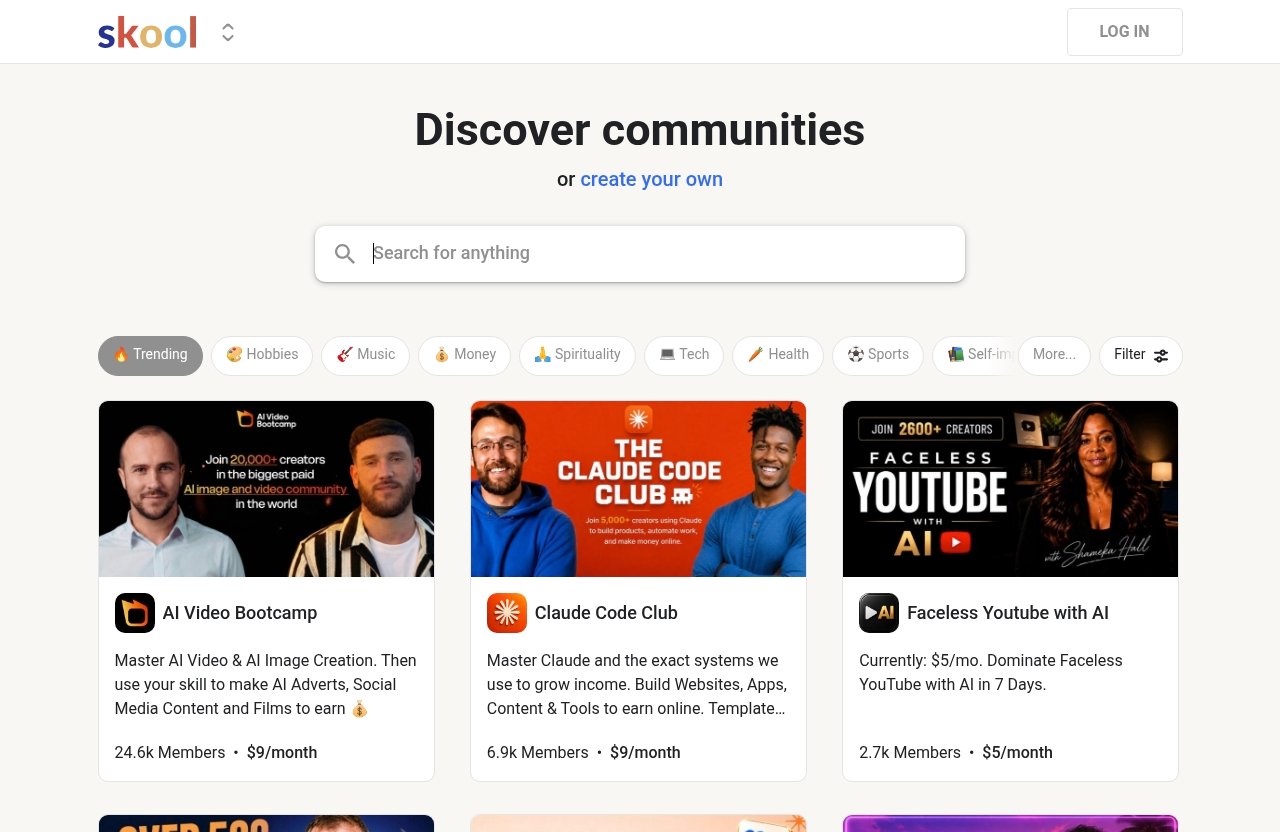
Skool is best understood as a simple membership platform that combines community and learning in one place. That simplicity is its biggest advantage—and sometimes its biggest limitation.
When comparing skool alternatives, the important question is not “Which platform has the most features?” It is “Which platform matches how I sell, teach, and engage my audience?”
Skool’s core strengths
Skool works well for creators who want one place for members, courses, videos, live calls, and affiliates without building a complicated tech stack. Its appeal is that it feels easier to explain than many broader creator platforms.
For a coach or educator launching a paid community, that matters. The fewer systems you need to connect, the faster you can start serving members.
Skool is also useful when you want the community itself to drive retention. Instead of treating discussion as an add-on to a course, Skool keeps the member experience centered around participation.
Limits creators mention most often
Creators often compare skool alternatives when they outgrow a simplicity-first setup. The common reasons include wanting more branding control, deeper community management, more flexible learning formats, more advanced marketing tools, or a platform better suited to a specific business model.
For example, a premium membership brand may want stronger customization and white-labeling. A cohort-based educator may care more about live teaching flow. A course seller may prefer a dedicated course platform like Teachable or Thinkific.
This does not make Skool weak. It means Skool is optimized for ease, while other platforms may be optimized for control, scale, or business operations.
How pricing affects the decision
Pricing is one reason many creators research skool alternatives. A lower entry cost can be attractive, but transaction fees, platform fit, and future migration costs matter too.
Official Skool pricing facts verified from Skool’s official pricing page:
| Skool plan | Monthly price | Included |
|---|---|---|
| Hobby | $9/month | unlimited members, unlimited courses, unlimited videos, unlimited live calls, 10% transaction fee, custom URL, affiliates |
| Pro | $99/month | unlimited members, unlimited courses, unlimited videos, unlimited live calls, 2.9% transaction fee, custom URL, affiliates |
Skool’s official pricing page shows Monthly and Yearly billing options, and the page says “2 months free!”
The key decision is whether the Hobby plan’s lower monthly cost fits your business despite the 10% transaction fee, or whether the Pro plan’s 2.9% transaction fee makes more sense as revenue grows. Do not assume Skool has a free plan; the official current pricing structure shows Hobby at $9/month and Pro at $99/month.
How We Chose the Best Skool Alternatives
To compare skool alternatives fairly, we looked at the decision factors that matter most to creators choosing a platform for real revenue—not just a feature checklist.
The best community platform for a creator depends on audience size, product type, engagement style, brand expectations, and how much operational complexity they are willing to manage.
Pricing and entry cost
Entry cost matters, especially for creators validating an offer. But cheap is not always cheaper if the platform creates friction, limits your format, or forces a migration later.
Because competitor pricing can change and was not provided as verified official data here, this guide does not invent exact competitor prices. Instead, we compare pricing posture: budget-friendly, advanced, course-first, or all-in-one.
Community features
For community-first creators, the core question is whether members will actually participate. Features like native events, polls, structured spaces, notifications, and social-style interaction can make a difference, depending on the platform.
Skool handles community in a simple way. Circle, Mighty Networks, Heartbeat, and Bettermode are often considered when creators want more depth in community experience, branding, or engagement.
Course delivery and cohort support
Not every creator community is a course business. But if your paid offer depends on lessons, modules, student progress, live cohorts, or guided learning, then course delivery becomes a primary factor.
That is where Teachable, Ruzuku, Thinkific, and Kajabi often enter the conversation as course platform alternatives. Ruzuku is especially relevant for live cohort teaching, while Teachable is a familiar choice for course-first creators.
Branding and scalability
Branding matters more as you move upmarket. A beginner group may be fine with a simple community space, but a premium brand may need more control over the customer experience.
This is why Circle alternatives and advanced community platforms come up in serious comparisons. Circle is attractive for branding control and advanced community management, while Mighty Networks and Bettermode can appeal to creators who want more developed community experiences.
Best fit by creator type
The best skool alternatives are not universally better than Skool. They are better for specific creator types.
A solo coach with one paid membership may choose Skool. A course creator may choose Teachable. A cohort educator may choose Ruzuku. A premium community brand may choose Circle. A multi-offer business may choose Kajabi.
Best Cheap Skool Alternatives for Creators on a Budget
Budget-conscious creators usually want the lowest sensible entry point without losing the ability to sell, teach, and retain members. The challenge is that cheaper tools often specialize in one job.
When evaluating cheap skool alternatives, be clear about what you are willing to trade: community depth, branding, automation, course structure, or business tools.
Teachable for course-first creators
Teachable is a strong option if your main product is a course rather than a community. It is best for creators who want to package educational content clearly and sell access to students.
Compared with Skool, Teachable is less about turning the community into the center of the experience. It makes more sense when your lessons, curriculum, and course sales are the foundation of your business.
If you are comparing Teachable, Thinkific, and Skool, ask this simple question: “Would customers still buy if the community were removed?” If yes, a course-first platform may be the better starting point.
Ruzuku for live cohort teaching
Ruzuku is worth considering if your offer depends on live cohorts, group instruction, and guided participation. Some creators do not need a broad social community; they need a reliable structure for teaching groups through a defined program.
This makes Ruzuku different from many skool alternatives. It is not just about hosting content—it is about supporting a live learning rhythm.
For coaches who run launches, challenges, workshops, or cohort-based programs, that structure can matter more than having the most advanced community interface.
Heartbeat for simple community + learning
Heartbeat sits in an interesting middle ground for creators who want community plus learning without unnecessary complexity. It is often considered by people comparing skool vs heartbeat because both can appeal to creators who value simplicity.
The difference is mostly about the experience you want to create. Skool is known for its straightforward membership feel, while Heartbeat is often evaluated as a simple community-and-learning option.
If Skool feels too opinionated but Circle or Kajabi feels too heavy, Heartbeat may be a practical middle path.
When cheaper does not mean better
Searching for skool alternatives free can be tempting, especially before your offer is validated. But free or very low-cost tools can create hidden costs if they are not built for paid memberships, student delivery, or community retention.
The most expensive platform is often the one you must abandon after your first successful launch. Migration disrupts members, content, payments, and operations.
Choose the cheapest platform that supports your next stage—not just your current month.
Official website · Latest pricing & offers
Best More Advanced Skool Alternatives for Scaling Communities
Scaling creators usually care less about “Can I launch this week?” and more about “Can this platform support the brand I am building for the next two years?”
That is where advanced skool alternatives become more compelling. These platforms are often chosen for stronger branding, community management, mobile engagement, events, polls, cohort support, AI workflows, white-labeling, or all-in-one operations.
Circle for branding control and advanced community management
Circle is one of the most frequently compared platforms in the skool vs circle debate. It is generally better suited to creators who want a more premium branded community experience and more advanced community management.
Skool’s advantage is simplicity. Circle’s advantage is control.
If your community is a high-ticket membership, professional network, paid mastermind, or customer community, Circle may feel more aligned with a polished brand experience. It is also a strong option for creators researching Circle alternatives because they want flexible community architecture without turning the platform into a full all-in-one business suite.
Choose Circle if community experience and brand presentation are central to why members pay.
Mighty Networks for social-style learning and mobile engagement
Mighty Networks is a strong alternative for creators who want a social-style learning environment. The skool vs mighty networks comparison usually comes down to simplicity versus engagement depth.
Mighty Networks is often considered when creators want a platform that feels more like a dedicated social ecosystem. Depending on your needs, that can support more ongoing interaction, mobile-first participation, and member-to-member engagement.
Skool may be easier for a lean membership. Mighty Networks may be more attractive when the community itself needs to feel alive, social, and highly interactive.
For creators who rely on member networking, discussion, live engagement, and ongoing participation, Mighty Networks deserves serious consideration.
Bettermode for flexible community experiences
Bettermode is another advanced community option for creators and brands that want more flexibility in how the community experience is structured. It fits the category of skool alternatives for teams thinking beyond a simple paid group.
This can be relevant for customer communities, education brands, and businesses that want the community to support learning, retention, feedback, and product engagement.
Bettermode is less of a “quickest path to launch” recommendation and more of a platform to evaluate when community strategy is becoming a serious part of the business.
Kajabi for all-in-one business operations
Kajabi is different from many skool alternatives because it is not only a community platform. It is commonly considered by creators who want an all-in-one stack for digital products, courses, marketing, and business operations.
If you are selling multiple offers, building funnels, managing content, and trying to reduce separate tools, Kajabi may make more sense than a simpler community platform.
The trade-off is complexity. An all-in-one tool can be powerful, but it can also be more than you need if your goal is simply to host a paid group with courses and live calls.
Choose Kajabi if your platform decision is really a business infrastructure decision.
Best Skool Alternatives by Use Case
The fastest way to narrow your options is to match the platform to your use case. The best creator community platform is the one that supports how you acquire customers, deliver value, and keep members engaged.
Here are the most practical recommendations by business model.
Best for coaching communities
For coaching communities, Skool, Circle, Heartbeat, and Mighty Networks are the most relevant options. Skool is appealing if you want a simple place for members, courses, videos, live calls, and affiliates.
Circle is better if your coaching brand needs more polish and advanced community management. Mighty Networks is stronger if peer interaction and social-style engagement are central to the member experience.
Best for courses plus community
If courses and community are equally important, compare Skool, Teachable, Thinkific, Kajabi, and Heartbeat. Skool works when the community is the hub and courses support the membership.
Teachable or Thinkific may fit better when the course is the product and community is secondary. Kajabi may be better if your course business also needs broader business tools.
This is one of the most important distinctions when reviewing skool alternatives: course-first and community-first platforms solve different problems.
Best for membership businesses
For ongoing memberships, Skool is a strong simplicity-first choice. Circle and Mighty Networks become more attractive as the membership brand becomes more premium or community interaction becomes more important.
Heartbeat can work for creators who want a lighter community-and-learning setup. Kajabi can work if the membership is one part of a broader digital product business.
If retention depends on discussion, events, accountability, and belonging, prioritize community depth over raw course features.
Best for cohort-based programs
Ruzuku is a practical option for live cohort teaching, especially when the learning experience is time-bound and guided. Cohort-based creators often need structure, clarity, and live participation more than a permanent social feed.
Circle and Mighty Networks can also be considered if the cohort experience includes networking, events, discussion, and long-term community access.
Skool can still work for cohorts, but creators comparing skool alternatives often look elsewhere when live teaching format and cohort flow are the main priority.
Best for mobile-first engagement
Mighty Networks is the most obvious platform to consider for social-style learning and mobile engagement. If your members are likely to participate from their phones, the community experience should feel natural on mobile.
Circle and Bettermode may also be worth comparing if you care about branded community experiences and scalable engagement. Skool remains a simpler option if you want fewer moving parts.
For mobile-first communities, think less about content storage and more about whether members will check in, respond, and build habits.
Skool vs the Top Alternatives: Side-by-Side Comparison
This section condenses the main decision factors. Use it as a practical shortlist before testing demos, reading recent skool alternatives reddit threads, or comparing official product pages.
No platform is universally best. The right choice depends on whether your priority is simplicity, course delivery, community depth, branding, or an all-in-one system.
| Comparison | Skool is stronger for | Alternative is stronger for |
|---|---|---|
| Skool vs Circle | Simplicity and lower entry price | Branding control and advanced community management |
| Skool vs Mighty Networks | Simple memberships and learning hub | Social-style learning and mobile engagement |
| Skool vs Teachable | Community-centered memberships | Course-first selling and delivery |
| Skool vs Kajabi | Lean community/course setup | All-in-one business operations |
| Skool vs Heartbeat | Simple Skool-style membership flow | Simple community + learning alternative |
Skool vs Circle
The skool vs circle decision is mainly about simplicity versus control. Skool is easier to understand quickly and has a lower entry price through its Hobby plan.
Circle is generally better for creators who want stronger branding control and more advanced community management. If your community needs to feel like a premium brand asset, Circle may be the better platform.
If you want the simplest path to a paid membership, Skool remains compelling.
Skool vs Mighty Networks
The skool vs mighty networks comparison is about the kind of engagement you want. Skool is simpler and more direct for memberships that combine community, courses, videos, live calls, and affiliates.
Mighty Networks is better aligned with social-style learning and mobile engagement. It may be a better fit when member interaction, networking, and ongoing participation are the heart of the offer.
Choose Skool for simplicity. Choose Mighty Networks for a more social community experience.
Skool vs Teachable
Skool and Teachable serve different primary needs. Skool is community-first, while Teachable is course-first.
If your main revenue comes from selling structured courses, Teachable may be the better fit. If your main revenue comes from an active membership or coaching community, Skool may be more natural.
Creators comparing skool alternatives should be careful not to choose a course platform when what they really need is retention and interaction.
Skool vs Kajabi
Kajabi is best considered when you need an all-in-one business platform. Skool is simpler and more focused on community, courses, videos, live calls, custom URL, and affiliates within its verified official pricing structure.
Kajabi can make sense if you want fewer separate tools across your digital product business. But if you only need a creator community platform, it may be more system than necessary.
The decision is simple: choose Skool for lean delivery, or Kajabi for broader business operations.
Skool vs Heartbeat
The skool vs heartbeat comparison is useful for creators who want simplicity but are not fully sold on Skool’s approach. Both can appeal to community builders who do not want the complexity of a large all-in-one platform.
Skool is attractive because of its clear structure and official pricing. Heartbeat is worth exploring if you want another simple community-plus-learning option.
If you are early-stage, compare how each platform feels to members—not just how it looks to you as the admin.
Which Skool Alternative Is Best for You?
By this point, the best choice should be clearer. The right platform is the one that matches your offer, member expectations, and growth stage.
Here is the plain-English version of the decision.
Choose Skool if you want simplicity
Choose Skool if you want a simple membership platform with unlimited members, unlimited courses, unlimited videos, unlimited live calls, custom URL, and affiliates based on the official pricing facts. It is especially attractive if you want to launch without overbuilding.
Skool is also a good choice if community is central but you do not need advanced customization or a full business suite.
For readers who decide Skool is the best match after comparing skool alternatives, you can learn more through our Skool resource page.
Choose Circle if you want a premium community brand
Choose Circle if your brand experience matters as much as the content itself. This is especially true for professional communities, premium memberships, masterminds, and creator brands that want stronger control.
Circle is one of the best skool alternatives when community management and presentation are priorities.
It is not necessarily the simplest option, but it may be the better long-term home for a more refined community experience.
Choose Mighty Networks if you want social engagement
Choose Mighty Networks if you want members to interact in a more social, ongoing way. It is a better fit for communities where participation, networking, and mobile engagement are core to the value proposition.
Skool may still be easier. Mighty Networks may be more engaging for the right audience.
If your members expect a social platform feel, do not ignore Mighty Networks.
Choose Teachable or Ruzuku if courses matter more
Choose Teachable if your primary product is a structured course. Choose Ruzuku if your teaching model is more live, guided, and cohort-based.
These are not always direct community replacements, but they can be better business fits for educators. Thinkific may also be worth comparing if you are evaluating course platform alternatives.
The more your revenue depends on curriculum delivery, the more you should prioritize course functionality over community aesthetics.
Choose Kajabi if you want an all-in-one stack
Choose Kajabi if your platform decision includes more than community. If you want one broader system for digital products, courses, marketing, and business operations, Kajabi belongs on your shortlist.
It may not be the leanest option. But for creators with multiple offers and a more mature business, an all-in-one stack can simplify operations.
Kajabi is one of the most important skool alternatives for creators who are building a business ecosystem, not just a paid group.
Final Recommendation
The best platform is not the one with the longest feature list. It is the one that fits your offer, budget, customer expectations, and growth plan.
Skool remains the simplicity-first benchmark. But the best skool alternatives can be cheaper, more specialized, or more advanced depending on what you need.
Best overall alternative
Circle is the best overall alternative for creators who want a premium community experience with stronger branding control and advanced community management.
It is especially compelling for memberships, masterminds, professional networks, and creators who want the community to feel more custom and scalable than a basic group.
Best budget-friendly choice
Teachable is a strong budget-conscious option for course-first creators, while Ruzuku is worth considering for live cohort teaching. Heartbeat is also a practical option for simple community plus learning.
The right budget choice depends on whether you are selling courses, cohorts, or an ongoing membership.
Best advanced choice
Kajabi is the best advanced choice if your real need is an all-in-one business system. Circle and Mighty Networks are stronger advanced choices if your main focus is community experience.
Bettermode also deserves consideration for brands that want flexible community experiences beyond a simple creator membership.
When to stay with Skool
Stay with Skool if you value simplicity, want a clear membership setup, and do not need advanced branding or a full business operations platform. Its official pricing structure is straightforward: Hobby at $9/month and Pro at $99/month, with the verified inclusions listed above.
For many creators, that simplicity is the point. The smartest decision is not always to choose the most advanced tool—it is to choose the platform your members will actually use.
Official website · Latest pricing & offers
FAQ
What is better than Skool?
The best option depends on your needs. Circle is often better for advanced branding and community management, Mighty Networks for social engagement, Teachable or Ruzuku for course-first teaching, and Kajabi for all-in-one business operations.
Skool is still a strong choice if simplicity is your top priority.
Is Circle or Skool better?
Circle is generally better for creators who want more branding control and advanced community management. Skool is attractive for creators who want a simpler setup and a lower entry price through its Hobby plan.
In the skool vs circle decision, choose Circle for control and Skool for simplicity.
Is there a free version of Skool?
Skool’s official pricing page currently shows Hobby at $9/month and Pro at $99/month. It also shows Monthly and Yearly billing options and says “2 months free!”
Based on the verified official pricing facts provided, do not assume there is a free version of Skool.
Is Substack similar to Skool?
Substack is similar only in the broad sense that creators can build an audience and monetize content. It is more focused on publishing and newsletter-style audience building.
Skool is built around communities, courses, videos, live calls, memberships, custom URL, and affiliates based on its official pricing structure. For a creator community platform, Skool is much closer to Circle, Mighty Networks, Heartbeat, or Kajabi than to Substack.