
Skool vs Thinkific: Full 2026 Breakdown

If you are comparing skool vs thinkific for a course, coaching, or membership business, the simplest way to decide is this: Skool is usually the better fit when community is central to the offer, while Thinkific is commonly considered when structured course delivery is the priority.
This article may contain affiliate links. If you buy through them, toptrustreview.com may earn a commission at no extra cost to you. That said, you should choose based on verified features, pricing, and business fit—not hype.
Official website · Latest pricing & offers
Skool vs Thinkific: Quick Verdict for 2026
The skool vs thinkific decision comes down to your business model. Are you selling a learning library with lessons, assessments, and a more traditional course experience? Or are you building a paid community where courses, calls, and discussion all support member engagement?
Skool is stronger for community-first creators who want a simple launch, unlimited members, unlimited courses, unlimited videos, and unlimited live calls on the published plans. Thinkific is often discussed as a stronger choice for creators who need more traditional course-building depth, although you should verify its current official feature set before buying.
| Decision Factor | Choose Skool | Choose Thinkific |
|---|---|---|
| Main business model | Paid community, coaching, membership | Structured online course business |
| Setup preference | Simple, streamlined launch | More course-building control |
| Community priority | High | Secondary or add-on |
| Course depth priority | Simple course hosting | More formal learning experience |
| Best fit | Community-led creators | Course-first educators |
Who Skool is best for
Skool is best for creators who want the course and community in one place without building a complex tech stack. Based on Skool’s official pricing page, its plans include unlimited members, unlimited courses, unlimited videos, unlimited live calls, custom URL support, and affiliates.
That makes it appealing for coaches, cohort leaders, membership operators, and creators selling access to a group experience. If your students are more likely to succeed through accountability, peer discussion, and recurring calls, Skool has the clearer fit.
Who Thinkific is best for
Thinkific is best known in the market as a course platform for creators who want a more traditional online learning setup. In many skool vs thinkific review discussions, Thinkific is commonly positioned around structured lessons, learning paths, assessments, customization, and course-business tooling.
Because official Thinkific facts were not provided for this article, I am not listing specific Thinkific plan limits, prices, or feature numbers. Before purchasing, verify current details directly from Thinkific’s official website.
The fastest way to choose between them
Choose Skool if you want to launch a community-led offer quickly, deliver course content simply, and keep members active through discussion and live calls. You can view the current Skool offer through this Skool affiliate link and compare it against your business needs.
Choose Thinkific if your main product is a structured course and you care more about formal course design than community momentum. In short, the thinkific vs skool choice is not about which platform is universally “better”; it is about whether your revenue depends more on learning structure or community retention.
What Skool Is and How It Works
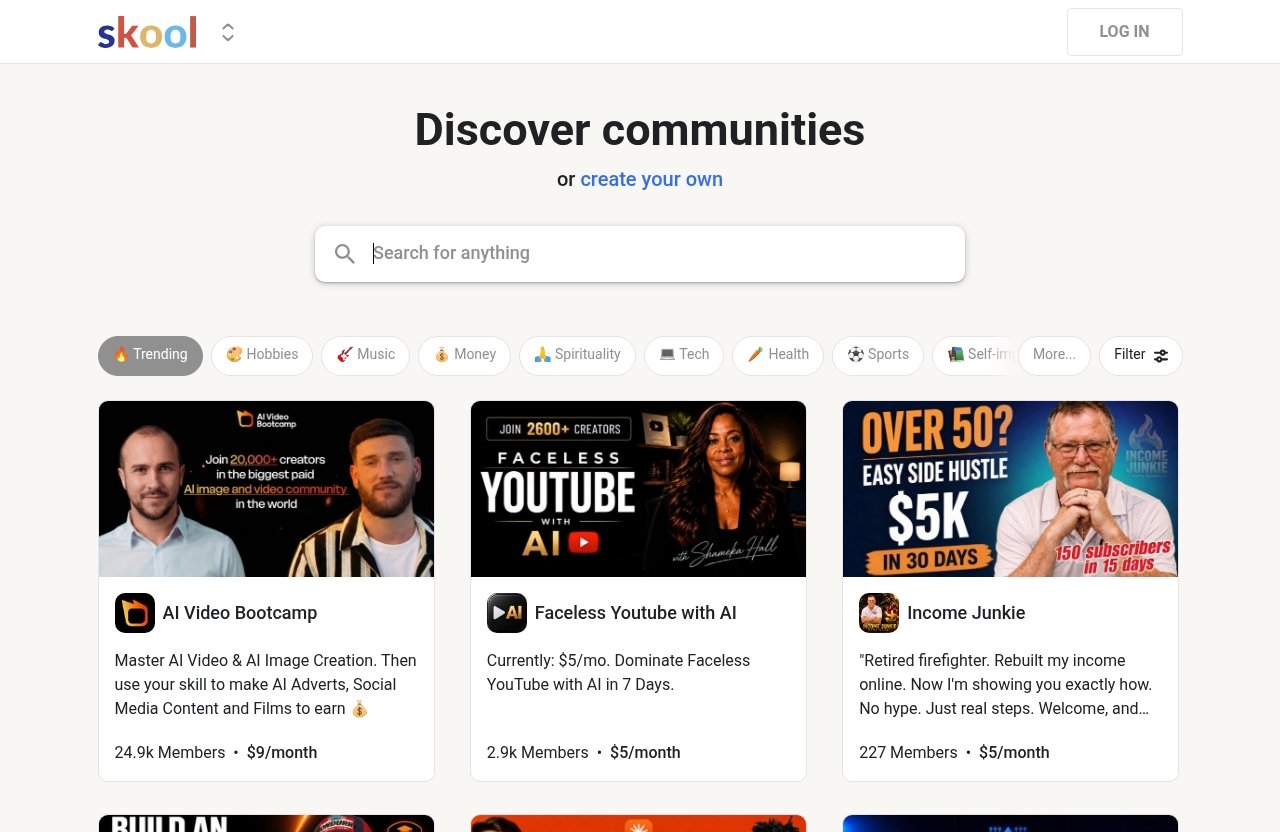
Skool is a community-first platform for creators who want to build or join online communities. The official Skool homepage positions the product around discovering or creating communities, with examples centered on courses, coaching, AI, and memberships.
In the skool vs thinkific comparison, Skool’s core advantage is that it feels purpose-built for simple community monetization. Rather than separating the course, group, and calls into too many disconnected tools, Skool brings the essentials into one simpler environment.
Skool’s community-first structure
The skool community platform is designed around the idea that members should have a shared place to learn, interact, and stay engaged. That matters because many modern creator businesses are not just selling information; they are selling access, support, and accountability.
Skool’s homepage examples point toward communities for courses, coaching, AI, and memberships. That positioning is important because it shows the platform’s center of gravity: community is not treated as an afterthought.
Course hosting inside Skool
Skool’s official pricing page states that both listed plans include unlimited courses and unlimited videos. That makes it practical for creators who want to host training content without worrying about course count or video count limits on those plans.
For a creator comparing skool vs thinkific pricing, this is one of Skool’s clearest value points. You still need to consider transaction fees and your expected revenue, but the included course and video capacity is straightforward.
Live calls, members, and simplicity
Skool’s published plans also include unlimited members and unlimited live calls. For coaching programs, group mentorship, and recurring community sessions, that combination is commercially meaningful.
The platform’s pricing page also emphasizes “Simple pricing” and “2 months free!” At the time of writing, the listed Skool plans are Hobby at $9/month and Pro at $99/month, with different transaction fees.
What Thinkific Is Known For
Thinkific is widely known as a thinkific course platform for building and selling online education products. In broader market discussions, it is often grouped with tools focused on course structure, lesson delivery, student progress, and creator-controlled learning experiences.
For fairness, this section uses general market consensus rather than official feature claims. Since current official Thinkific details were not supplied, you should verify pricing, plan limits, and available features directly before making a final purchase.
Typical Thinkific use case
The typical Thinkific user is a creator, educator, or business that wants to sell online courses as the primary product. In many comparison discussions, Thinkific is treated as a course-first platform rather than a community-first platform.
That distinction is central to the skool vs thinkific decision. If your buyers expect a traditional course environment, Thinkific may feel more familiar.
Course delivery strengths
Thinkific is commonly discussed as strong for structured learning experiences. Reviewers often mention course organization, assessments, customization, and learning management style features as reasons creators consider it.
However, without verified current official Thinkific specs in this prompt, I will avoid claiming exact features or limitations. Treat this as a market-positioning summary, not a substitute for checking Thinkific’s current product pages.
Why creators consider it
Creators often consider Thinkific when their product is education-heavy and community is secondary. If you need more formal course depth, it may be worth evaluating.
Still, when the business depends on recurring engagement, peer interaction, and ongoing accountability, Skool often becomes the more natural option. That is why skool vs thinkific is really a business-model comparison, not just a feature checklist.
Skool vs Thinkific: Core Feature Comparison
This skool vs thinkific section compares verified Skool facts against carefully qualified Thinkific market consensus. Skool facts here come from the provided official pricing and homepage information. Thinkific statements are broad and should be verified with Thinkific’s current official materials.
| Category | Skool | Thinkific |
|---|---|---|
| Positioning | Community creation and discovery, with examples around courses, coaching, AI, and memberships | Commonly known as a course-first platform |
| Courses | Unlimited courses on listed Skool plans | Commonly discussed as strong for structured course delivery |
| Videos | Unlimited videos on listed Skool plans | Verify current video/course limits officially |
| Members | Unlimited members on listed Skool plans | Verify current plan limits officially |
| Live calls | Unlimited live calls on listed Skool plans | Verify official live/community options |
| Affiliates | Included on listed Skool plans | Verify current affiliate/marketing features |
| Pricing clarity | Hobby $9/month; Pro $99/month; transaction fees apply | Pricing should be checked directly because it changes |
| Best fit | Community-led course, coaching, membership | Traditional course business |
Course delivery and lesson structure
Skool supports course hosting and unlimited videos on the published plans. For many creators, that is enough to deliver a practical curriculum alongside community discussion and live support.
Thinkific is commonly considered stronger when the course itself needs more formal structure. If your learning experience depends on detailed lesson sequencing, assessments, and academic-style delivery, Thinkific may deserve a closer look.
Community and engagement tools
Skool’s main edge in the skool vs thinkific comparison is community. The platform is positioned around communities, and its homepage shows use cases where people gather around coaching, courses, AI, and memberships.
Thinkific may offer ways to support learners, but it is generally discussed as more course-first than community-first. If engagement is the product, Skool is the cleaner fit.
Assessments, quizzes, and learning depth
Thinkific is often mentioned in market comparisons as a better fit for assessment-heavy or structured learning experiences. That may matter if you sell certification-style training, academic programs, or courses where testing is central.
Skool is simpler. That simplicity is a strength for creators who do not need a complex learning management system, but it can be a limitation if your course requires deeper instructional controls.
Branding, customization, and control
Skool’s verified pricing information includes a custom URL on both listed plans. That helps creators present a more branded destination without overcomplicating setup.
Thinkific is commonly discussed as offering more customization and course-business control, but exact capabilities should be verified from current official sources. If deep design control matters, do not rely on secondhand skool vs thinkific reddit comments alone.
Setup Ease and Creator Experience
Setup ease is where Skool becomes especially attractive. Its simple pricing, community-first positioning, and bundled course/community/call model reduce the number of decisions a creator has to make before launching.
For commercial investigation, this matters. A platform with more options is not always better if it slows down your first sale, first cohort, or first paid community launch.
How fast you can launch on Skool
Skool is built for a straightforward creator workflow: set up the community, add course content, bring in members, and run live calls. With unlimited courses, videos, members, and live calls on the listed plans, creators can plan around usage without constantly checking caps.
That is a major advantage in the skool vs thinkific decision for non-technical founders. If your goal is to validate an offer quickly, Skool removes friction.
How Thinkific usually feels for new users
Thinkific may feel more robust for creators who want to design a detailed course business. That can be useful, but it may also add setup steps for creators who simply want to sell access to content plus a group.
This is not necessarily a flaw. It just means Thinkific may be better suited to people who want to spend more time shaping the course experience before launch.
Best choice for non-technical creators
For non-technical creators, Skool is usually the easier recommendation. It is especially compelling if you do not want to connect separate tools for course hosting, community, calls, and affiliate support.
If you are comparing other simplified creator platforms too, our [Skool vs Podia](/skool-vs-podia/) guide may help. For sales funnels and broader business systems, comparisons like [Systeme.io vs Kajabi](/systeme-io-vs-kajabi/) can also be useful.
Official website · Latest pricing & offers
Pricing Breakdown and Value in 2026
The skool vs thinkific pricing question should be handled carefully because pricing changes. For this article, I am using only the verified Skool pricing details provided and avoiding unverified Thinkific numbers.
Skool’s official pricing page states “Simple pricing” and “2 months free!” It lists two plans: Hobby and Pro.
Skool pricing plans
| Skool Plan | Monthly Price | Included Based on Verified Pricing Facts | Transaction Fee |
|---|---|---|---|
| Hobby | $9/month | Unlimited members, courses, videos, live calls, custom URL, affiliates | 10% |
| Pro | $99/month | Unlimited members, courses, videos, live calls, custom URL, affiliates | 2.9% |
The key difference is not just the monthly fee. The transaction fee matters because it affects your margin as revenue grows.
What ‘unlimited’ means on Skool
Based on the provided Skool pricing facts, both plans include unlimited members, unlimited courses, unlimited videos, and unlimited live calls. That is valuable for creators who want pricing predictability as their content library and member base grow.
However, “unlimited” should still be interpreted within the platform’s terms and practical use expectations. Always review current official terms before relying on any platform for high-volume operations.
How to think about total cost of ownership
When evaluating skool vs thinkific, do not compare monthly price alone. Look at transaction fees, add-on tools, email marketing needs, payment processing, support workflows, community retention, and time spent managing the system.
Skool’s value is strongest when it replaces multiple tools and helps you launch faster. If it reduces complexity and keeps members engaged, the business value can outweigh a simple plan-price comparison.
Where Thinkific pricing should be verified
Thinkific pricing should be checked directly from Thinkific’s current official pricing page before publishing or buying. Since no verified Thinkific pricing was provided here, I am not including plan names, limits, or monthly costs.
This is the safest way to compare platforms in 2026. Pricing pages can change quickly, and outdated numbers can lead to bad buying decisions.
Community Building: Which Platform Wins?
For community building, Skool is the clear winner in this skool vs thinkific comparison. The platform’s homepage positioning, community discovery angle, and examples around courses, coaching, AI, and memberships all support that conclusion.
Thinkific may be suitable for creators who want some community around a course. But if the community itself is the main product, Skool is more aligned with that model.
Discussion and engagement
Skool is built around a shared community space where course content and member interaction can live together. That reduces the feeling of sending students into one tool for lessons and another tool for discussion.
For creators, this matters because engagement is often what improves retention. A quiet course library is easier to cancel than an active community with ongoing value.
Retention and member activity
A paid community needs recurring reasons for members to return. Skool’s verified inclusion of unlimited live calls supports that recurring rhythm, especially for coaching, accountability, and group learning.
In the skool vs thinkific decision, this is a major practical advantage. If your offer depends on member activity, you should prioritize the environment where activity is easiest to maintain.
When community matters more than course features
Community matters more than course features when your buyers want feedback, networking, accountability, or implementation support. In those cases, the course content may be important, but it is not the whole offer.
That is why many creators looking for a thinkific alternative consider Skool. It gives them a simpler way to package learning and belonging together.
Course Delivery: Which Platform Is Better for Structured Learning?
For structured learning, Thinkific is commonly considered the stronger option. In many market comparisons, it is discussed as more course-first, especially for creators who need a traditional curriculum experience.
That does not make Skool weak. It means the skool vs thinkific trade-off is about simplicity and engagement versus deeper course-building control.
Module organization and progression
Skool can host courses and videos, which is enough for many memberships, coaching programs, and creator-led learning communities. If your students mostly need access to training content plus support, Skool’s model is practical.
Thinkific is often discussed as a better fit for creators who want more formal course organization and progression. Verify the current official feature set if this is a key buying factor.
Assessments and learning tools
If your course requires quizzes, graded assessments, certificates, or more formal learning tools, Thinkific may be the better platform to evaluate first. I am phrasing this cautiously because exact current Thinkific features should be checked at the source.
Skool is better suited when learning is supported by community, calls, and ongoing participation. For many creator businesses, that is enough.
When structured education should win
Structured education should win when students are paying for a precise instructional path. This includes professional training, compliance-style learning, or academic-style courses.
If that describes your business, Thinkific may be the better starting point. But if your course is part of a broader community offer, Skool remains the stronger commercial fit.
Marketing, Discovery, and Growth
Marketing tools matter, but they should not distract from your actual growth engine. For most creators, growth comes from audience trust, a clear offer, strong onboarding, member results, and consistent retention.
In the skool vs thinkific comparison, Skool’s biggest growth advantage is not a flashy marketing claim. It is the ability to keep your members in a focused community environment where the product experience itself supports retention.
Built-in growth considerations
Skool’s homepage positions the platform around discovering or creating communities. That discovery-oriented framing is useful context, though creators should not assume guaranteed traffic or sales unless officially stated.
The practical growth benefit is simpler: if your members return often, participate, and attend calls, your offer is easier to retain and improve. That can support referrals and long-term monetization.
Affiliate/supporter angle for Skool
Skool’s verified pricing facts include affiliates on both listed plans. For creators with partners, fans, or students who can refer others, that can be commercially useful.
If you are evaluating Skool for a community-led business, you can review the current plans through this Skool affiliate link. Make sure to compare the transaction fee, plan price, and expected revenue before choosing.
What creators need beyond the platform
No platform replaces a strong offer. You may still need email marketing, payment strategy, analytics, content production, and audience-building systems.
For example, creators comparing automation and CRM-heavy stacks may find [GoHighLevel vs ActiveCampaign](/gohighlevel-vs-activecampaign/) helpful. If affiliate monetization is part of your plan, our [Systeme.io Affiliate Program Review 2026](/systeme-io-affiliate-program-review-2026/) may also be worth reading.
Best Use Cases: Which Platform Should You Choose?
The best platform depends on what you are selling. The best online course platform 2026 for a coach running a paid accountability group may not be the same as the best platform for an educator selling a formal certification course.
Here is how I would decide in practical buying scenarios.
Choose Skool if you want a paid community
Choose Skool if your offer is built around community, coaching, live calls, accountability, and ongoing member interaction. It is especially strong if you want a simple platform with unlimited members, courses, videos, and live calls on the listed plans.
This is the clearest skool vs thinkific recommendation. If community is the business model, Skool is the better fit.
Choose Thinkific if you want a course business
Choose Thinkific if your primary product is a structured course and you need more traditional course-building depth. This is especially true if your buyers expect a polished learning path rather than a community-led experience.
Thinkific is also worth considering if you value more course-first customization and are comfortable verifying the current official pricing and features yourself.
Choose neither if your needs are different
Choose neither if you need a full website builder, advanced funnel system, enterprise LMS, or highly custom digital product stack. In that case, you may need a broader platform or a custom combination of tools.
For website-first decisions, see our [Webflow vs Wix](/webflow-vs-wix/) comparison. For all-in-one funnel ecosystems, [Systeme.io vs Kajabi](/systeme-io-vs-kajabi/) may be more relevant than skool vs thinkific.
Official website · Latest pricing & offers
FAQ
What is better than Skool?
A platform may be better than Skool if your needs are outside Skool’s community-first model. For example, some creators may prefer a more advanced LMS for formal education, or a dedicated community tool if they need deeper customization.
But “better” depends on priority. Skool is often the better fit for simple course-plus-community businesses, while another skool alternative may make sense for advanced course control, enterprise requirements, or heavy design customization.
What are the disadvantages of Thinkific?
Commonly reported Thinkific trade-offs include a more course-first experience, potentially more setup complexity than simpler platforms, and possible extra cost considerations for advanced needs. Because official current Thinkific plan details were not provided here, verify exact limitations directly before buying.
In a skool vs thinkific decision, Thinkific’s biggest disadvantage is usually not course delivery. It is that community may not feel as central to the business model.
Is the Skool platform worth it?
Skool can be worth it for creators who want an all-in-one course-plus-community setup with simple pricing. The verified Skool plans include unlimited members, unlimited courses, unlimited videos, unlimited live calls, custom URL support, and affiliates.
It is most worth it when community engagement, live interaction, and simple launch speed matter. If you need advanced LMS depth, evaluate other options too.
What is the best platform for courses?
The best platform for courses depends on your business model. Skool is a strong choice for community-led courses, coaching programs, and paid memberships.
Thinkific is commonly considered a strong option for structured course delivery. Other platforms may be better for advanced customization, enterprise learning, or complex marketing funnels.
Final Verdict: Skool or Thinkific in 2026?
The skool vs thinkific verdict is clear: Skool is the stronger fit for community-first creators and simpler launches, while Thinkific is better to evaluate when structured course delivery is the main priority.
Both platforms can make sense, but they solve different problems. Your choice should come from your offer design, not from generic platform rankings.
Summary of strengths
Skool’s strengths are simplicity, community-first positioning, and verified plan inclusions such as unlimited members, unlimited courses, unlimited videos, unlimited live calls, custom URL support, and affiliates. Its pricing is also easy to understand: Hobby at $9/month with a 10% transaction fee, and Pro at $99/month with a 2.9% transaction fee.
Thinkific’s strengths are commonly discussed around structured course delivery, learning depth, and course-first control. Verify all current official features and prices before making a purchase.
Main trade-offs
Skool may not be the best fit if you need a highly formal LMS experience with deep assessments and advanced course controls. Its advantage is focus, not maximum complexity.
Thinkific may not be the best fit if your product depends heavily on community energy, live interaction, and member retention. In that case, a simpler community-led platform can create a better business experience.
My recommendation
For most creators building a paid community, coaching program, or membership with course content included, I would choose Skool. It is simpler to launch, easier to understand, and more aligned with how community-first creator businesses operate in 2026.
For formal course businesses, Thinkific remains worth evaluating. But if your priority is a clean course-plus-community setup, the practical skool vs thinkific winner is Skool.
Related Reading
References
- Skool Pricing
- Skool Homepage
- Skool vs Thinkific (2026): I've Used Both (Comparison & Verdict)
- Skool vs Thinkific (2025): Best Online Course & Community Platform?