
Best Trustindex Alternatives in 2026: A Practical Buyer’s Guide

Businesses comparing trustindex alternatives usually want one of three things: a lower-cost way to show reviews, a more specialized review collection workflow, or a different style of on-site widget. The right answer depends on whether your priority is collecting fresh feedback, displaying third-party reviews, managing reputation, or improving ecommerce product-review experiences.
Trustindex remains a credible option for businesses that need broad review-source coverage, review display widgets, badges, certificates, trustmarks, and review management in one platform. Still, evaluating alternatives first is sensible—especially if you need a trustindex alternative free plan, an ecommerce-focused stack, or a GDPR compliant review tool.
Official website · Latest pricing & offers
Best Trustindex Alternatives in 2026: Quick Verdict
There is no universal winner among the best trustindex alternatives. WiserReview, Trustmary, Judge.me, Senja, Stamped.io, Endorsal, Reviews.io, and Elfsight all address adjacent needs, but their fit varies by business model and implementation goal.
A local service company may prioritize a Google reviews widget and easy testimonial capture. An online store may need ecommerce review widgets that fit its product pages and post-purchase workflow. Agencies may care more about client management, reusable displays, and brand flexibility.
What Trustindex Is Best At
Trustindex is particularly strong for businesses that want to collect and embed reviews from many sources. Its official site lists widgets for Google, Facebook, Tripadvisor, Booking.com, Airbnb, Yelp, Expedia, eBay, Etsy, AliExpress, Hotels.com, Houzz, OpenTable, and more.
It also supports social feed widgets for Instagram, Google, TikTok, YouTube, Twitter, and Pinterest. Beyond display tools, Trustindex offers review collection, email campaigns, QR codes, NFC cards, review management, review tagging, AI-assisted review replies, trustmarks, badges, certificates, offers, rich snippets, and review summary pages.
Who Should Switch From Trustindex
A switch may make sense if your current requirements are narrower than Trustindex’s feature set. For example, you may only need a lightweight testimonial widget alternative, a product-review tool for an ecommerce store, or a platform with a pricing model that better matches your volume and team size.
Businesses should not change platforms merely because another tool appears on a comparison list. Compare the actual collection workflow, the review sources you need, widget controls, branding requirements, ownership of collected content, and the effort required to migrate.
How We Judged Each Alternative
This guide uses a buyer-first framework: review collection, review display options, source coverage, implementation fit, pricing transparency, and likely business use case. Competitor-specific prices, integration counts, and feature limits are not stated unless verified in the supplied source material.
That distinction matters. The products below are widely considered trustindex competitors, but you should confirm current plans, integrations, compliance documentation, and available widgets directly with each provider before purchasing.
Trustindex at a Glance: Official Features, Use Cases, and Limitations
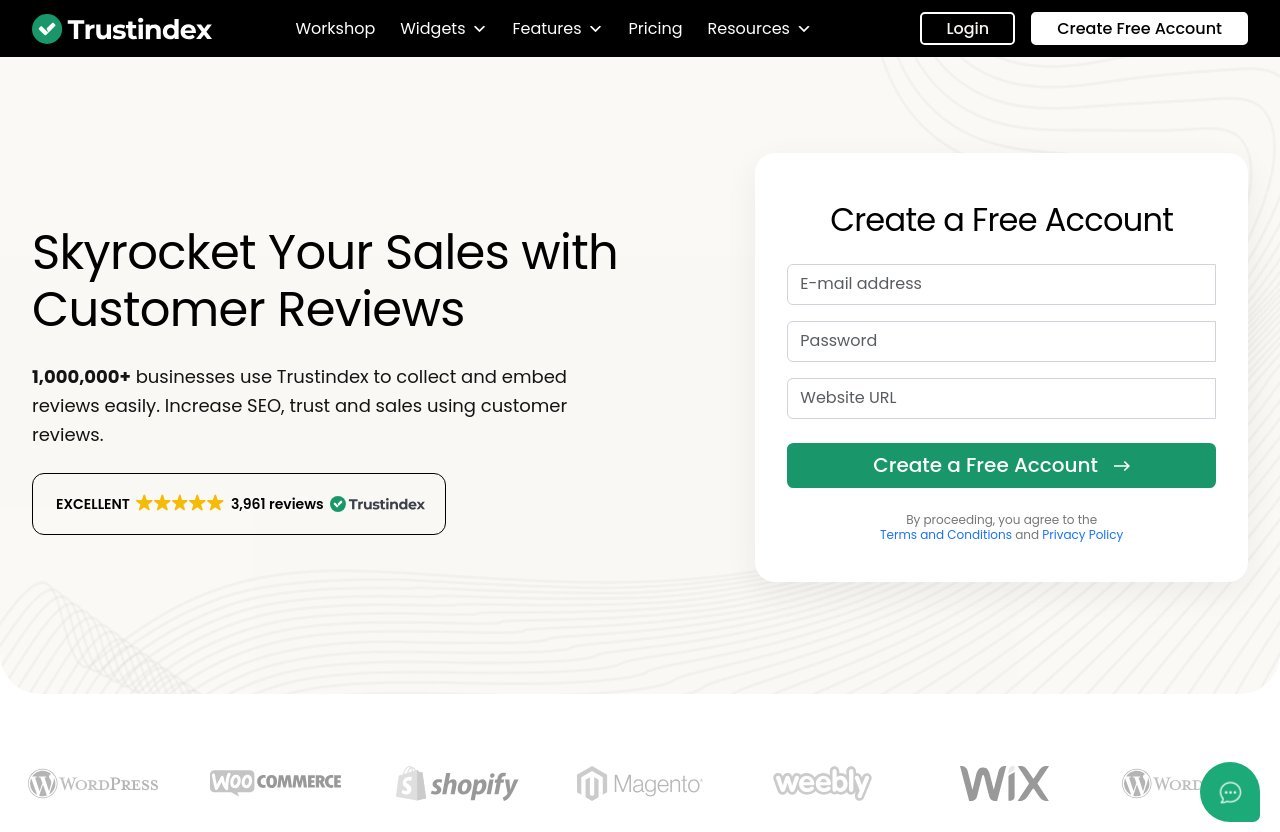
Trustindex is built around helping businesses collect, manage, and display customer reviews. According to its official homepage, more than 1,000,000 businesses use the platform to collect and embed reviews.
Official Product Snapshot
The platform combines review collection and review presentation rather than treating them as separate problems. Its official feature list includes email campaigns, QR codes, NFC cards, review widgets, review management, tagging, offers, and an option to reply to reviews with ChatGPT.
Trustindex also offers display-oriented trust assets such as top-rated badges, a Trustindex verified badge, review certificates, trustmarks, email signature widgets, and a review image generator. That makes it relevant to businesses that want to turn social proof into website content and marketing materials.
Key Display and Collection Features
Trustindex’s major advantage is its variety of supported review and feed widgets. A business that receives reviews across Google, Facebook, hospitality platforms, marketplaces, and local directories can potentially centralize those reviews into a more consistent on-site presentation.
The platform also includes rich snippets and review summary pages among its official features. As with any review display widget, implementation should be checked carefully on your own website, especially if you have existing schema markup, caching tools, ecommerce apps, or custom development.
Where Users May Want an Alternative
Some buyers do not need broad third-party source coverage or multiple trust assets. They may prefer a dedicated review collection tool for first-party testimonials, a design-led review widget alternative, or software tightly aligned with their ecommerce platform.
Pricing is another reason to compare. Trustindex’s official pricing page was not accessible in the provided source material, so this guide does not state a price, plan structure, or free-plan availability for Trustindex. Review the official signup flow and current pricing information before making a decision.
How to Choose the Right Trustindex Alternative
The strongest trustindex alternatives are not necessarily the platforms with the longest feature lists. The best choice is the one that matches your customer journey and lets your team maintain reviews without adding unnecessary work.
Pricing Model and Free Plan
Start by deciding whether you truly need a free tool or simply a predictable paid plan. A trustindex alternative free option may be useful for early-stage companies, but it can also come with branding, display, volume, or feature constraints.
Do not compare monthly pricing alone. Ask whether the cost includes collection campaigns, widget use, multiple sites, additional users, ecommerce functionality, exports, or support. If a vendor does not clearly answer those questions, treat that as a procurement issue rather than an assumption.
Review Collection Versus Display-Only
Review collection and review display solve different problems. Collection tools help request, organize, and publish newly gathered customer feedback, while display-focused tools often help embed existing third-party reviews or social content on your site.
If your business already has a strong Google Business Profile, you may primarily need a Google reviews widget. If you lack a consistent process for asking happy customers for feedback, prioritize the collection workflow first.
Integrations and Source Coverage
List every platform where customers currently leave feedback: Google, Facebook, ecommerce platforms, booking portals, marketplaces, and industry directories. Then identify which reviews you want to display on your site and which sources you only need to monitor.
This step can quickly narrow the field. Trustindex’s official source coverage is broad, while a more specialized tool may better suit a single-store ecommerce brand or a service business collecting direct testimonials.
Widget Customization and Branding
A review display widget should fit your site rather than interrupt it. Check layouts, typography controls, mobile behavior, filters, moderation options, page-placement flexibility, and whether your team can update the widget without developer support.
Also consider the context of the proof. A testimonial near a booking form serves a different role than a product-review block on a product page. The best testimonial widget alternative is often the one that provides the right format for the page, not the most elaborate visual effect.
SEO, Schema, and Local Business Needs
Review-related SEO claims deserve caution. Before adding new widgets or structured data, confirm how they work with your current website setup and whether they create duplication, performance, or markup conflicts.
Local businesses should prioritize review-source relevance and ease of sharing reputation signals. Ecommerce operators should focus on product-page placement, post-purchase workflows, and whether the tool fits their store technology. For regulated teams, a GDPR compliant review tool should be assessed against the vendor’s current documentation and your own privacy obligations.
Official website · Latest pricing & offers
8 Best Trustindex Alternatives Compared
The following products are practical options to investigate when comparing trustindex alternatives. The available source material identifies them as leading contenders, but it does not verify detailed competitor plans, exact integrations, feature caps, or current prices. Treat the summaries as a shortlist for live product evaluation.
| Alternative | Best For | Pricing Posture | Primary Evaluation Focus |
|---|---|---|---|
| WiserReview | General review workflows | Confirm directly | Collection and display fit |
| Trustmary | GDPR-focused teams | Confirm directly | Privacy positioning and widgets |
| Judge.me | Ecommerce stores | Confirm directly | Store and product-review workflow |
| Senja | Testimonial-led businesses | Confirm directly | Testimonial capture and presentation |
| Stamped.io | Growing ecommerce brands | Confirm directly | Ecommerce compatibility |
| Endorsal | Social-proof-led teams | Confirm directly | Testimonial display needs |
| Reviews.io | Reputation-focused businesses | Confirm directly | Review operations and display |
| Elfsight | Design-first website teams | Confirm directly | Widget design and embed flexibility |
1. WiserReview
WiserReview is a candidate for businesses looking for a review collection tool and an on-site display system in the same evaluation process. It may suit teams that want to compare direct customer-feedback workflows against broader third-party review aggregation.
Its key strength is its relevance to the same buyer category as Trustindex: businesses that need visible social proof rather than a passive review archive. Before choosing it, verify its collection methods, supported review sources, widget formats, integration compatibility, and whether its current pricing fits your expected usage.
2. Trustmary
Trustmary is a noteworthy option for teams evaluating a trustmary alternative approach, particularly where GDPR positioning is a major purchasing consideration. It belongs on the shortlist for European businesses, professional services, and organizations that need to review privacy practices carefully.
The main potential advantage is alignment with buyers seeking a GDPR compliant review tool. The trade-off is that compliance language alone should not decide the purchase; confirm data processing terms, consent workflows, review ownership, display features, and the exact geographic requirements relevant to your business.
3. Judge.me
Judge.me is a logical platform to investigate for ecommerce sellers that want a product-focused review workflow. For a store operator, the key question is not whether it is broadly “better,” but whether it supports the specific review collection and presentation process used after purchase.
Evaluate it against Trustindex based on your storefront, product-page layout, existing apps, and the types of reviews you want to show. If your priority is ecommerce review widgets and customer feedback tied closely to product pages, Judge.me may be more relevant than a broad multi-source widget platform.
4. Senja
Senja is worth reviewing for service businesses, consultants, creators, and B2B teams that depend heavily on selected testimonials. These businesses often need a simple way to turn customer praise into persuasive proof across landing pages, proposals, and campaigns.
Its likely fit is strongest when curated testimonials matter more than importing reviews from numerous third-party platforms. Confirm the available collection methods, display formats, export options, branding controls, and current commercial terms before treating it as your preferred review widget alternative.
5. Stamped.io
Stamped.io belongs on the shortlist for ecommerce operators assessing a more store-centered review experience. A merchant should examine whether its workflow suits product reviews, customer-generated content goals, and the systems already used for email, loyalty, and storefront management.
The potential drawback is that specialized ecommerce tools can be unnecessary for businesses that mainly want to display established Google or directory reviews. Compare the implementation effort and total cost with your actual needs rather than buying a larger reputation management software stack than required.
6. Endorsal
Endorsal is a relevant choice for businesses that see testimonials as a conversion asset. It may appeal to teams creating landing pages, sales pages, case-study sections, or service pages where selected feedback needs to be easy to present.
This approach can be useful when a business owns the testimonial relationship and wants to feature the strongest customer statements. However, it may be less suitable if your primary objective is wide review-source aggregation, so confirm source-import capabilities and display formats before migrating.
7. Reviews.io
Reviews.io is another contender for companies comparing review operations, customer feedback, and on-site trust messaging. It is best evaluated by businesses that want to assess review collection, review management, and display options as part of one broader customer-experience process.
Its potential strength is relevance to businesses seeking a more full-service review environment. Its possible drawback is complexity or cost mismatch for a small company that only needs a straightforward Google reviews widget. Request current pricing and feature details directly rather than relying on older comparison pages.
8. Elfsight
Elfsight is a practical option for design-conscious teams exploring embedded website widgets. It may appeal to marketers and site managers who want to test how social proof, feeds, and review displays look within their existing page design.
The trade-off is that a widget-first approach may not replace a robust review collection tool or reputation management workflow. Evaluate whether you need simply a polished display layer or an end-to-end system for collecting, managing, and responding to reviews.
Best Alternative by Use Case
The best trustindex alternatives become easier to identify when you start with the business scenario instead of the brand name.
Best for Free Plans
A free plan can be useful for testing a tool’s dashboard, widget styling, and site compatibility. However, none of the supplied competitor data verifies free-plan availability, limits, or current eligibility.
Check each vendor’s official pricing page before deciding that a particular platform is the best trustindex alternative free option. Compare what is included at the level you can actually use, not just whether a free tier exists.
Best for Ecommerce Stores
Judge.me and Stamped.io are the most relevant names in this list for ecommerce operators to investigate first. Their suitability should be judged through a store-specific review: product-page use, post-purchase communications, storefront fit, and compatibility with your current technology.
Trustindex can still be useful for stores that want to showcase reviews from a broader mix of marketplaces and external sources. The better choice depends on whether your priority is product-review collection or multi-source reputation display.
Best for Agencies and Service Businesses
Senja and Endorsal are worth assessing for agencies, consultants, and B2B service providers that use testimonials across lead-generation pages. WiserReview and Reviews.io may also belong in the comparison if your needs extend to structured review collection and management.
For these businesses, the most important question is how easily the team can request, approve, organize, and reuse client feedback. Do not overlook sales collateral, proposal pages, and local landing pages when evaluating display formats.
Best for GDPR-Focused Teams
Trustmary deserves close evaluation from privacy-focused teams because of its GDPR positioning in the available SERP guidance. That said, no software can make an organization compliant by itself.
Review the provider’s current documentation, processing terms, consent flows, retention controls, and applicable regional requirements. This is especially important when review requests involve customer contact details or when reviews are reused in marketing.
Best for Design-First Widgets
Elfsight is a reasonable starting point for teams that place design flexibility at the center of their widget selection. Senja and Endorsal may also be worth comparing for testimonial-oriented page design.
Trustindex remains competitive here for buyers who want many review-source and social-feed widget options alongside badges, trustmarks, and review certificates. You can evaluate Trustindex alongside these alternatives once you have defined the sources and displays you truly need.
When Trustindex Is Still the Better Choice
A comparison of trustindex alternatives should not assume that moving away from Trustindex is automatically beneficial. In several use cases, its official feature breadth makes it a practical choice.
If You Need Many Review-Source Widgets
Trustindex is a strong candidate if reviews are distributed across platforms such as Google, Facebook, Tripadvisor, Booking.com, Airbnb, Yelp, Expedia, eBay, Etsy, AliExpress, Hotels.com, Houzz, and OpenTable.
For a business with varied sources, managing separate plugins or individual embeds can create inconsistency. A platform designed to display multiple review sources can simplify the buyer’s evaluation, provided the available widgets match your site’s requirements.
If You Want Review Certificates and Trustmarks
Trustindex officially includes top-rated badges, a verified badge, review certificates, and trustmarks. These assets may be valuable to service businesses, hospitality operators, and ecommerce brands that want recognizable trust signals beyond a standard carousel.
Not every alternative will emphasize these features. If your goal is to place review proof across your website, email signature, social materials, and customer-facing pages, compare the full trust-asset package rather than only the main widget.
If You Want an All-in-One Display-First Tool
Trustindex makes sense for businesses that want review collection, management, display widgets, feed widgets, and related trust assets in one environment. Its review image generator, email signature widget, offers, and AI-assisted replies indicate a broader display-and-reputation focus.
That does not mean it is automatically the best choice for every buyer. But after evaluating the alternatives, businesses that value multi-source widgets, certificates, badges, trustmarks, and review management may find that Trustindex still fits their needs well.
How to Migrate from Trustindex Without Losing Reviews
A migration should be treated as a website and customer-experience project, not simply a software cancellation. Plan the change before removing active review displays.
Inventory Current Widgets and Sources
Document every page that contains a Trustindex widget, badge, certificate, feed, or review summary. Record the review source, widget format, page location, custom styling, and any campaign or QR code currently used to request feedback.
This inventory helps prevent gaps after launch. It also reveals whether you need a full replacement platform or only a narrower tool for a few high-value pages.
Export or Recreate Displays
Check what review content, settings, and assets can be retained or recreated under the terms of your chosen platforms. Save screenshots of current layouts and note which reviews, filters, and brand elements appear in each display.
Avoid assuming that review data will transfer automatically between tools. Ask both providers about export options, ownership, source connections, and whether imported content needs manual recreation.
Preserve SEO and Structured Data
Before removing any widget, review your existing pages for visible review content and structured data. Keep a record of page URLs, titles, headings, and markup currently associated with review sections.
If you are changing schema or embedding methods, involve a qualified developer or SEO professional. The goal is not to make unverified SEO promises; it is to avoid accidental content loss, duplication, or technical conflicts during the transition.
Test Mobile and Page Speed After Migration
Test replacement widgets on mobile devices, major browsers, product pages, service pages, and conversion pages. Check that the display is readable, loads properly, and does not distract from booking, checkout, or lead-form actions.
Finally, compare page behavior before and after the change. A review display widget should support trust and clarity, not make the site harder to use.
Official website · Latest pricing & offers
FAQ
Is TrustIndex free?
The official Trustindex pricing page was not accessible in the source material used for this guide, so free-plan availability cannot be confirmed here. Check Trustindex’s official pricing or signup flow for current options.
Buyers looking for a trustindex alternative free plan should also verify each competitor’s current free-tier limits, branding rules, and included features before choosing.
Is there anything better than Trustpilot?
It depends on what “better” means for your business. If you need public marketplace credibility, Trustpilot may fit; if you need owned-site widgets, multi-source displays, or a review collection workflow, another platform may be more suitable.
The best choice depends on budget, review sources, collection needs, and whether your goal is third-party visibility or conversion support on your own website.
What are the top 10 review sites in the USA?
There is no single definitive top-10 list for every industry. Major review destinations commonly considered by businesses include Google, Facebook, Yelp, Tripadvisor, Trustpilot, Better Business Bureau, Amazon, Angi, Houzz, and industry-specific marketplaces or booking platforms.
The useful question is which sites influence your customers. Tools like Trustindex can be relevant when you want to display reviews from multiple sources rather than relying on one review platform alone.
Which is better, Feefo or Trustpilot?
Neither is universally better. Compare Feefo and Trustpilot based on moderation approach, review collection workflow, customer support, budget, public marketplace visibility, and the type of trust proof your buyers value.
If your priority is public third-party credibility, marketplace presence may matter more. If your goal is to manage and display feedback on your own site, compare their on-site review options with other trustindex alternatives before committing.
Related Reading
- Local Falcon vs Localo: Which Local SEO Tool Is Better in 2026?
- Tally vs Wufoo: Best Choice for Simple Forms
- Wpforms Discount 2026: Verified Ways to Save on a Better WordPress Form Builder
References
- Trustindex.io – Official homepage
- Trustmary Trustindex alternative page
- WiserReview: 8 Best Trustindex Alternatives
- Elfsight Trustindex alternative comparison