
Youlearn AI for Medical Students: A Practical 2026 Study Workflow

Medical school rewards consistent recall, not simply spending more hours rereading slides. YouLearn AI for medical students can be useful when lecture PDFs, slide decks, recordings, and review materials start piling up faster than you can organize them.
The practical appeal is simple: YouLearn AI is an AI tutor that can work with learning materials and turn them into notes, interactive chats, quizzes, and more. For a medical student, that can mean moving from a dense lecture to a structured active-recall session without manually creating every review resource from scratch.
| Product Facts | Verified Information |
|---|---|
| Core purpose | YouLearn AI is an AI tutor made for you. |
| Supported study material | It can chat with YouTube videos, PDFs, slides, websites, files, and lectures. |
| Learning outputs | It can turn learning materials into notes, interactive chats, quizzes, and more. |
| Assessment support | It can create personalized exams and provide answer breakdowns. |
| Tutor interaction | Students can talk with an AI tutor to simplify ideas and receive guidance. |
| Official homepage statement | The homepage says it understands PDFs, YouTube videos, and recorded lectures. |
This article contains an affiliate link. If you decide to try YouLearn AI through a link on this page, TopTrustReview may earn a commission at no extra cost to you. That relationship does not change the need to verify medical facts against your school materials and trusted medical references.
Official website · Latest pricing & offers
What Is YouLearn AI for Medical Students?
YouLearn AI for medical students is best understood as a study-support platform rather than a replacement for medical school instruction. It can help turn course material into more reviewable formats, including notes, chats, quizzes, and personalized exams.
For students managing anatomy labs, pharmacology mechanisms, pathology slides, physiology pathways, and long lecture recordings, the real value is workflow speed. Instead of repeatedly skimming the same 80-slide deck, you can use the source material to guide more focused recall practice.
Why Med Students Search for It
Medical students often look for an AI tutor because the volume of information is unusually high. A single block may require learning biochemical pathways, drug classes, disease mechanisms, clinical associations, and exam-specific details at the same time.
A youlearn ai for medical students review is usually less about whether AI is “smart” and more about whether it reduces setup time. Students want to know whether it can help them identify high-yield concepts, create study prompts, and test recall before an exam.
What Problems It Solves in Med School
The biggest problem is not always understanding a lecture once. It is returning to that material enough times to retain it. Dense lectures can also hide the relationships between concepts, such as linking a receptor to a drug effect, adverse effect, contraindication, and clinical use.
YouLearn AI for medical students may help organize that overload into smaller study tasks. For example, you could use a pharmacology PDF as the basis for a summary, then ask for recall questions on mechanisms and adverse effects.
How It Fits Into a Modern Study Workflow
A strong medical-school workflow still begins with class objectives, lecture notes, textbooks, and school-provided resources. AI works best as a layer that helps you turn those sources into active study sessions.
Think of it as a bridge between content intake and retrieval practice. You learn from the original materials, use an AI tutor to clarify or generate practice, then verify uncertain answers using authoritative resources.
Best Uses of YouLearn AI for Medical Students
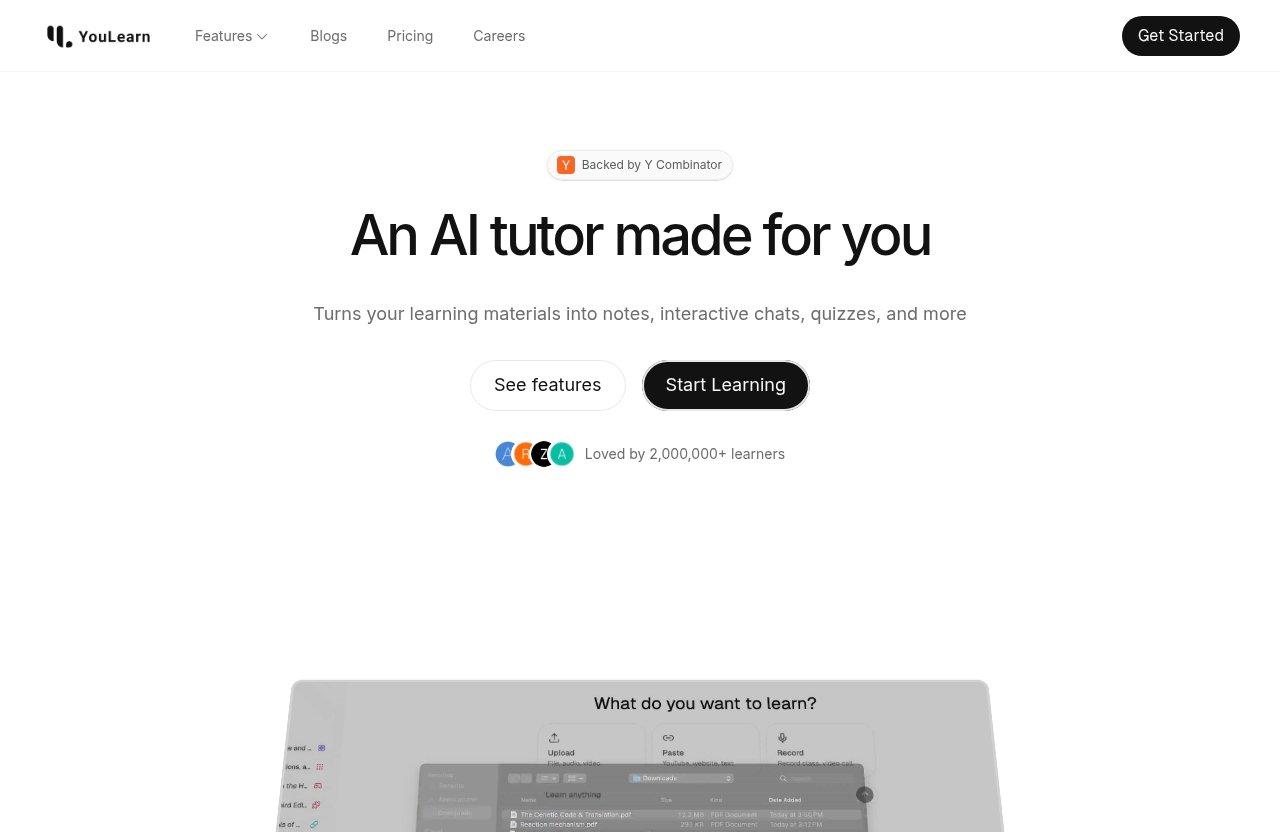
The strongest use of YouLearn AI for medical students is converting passive material into active study. It is especially relevant when you already have quality source content but need a faster way to review it.
Lecture-to-Flashcard Conversion
Flashcards are valuable because they force a prompt-and-answer format. Rather than recognizing a fact on a slide, you must retrieve it from memory. That distinction is central to active recall med school strategies.
After uploading a lecture PDF or slide set, ask for short, specific flashcards rather than broad definitions. For example, a renal lecture can become prompts such as:
- “Which nephron segment is impermeable to water?”
- “What happens to urine concentration when ADH increases?”
- “Which diuretic class acts on the thick ascending loop?”
When using YouLearn AI for medical students for flashcards, review every card before relying on it. Improve vague prompts, split overloaded cards, and correct any wording that conflicts with your lecture objectives.
Rapid Review of Pathology, Pharmacology, Anatomy, and Physiology
Rapid review is most effective when it has a defined target. Before an exam, asking for “everything about cardiology” is unlikely to be efficient. Asking for a concise review of heart-failure drug classes, pressure-volume loops, or valvular lesion murmurs is more manageable.
For pathology, focus on mechanism, morphology, clinical pattern, and key differentiators. For anatomy, use structured prompts around innervation, blood supply, muscle action, and lesion consequences. For physiology, prioritize cause-and-effect relationships instead of isolated facts.
This makes YouLearn AI for medical students a practical option for medical school rapid review, particularly after you have completed the initial learning pass.
Quiz Generation for Active Recall
Quizzes help reveal whether you can retrieve information without hints. YouLearn AI can create quizzes from learning materials, and personalized exams with answer breakdowns can make review more targeted.
A helpful workflow is to start with short quizzes of five to 10 questions. If you miss a question, do not just reread the explanation. Identify why you missed it: did you forget a fact, confuse two conditions, misunderstand the mechanism, or misread the stem?
For youlearn ai for medical students, quiz quality improves when you give narrow instructions. Specify the topic, desired difficulty, and question style, such as “five mechanism-focused questions from this autonomic pharmacology lecture.”
Turning Slides and PDFs Into Board-Style Practice
Students often want board-style practice from course materials. A platform can support this by turning your uploaded content into quizzes or personalized exams, but those questions should not be treated as validated board questions.
Use AI-generated questions to identify weak concepts and improve your reasoning process. For actual USMLE preparation, continue using dedicated board resources, official exam guidance, and trusted question banks appropriate to your stage of training.
This approach makes YouLearn AI for medical students useful as a supplement to a usmle study ai workflow, not a substitute for professionally developed board preparation.
Reviewing Recorded Lectures Before Exams
Recorded lectures are useful but time-consuming to revisit. The official homepage says YouLearn AI understands recorded lectures, which can be particularly helpful when you need to locate key themes from a class session.
Before a block exam, use a recording as a source for a focused study outline. Then compare that outline against the lecture objectives and any faculty emphasis. This is a more efficient approach than replaying every recording at normal speed.
A Practical Med-School Study Workflow With YouLearn AI
A repeatable process matters more than any individual tool. The following workflow uses YouLearn AI for medical students to support active recall, spaced repetition, and careful source verification.
Step 1: Upload the Source Material
Start with the material most likely to match your assessment: a lecture PDF, slides, course file, or recorded lecture. Avoid mixing unrelated topics in the same session, especially during content-heavy blocks.
For example, upload one lecture on antiarrhythmic medications rather than an entire cardiovascular module. A narrower source usually produces more precise review outputs.
Step 2: Extract Key Concepts and Weak Points
Ask for a structured list of major concepts, relationships, and likely confusion points. You might request categories such as mechanism, clinical use, adverse effects, contraindications, and comparisons between similar drug classes.
Then compare the output to your faculty learning objectives. This step is essential because medical-school exams often emphasize the way your course presents a topic, not just general textbook facts.
With YouLearn AI for medical students, treat the source material as the anchor and the AI output as a study draft. That keeps your review aligned with what you are actually expected to know.
Step 3: Build Flashcards and Quick Quizzes
Next, turn the key concepts into small recall prompts. Good flashcards test one idea at a time. Bad flashcards ask for an entire disease presentation, diagnostic workup, and treatment plan in one answer.
A practical sequence looks like this:
- Upload a pathology lecture PDF.
- Request concise notes organized by disease mechanism and distinguishing findings.
- Generate flashcards for high-yield associations.
- Ask for a five-question quiz on your weakest area.
- Review missed questions and create corrected cards.
This method supports flashcards for medical students ai workflows while keeping the student responsible for final quality control.
Step 4: Use Spaced Repetition and Self-Testing
Spaced repetition means returning to material at increasing intervals rather than cramming it once. The exact schedule can vary, but the principle is consistent: revisit difficult concepts before they fade.
A simple schedule is to review a new topic the same day, again within a few days, and again before the block exam. In each session, prioritize unanswered or missed questions over familiar material.
YouLearn AI for medical students can fit into this process by supplying fresh quiz prompts or explaining confusing concepts, while your flashcard system or calendar manages repeat exposure. A spaced repetition ai strategy only works when you actually schedule the reviews.
Step 5: Review and Refine Before Exams
In the final days before an exam, do not generate endless new material. Use the study resources you already created to identify gaps quickly.
Focus on missed questions, repeatedly forgotten details, and faculty-highlighted topics. Then perform a final verification pass using lecture slides, textbooks, and course resources.
Where YouLearn AI Helps Most in Medical Education
Different stages of training require different types of review. YouLearn AI for medical students is most useful when a student needs to convert source material into organized practice rather than seek clinical decision-making advice.
Pre-Clinical Exam Prep
Pre-clinical courses often involve large volumes of foundational science. Biochemistry, immunology, anatomy, physiology, and pharmacology all reward repeated retrieval.
An AI tutor for medical students can help break a long lecture into manageable question sets. It may be especially useful when you understand the general topic but cannot yet recall specific enzymes, receptors, pathways, or associations.
Lecture-Heavy Blocks and Block Exams
Block exams create a timing problem: several weeks of content may be tested in a short window. You need a way to revisit major themes without rereading every deck in full.
For lecture-heavy courses, YouLearn AI for medical students can support a rapid review plan based on your actual class files. Build short quizzes by lecture, then combine weak areas into a final cumulative review session.
USMLE-Style Review
USMLE-style reasoning requires more than memorizing facts. You need to connect symptoms, mechanisms, diagnostic clues, and management principles within a clinical vignette.
Use AI-generated quizzes from your own material to practice recognizing those relationships. However, dedicated board resources remain important because they are built specifically around exam-style content and quality-controlled questions.
Clinical Rotation Refreshers
During clinical rotations, students may need to refresh physiology, pharmacology, anatomy, or disease mechanisms encountered on service. This is a study use case, not a substitute for asking supervisors or consulting clinical guidelines.
A medical student ai app can be helpful for reviewing foundational concepts before rounds. Clinical decisions, patient-specific treatment questions, and urgent issues should always be handled through appropriate clinical supervision and authoritative institutional resources.
Last-Minute Rapid Revision
Last-minute review should be selective. The goal is not to master a new organ system overnight; it is to reinforce material that you have already studied.
YouLearn AI for medical students can help create a concise review outline or quick quiz from a lecture. Keep the session focused on high-yield learning objectives and errors from previous self-testing.
Official website · Latest pricing & offers
What YouLearn AI Can Generate for Faster Memorization
The official product information describes YouLearn AI as a tutor that can turn learning materials into notes, interactive chats, quizzes, and more. The outputs below are most relevant to memorization-heavy medical coursework.
Flashcards
Flashcards can convert lecture facts into retrieval prompts. For effective studying, request short cards with a clear question and a single answerable learning point.
When using YouLearn AI for medical students to create flashcards, check them against your original source. This matters most for dosage details, diagnostic criteria, mechanisms, and exceptions.
Practice Questions
Practice questions reveal whether you can use knowledge, not merely recognize it. Ask for questions that compare similar disorders, drug classes, or physiologic states.
After answering, explain your reasoning aloud before reading the breakdown. That small habit turns a quiz into active learning rather than passive answer checking.
Summaries and Key Takeaways
A good summary is a map, not a replacement for study. Use it to identify the core logic of a lecture before working through flashcards and questions.
For example, a summary of acid-base disorders should make the compensatory relationships clear. You still need to practice interpreting actual lab patterns independently.
Interactive Tutor Chat
Interactive chat can be useful when a concept feels too complicated or poorly explained in one source. Ask the tutor to simplify the concept, compare related conditions, or walk through a pathway step by step.
This is where YouLearn AI for medical students may be particularly helpful for physiology and pharmacology. Follow up by checking key explanations against a textbook or school material.
Personalized Exams
YouLearn AI can create personalized exams and provide answer breakdowns. That can help students build targeted review sessions from their own material.
The best use is diagnostic: find what you do not know, return to the source, and test again. Do not assume a generated exam reflects the exact quality, format, or difficulty of a school or licensing examination.
Limitations and Best Practices for Medical Students
No AI study platform can guarantee accuracy, completeness, or alignment with your school’s curriculum. A balanced youlearn ai for medical students review should consider this before focusing on speed alone.
Why AI Should Not Replace Textbooks or Lecture Notes
Lecture notes, faculty objectives, textbooks, and official school resources remain your foundation. They provide the context, curriculum alignment, and quality control that generated study materials may lack.
Use AI to organize and practice what you are learning. Do not use it as your sole source for high-stakes medical facts.
How to Verify Accuracy on High-Stakes Topics
Verify any fact that could affect an exam answer or patient-care understanding. This includes diagnostic criteria, drug mechanisms, contraindications, anatomy landmarks, treatment recommendations, and guideline-based decisions.
A simple rule works well: if you would hesitate to defend the answer to a professor or resident, check the original source. This is especially important when studying rapidly from generated notes.
When to Use Board Resources Instead of AI Alone
Dedicated board resources are usually better when you need validated question quality, curated content, and a structured exam-prep plan. AI can complement those resources by helping you review personal notes or clarify difficult concepts.
For students comparing the best ai tools for medical students, the right choice is often a combination: trusted board material for exam strategy and an AI tutor for personal lecture organization and recall practice.
How to Avoid Passive Studying
AI summaries can become another form of passive rereading if you only consume them. To avoid that trap, answer questions before revealing explanations, cover the answer side of flashcards, and write brief explanations in your own words.
YouLearn AI for medical students becomes more valuable when every interaction ends with retrieval. Ask yourself, “Could I answer this without seeing the source?” If not, schedule it for another review.
Is YouLearn AI Worth It for Medical Students?
Whether YouLearn AI for medical students is worth using depends on your existing system. It is most compelling for students who have plenty of lecture material but not enough time to turn it into structured review resources.
Best for Students Who Need Speed and Structure
Students who struggle with organizing PDFs, slide decks, and recordings may benefit most. The platform’s ability to work with learning materials and produce notes, chats, quizzes, and personalized exams can reduce the friction between attending class and beginning active review.
It may also suit students who want a flexible study assistant instead of a rigid, one-format system.
Best for Students Who Learn Through Active Recall
If you already use flashcards, self-testing, and spaced repetition, YouLearn AI for medical students can fit naturally into your process. The main advantage is using your own material to create practice more quickly.
It is less useful if you mainly want polished, prebuilt board content. In that case, dedicated board tools and established question banks may deserve priority.
Who May Prefer Other Tools
Students who prefer manual flashcard creation may find that writing every prompt themselves improves retention. Others may need a tool with a highly specific curriculum, specialty focus, or school-approved workflow.
Also consider your study habits. A tool cannot fix inconsistent review, skipped lectures, or a lack of source verification.
Affiliate Disclosure and Buying Guidance
TopTrustReview may earn a commission if you choose to explore YouLearn AI through this YouLearn AI link. The recommendation is not that every student needs it; it is that students who want faster lecture-to-review workflows may find it worth evaluating.
Before subscribing, test whether it fits your actual week. Use one representative lecture, create a small set of flashcards and questions, then decide whether the output saves time without lowering your standards for accuracy.
Pricing, Access, and What to Check Before Subscribing
Pricing can influence whether YouLearn AI for medical students makes sense alongside existing school costs, question banks, textbooks, and flashcard tools. Current pricing details were not available in the verified product information provided for this review.
How to Verify Current Pricing on the Official Site
Check the official YouLearn pricing page before subscribing. Confirm the current price, available access options, usage limits, billing frequency, and cancellation terms directly on the official site.
Students searching for youlearn ai for medical students free should also verify the latest free-access availability there rather than relying on older reviews or social-media posts.
What to Look for in Free Versus Paid Access
If the official site offers different access levels, compare them based on your study workload. Consider how often you expect to use PDFs, slides, videos, files, recorded lectures, quizzes, and personalized exams.
Do not subscribe based only on the idea of an AI tool. Subscribe if it reliably supports a workflow you will use during real exam weeks.
Why Pricing Can Change
Software pricing, access policies, and included features can change. That is why the official pricing page is the best source before making a purchase decision.
The same caution applies to searches for youlearn ai for medical students login or youlearn ai for medical students download. Confirm the current access process and supported options through official YouLearn channels.
Official website · Latest pricing & offers
FAQ
Can YouLearn AI make flashcards from med-school lectures?
YouLearn AI can turn learning materials and lectures into study outputs such as notes, quizzes, and more, making it suitable for a flashcard-based workflow. Use your uploaded lecture PDF, slides, or recording as the source, request focused flashcards, and verify each card against your course material.
Is YouLearn AI good for dense memorization?
YouLearn AI for medical students can be helpful for dense memorization when used with active recall and repeat review. It is most useful for turning PDFs, slides, and lectures into smaller study tasks, but you should still verify high-stakes facts.
Can it help with board-style review?
It can support board-style review by creating quizzes and personalized exams from your study materials. However, it should complement—not replace—dedicated board resources, validated question banks, and official exam guidance.
Is YouLearn AI free?
Check the official YouLearn pricing page for current free-access and paid-access information. Pricing details, access limits, and subscription options can change, so avoid relying on outdated claims.
Does it work with PDFs, slides, and recordings?
Yes. Verified product information states that YouLearn AI can chat with PDFs, slides, files, lectures, and other learning materials. Its official homepage also says it understands PDFs, YouTube videos, and recorded lectures.
Related Reading
References
- YouLearn AI
- Best AI Tools for Medical Students in 2026: Study Smarter for Boards and …
- AI Use for Medical Students: Impact on Clinical Skill Acquisition and …
- 28 Best AI for Medical Students to Accelerate Exam Prep – HyperWrite