How to Build a Funnel in Systeme.io: A Beginner-Friendly 2026 Tutorial

Learning how to build a funnel in systeme.io is one of the fastest ways to turn a simple offer, lead magnet, or webinar idea into a guided customer journey. Instead of sending visitors to a general website and hoping they take action, a funnel gives them one clear next step at a time.
Systeme.io is useful for beginners because its funnel builder combines visual page editing with email, payment, membership, automation, and affiliate-tracking tools. In this guide, I will walk through the exact setup process, the funnel types available, and the checks I would make before sending traffic.
This article contains affiliate links, which means we may earn a commission at no extra cost to you. If you want to explore the platform while following along, you can start with Systeme.io here.
Official website · Latest pricing & offers
What a Systeme.io funnel is and when to use one
A funnel is a connected sequence of pages designed to move a visitor toward one goal. That goal could be joining your email list, purchasing an offer, registering for a webinar, or taking another specific action.
When you understand how to build a funnel in systeme.io, you can create a focused journey instead of asking visitors to navigate several unrelated pages. Each step should answer one question and guide the person naturally to the next step.
Quick definition of a sales funnel
A sales funnel is not just a sales page. It is the path that a person follows from first interest through to conversion.
For example, a simple systeme.io sales funnel might begin with an ad or social post, send visitors to an opt-in page, deliver a useful free resource, and later present a paid offer. A product-focused path may send people directly to an order form and then a thank-you page.
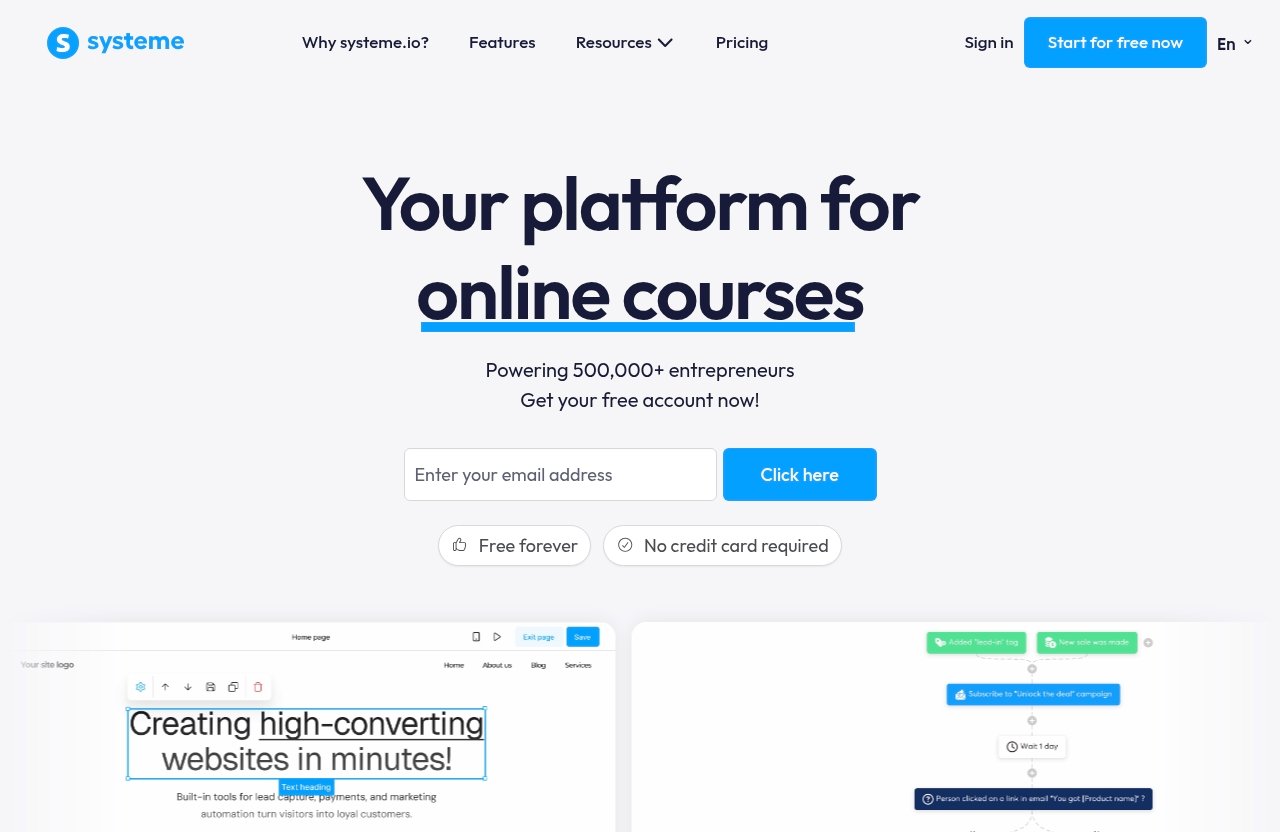
The Systeme.io funnel builder is a drag-and-drop tool for creating multi-step funnels. It includes templates and visual editing, so you do not need to build every page from a blank screen.
The 4-page funnel logic most beginners need
Many beginners make the mistake of building too much before testing their message. In practice, a straightforward four-step flow is enough for many paid offers:
- Landing or opt-in page — explains the offer and asks for one action.
- Sales page — explains the product, outcome, and next step.
- Order form — collects payment details for a purchase.
- Thank-you page — confirms the action and tells the buyer or subscriber what happens next.
Not every funnel needs all four pages. An email-list funnel can be shorter, while a webinar path can require a different sequence. The key lesson in how to build a funnel in systeme.io is to choose steps based on your real goal, not on what looks complicated.
Best use cases: lead capture, product sales, webinar, custom funnels
Systeme.io provides four funnel types in its official help documentation:
| Funnel type | Best for | Preset structure or purpose |
|---|---|---|
| Build an Audience | Email list growth | Opt-in page and Thank you page |
| Sell | Selling an offer | Order form and Thank you page |
| Custom | Unique page flows | Blank canvas for building pages from scratch |
| Run an evergreen webinar | Webinar-based selling | Specialized three-page webinar structure |
Use a Build an Audience funnel when your priority is capturing leads. Use Sell when visitors are ready to buy a product or service. Choose a systeme.io webinar funnel when your presentation is the main sales mechanism.
The Custom option is flexible, but it is generally better to begin with a preset structure unless you already know exactly which pages and logic you need.
Before you build: what you need ready inside Systeme.io
The most efficient way to approach how to build a funnel in systeme.io is to prepare the essentials before you open the builder. A little planning prevents half-finished pages, unclear calls to action, and missing checkout details.
You do not need perfect copy or polished graphics to start. You do need a clear offer and a simple goal.
Create or log into your Systeme.io account
First, create an account or log in to your existing Systeme.io workspace. The official setup path for creating a funnel is:
Sites tab > Sales funnels > Create
Once you reach the creation screen, you can choose the funnel type, name it, select a domain, and select a currency. If you are trying the platform for the first time, this is the point where the process becomes very practical.
Systeme.io has Free, Startup, Webinar, and Unlimited plans. Check the official pricing page for current prices, plan details, and feature availability before deciding which option fits your needs.
Prepare your offer, lead magnet, or webinar topic
Before you create funnel systeme.io pages, write down the core offer in one sentence. A useful formula is:
I help [audience] get [specific outcome] through [offer or method].
For a lead magnet, prepare the title, delivery format, and the main benefit. For a product, prepare the offer name, price, order-form details, and what happens after payment. For a webinar, define the topic and the action you want attendees to take afterward.
This preparation makes how to build a funnel in systeme.io much easier because you will not be making strategic decisions while editing page sections.
Decide your funnel goal and domain/currency settings
Choose one primary conversion goal before building. Examples include:
- Collect an email address for a guide or checklist
- Sell a digital product or service
- Register visitors for an evergreen webinar
- Send leads to a consultation or application process
- Deliver a simple post-purchase next step
During funnel creation, Systeme.io asks you to select a domain and currency. Think through the audience and offer currency before you begin, particularly if you are building a checkout flow.
A custom domain can be useful for branding, but do not let that delay your first funnel. Start with the domain setup available in your account, then review your domain options as your business develops.
How to build a funnel in systeme.io step by step
This systeme.io funnel tutorial follows the official navigation and keeps the first version simple. Your first funnel should be clear, functional, and tested—not overloaded with extra pages.
Go to Sites or Funnels and click Create
To begin how to build a funnel in systeme.io, log in and open the Sites tab. Then choose Sales funnels and select Create.
This opens the funnel setup area. Avoid building pages before choosing the funnel type, because the preset structure can save time and reduce setup errors.
Choose your funnel type and name it properly
Choose the funnel type that matches your goal: Build an Audience, Sell, Custom, or Run an evergreen webinar.
Next, give the funnel a clear internal name. Good names make reporting and organization easier when you create more than one funnel.
Try a naming format such as:
Lead Magnet - Content Planning GuideProduct - Starter CourseWebinar - Client Onboarding TrainingCampaign - Summer Promotion
When you build a sales funnel in systeme.io, avoid vague names such as “New Funnel” or “Test 2.” You will thank yourself later when reviewing your pages and traffic sources.
Select a domain and currency
Select the domain for the funnel and choose the appropriate currency. This is especially important when using a Sell funnel because your checkout experience should match the market you are targeting.
If you are still learning how to build a funnel in systeme.io, keep your first setup focused on one audience and one offer. Trying to support multiple markets, messages, and currencies in a first version can make troubleshooting harder.
Pick a template or start from scratch
Systeme.io offers templates and visual editing for funnel pages. Start by reviewing the available template options for your selected funnel structure.
For most beginners, choose a template that already resembles the page you need. It is faster to replace text, colors, images, and sections than to design every element from scratch.
Use a blank page only when you have a specific reason. The systeme.io custom funnel option is useful for experienced builders, but a template-led page usually helps a beginner launch sooner.
Add and arrange funnel steps
Now review the funnel steps that appear in your selected structure. A Build an Audience funnel includes an Opt-in page and a Thank you page. A Sell funnel comes preset with an Order form and Thank you page.
Add further pages only when they support the visitor’s decision. A simple sequence might look like this:
| Goal | Recommended starting order |
|---|---|
| Grow an email list | Opt-in page → Thank you page |
| Sell an offer directly | Sales page → Order form → Thank you page |
| Sell after lead capture | Opt-in page → Sales page → Order form → Thank you page |
| Run an evergreen webinar | Use the specialized webinar funnel structure |
This is the stage where how to build a funnel in systeme.io becomes a matter of customer logic. Ask what the visitor needs to see before they can comfortably take the next action.
Customize each page in the visual editor
Open each funnel step and use the visual editor to customize the page. Start with the essential elements:
- A benefit-driven headline
- A short explanation of the offer
- A relevant image, if it adds clarity
- One primary call to action
- Trust-building details that are accurate and relevant
- A clear next-step message
Write for the visitor’s current level of awareness. Someone downloading a free guide needs a quick reason to opt in. Someone on an order form needs confidence about what they are buying and what happens next.
For this part of how to build a funnel in systeme.io, resist the urge to add every available section. Strong pages are often easier to scan, easier to understand, and easier to act on.
Connect checkout, email automation, and thank-you logic
Your pages need to connect to the correct outcome. The official sales-funnels information notes integration with email lists, payment systems, membership sites, automation, and affiliate tracking.
For a lead-generation funnel, confirm that form submissions go to the correct email list or follow-up automation. For a purchase funnel, review your payment setup and ensure the buyer receives a useful confirmation and next instruction.
Your thank-you page should never be an afterthought. Tell subscribers where to look for their resource, or tell customers how they can access what they purchased. Clear post-conversion instructions reduce confusion and support requests.
Publish and test the funnel
Before sending traffic, test the full funnel as if you were a visitor. Open the live pages on desktop and mobile, submit a test opt-in where appropriate, and carefully review every step.
Use this launch checklist:
- Check every headline and button label
- Confirm that all links go to the right destination
- Test the opt-in form and follow-up path
- Review payment-related settings before selling
- Read the thank-you page for clarity
- Check mobile spacing, text size, and images
- Ask whether each page has one obvious next action
Testing is the final, non-negotiable stage of how to build a funnel in systeme.io. A beautiful funnel with a broken link or disconnected email follow-up will not produce the experience you intended.
Official website · Latest pricing & offers
Which funnel type should you choose in Systeme.io?
Choosing the right starting structure is one of the most important decisions in how to build a funnel in systeme.io. The best choice depends on your business goal, not on which template looks most impressive.
Build an Audience funnel
The Build an Audience funnel is the simplest option. It includes an Opt-in page and a Thank you page, and its primary purpose is growing an email list.
Use this systeme.io lead capture funnel if you have a checklist, mini-guide, template, email course, waitlist, or another useful free resource. Keep the opt-in page focused on the benefit of joining.
This is often the best first choice for a beginner because it helps you validate whether your message attracts the right people.
Sell funnel
The Sell funnel is designed to generate sales. It comes preset with an Order form and a Thank you page.
Use a systeme.io sell funnel when you already have a clear offer and want visitors to move toward checkout. You can build out the surrounding pages as needed, but begin by making the offer and buying process understandable.
When you build a sales funnel in systeme.io, make sure your sales message, order form, and post-purchase instructions all describe the same offer. Consistency builds confidence.
Custom funnel
The Custom funnel is a blank canvas for creating any type of page from scratch. It gives you more control, but it also requires more decisions.
A systeme.io custom funnel can make sense for a unique application flow, content hub, special promotion, or a sequence that does not fit the preset structures. For a first launch, however, start with a preset funnel unless your page flow genuinely requires custom work.
Evergreen webinar funnel
The Run an evergreen webinar option is a specialized three-page funnel structure optimized for selling and hosting evergreen webinars. It is intended for businesses using an on-demand webinar as part of their sales process.
The systeme.io webinar funnel option is available only on the Webinar and Unlimited plans. Confirm the current plan details on the official pricing page before planning your funnel around this option.
How to make your funnel convert better
A funnel converts better when every step reduces uncertainty and makes the next action easy. Once you know how to build a funnel in systeme.io, focus on improving clarity before adding complexity.
Use a clear headline and one primary CTA
Your headline should quickly explain the main benefit. Visitors should understand what they will get, who it is for, or what problem it helps solve without reading several paragraphs.
Use one primary call to action per page. For example: “Get the guide,” “Register for the webinar,” or “Continue to secure checkout.” Multiple competing buttons can distract visitors.
Keep opt-in pages focused
An opt-in page should not try to tell your entire brand story. It should make one offer and explain why it is worth exchanging an email address for it.
For a systeme.io lead capture funnel, use a specific title and describe the practical result. “Free guide” is vague; “A five-step client onboarding checklist” is clearer.
Match the sales page to the traffic source
Keep the message consistent from ad, email, social post, or partner link through to the funnel page. If the traffic source promises a beginner tutorial, the landing page should continue that exact conversation.
This simple message match is a valuable part of how to build a funnel in systeme.io because it reassures visitors that they have reached the right place.
Use urgency only when it is real
Systeme.io’s official sales-funnels page mentions deadline funnels. These can be useful when a real deadline exists, such as a genuine enrollment close or time-limited event.
Do not invent urgency. Clear offers and honest deadlines create a more durable relationship than pressure tactics that do not reflect reality.
Track conversions and improve one step at a time
Review where visitors stop progressing. If many people reach the opt-in page but do not submit, improve the headline, offer, or form clarity. If people reach the sales page but do not move forward, revisit the message and the fit of the offer.
Change one important element at a time when possible. That way, you can learn what improved the journey instead of guessing.
Common mistakes when building a funnel in Systeme.io
Even a good offer can underperform when small setup errors create friction. Use these common mistakes as a final review list for how to build a funnel in systeme.io.
Choosing the wrong funnel type
Do not select a webinar funnel when your actual goal is simply building an email list. Likewise, do not begin with a Custom funnel if the Build an Audience or Sell structure already does what you need.
Choose the simplest funnel that supports your immediate business goal. You can always create more advanced versions later.
Adding too many steps too early
A new systeme.io sales funnel does not need multiple upsells, extra opt-ins, long surveys, and several different offers on day one. More steps mean more opportunities for visitors to leave and more settings to test.
Begin with a short path. Add pages only after you have a strategic reason and a clear understanding of the customer journey.
Skipping mobile checks
Many visitors will view your pages on a phone. Always inspect the mobile version before publishing, especially headings, form fields, button placement, image size, and spacing.
A page that looks polished on a wide monitor can become hard to use on a small screen. This is one of the easiest issues to catch in a test run.
Forgetting to connect email or payment settings
A lead form must lead somewhere useful, and an order flow must be connected to the intended payment process. Check your email list, automation, and payment-related settings before promoting the funnel.
If you use membership-site delivery or affiliate tracking, verify those connections as part of your complete journey. The systeme.io funnel builder is designed to work with these workflows, but you still need to confirm your individual setup.
Launching without testing
Never assume a page works because it looks correct in the editor. Open the live funnel, test buttons, check the thank-you page, and complete a realistic visitor journey.
Quick pre-launch checklist
Before publishing, confirm:
- The funnel type fits the offer
- Every page has one clear purpose
- The main CTA works
- Mobile pages are readable
- Forms, email follow-up, and payment-related settings are checked
- The thank-you page gives a clear next instruction
Why Systeme.io is attractive for funnel building
For a beginner, the practical benefit of Systeme.io is that funnel creation does not need to be isolated from the rest of the customer journey. The platform’s official funnel information highlights integrations with email lists, payment systems, membership sites, automation, and affiliate tracking.
All-in-one funnel, email, and course workflow
A funnel often needs more than a landing page. You may need follow-up emails, a checkout process, access delivery, or automation after someone completes an action.
Understanding how to build a funnel in systeme.io within this connected workflow can simplify planning. Instead of treating every part of the journey as separate, you can build around the action you want a subscriber or customer to take next.
Template-based setup for faster launches
Templates and visual editing are useful when speed matters. You can start from an existing page design, customize the message, and concentrate on your offer rather than rebuilding common page elements.
The drag-and-drop approach is especially helpful for creators and small teams that want more control than a basic form, without starting a design project from scratch.
Built-in automation and affiliate tracking
Systeme.io officially lists automation and affiliate tracking among the tools connected to its funnel workflow. This matters when your funnel needs to trigger a follow-up sequence or when you plan to track referrals.
The platform also states that you can share a complete copy of a funnel with one click. That can be useful when standardizing a proven funnel structure or sharing a setup with another user.
Good fit for creators, coaches, and small businesses
Creators can use a funnel to grow a list or sell a digital offer. Coaches can use one to guide potential clients toward a webinar, application, or offer. Small businesses can use a focused page sequence instead of asking visitors to figure out a complex website.
The real advantage is not that every business needs a long funnel. It is that the systeme.io funnel builder gives you a structured way to create a focused customer path.
Official website · Latest pricing & offers
FAQ
How many steps should a funnel have in Systeme.io?
The best number depends on your goal. Beginners often start with an Opt-in page and Thank you page for list building, or a sales page, order form, and Thank you page for a paid offer.
When learning how to build a funnel in systeme.io, keep the first version short. Add steps only when they make the journey clearer or serve a real business purpose.
Can I build a funnel for free in Systeme.io?
Systeme.io offers a Free plan, according to its official pricing page. It also has Startup, Webinar, and Unlimited plans.
Check the official pricing page for current plan limits, prices, and feature availability before choosing a funnel type or planning a specific workflow.
What is the difference between a sales funnel and a landing page?
A landing page is one standalone page designed around a single action. A sales funnel is a sequence of connected pages designed to move a visitor from interest to conversion.
For example, a landing page may collect an email address, while a funnel can continue with a sales page, order form, and thank-you page.
Do I need a custom domain to start building a funnel?
The official funnel-creation process asks you to select a domain. Beginners can start with the domain setup available in their account and review custom-domain options later if needed.
Do not delay building your first funnel solely because your branding setup is not final. Prioritize a clear offer, a working flow, and thorough testing.
Can I edit a funnel after publishing it?
Yes. Funnels are meant to be customized and improved over time. It is normal to revise page copy, page design, steps, and automation after you see how visitors respond.
Treat publication as the start of improvement, not the final version. Test carefully after making important changes.
Conclusion
Now you know how to build a funnel in systeme.io: choose a clear goal, use the right funnel type, create the required pages, connect the visitor journey, and test every step before promotion. Start simple, keep each page focused, and improve based on real results.
If you are ready to put this tutorial into practice, you can try Systeme.io through this link and check the official pricing and help pages for the latest plan details and setup guidance.
Related Reading
- Systeme.io free trial explained
- Complete Gohighlevel tutorial for beginners
- Email marketing tools like Systeme.io
References
- The easiest funnel builder you'll ever use
- How to create a funnel
- Our Complete Guide to Build High-Converting Sales Funnels