
Foreplay Marketing 2026: How It Works

Foreplay marketing is a paid-social creative workflow built to help teams move from ad inspiration to organized briefs and performance review. People usually search this term because they want to know whether Foreplay can simplify ad research, competitor monitoring, creative collaboration, and analysis without forcing their team to work across disconnected tools.
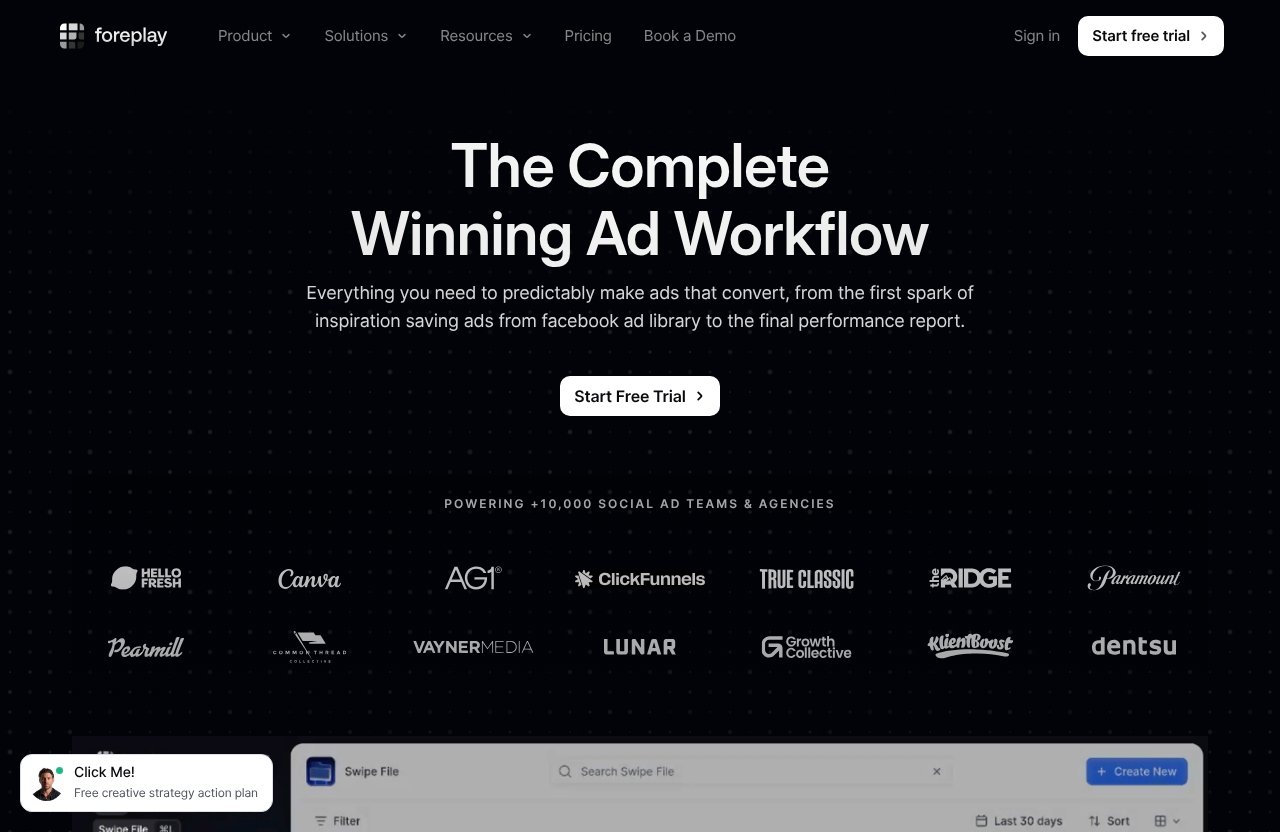
In practical terms, Foreplay positions itself as “The Complete Winning Ad Workflow.” It is designed for marketers who regularly collect ads, study what competitors are doing, turn findings into production-ready ideas, and review creative results with the people responsible for media buying and design.
Official website · Latest pricing & offers
What Is Foreplay Marketing?
Simple definition of Foreplay in the paid-social workflow
Foreplay marketing refers to using the Foreplay platform as a central workspace for paid-social creative research and production. Instead of saving ads in scattered browser bookmarks, screenshots, chat threads, and spreadsheets, teams can save inspiration, organize it, investigate competitor activity, build briefs, and review creative performance in a more connected workflow.
The platform’s core purpose is not simply “ad spying.” Its broader role is to bridge the gap between the people finding ideas, the people turning those ideas into ads, and the people evaluating campaign outcomes.
A useful way to think about it is as a creative operating system for paid ads:
| Workflow Stage | Typical Team Need | Foreplay Module |
|---|---|---|
| Research | Save useful ads and concepts | Swipe File, Chrome Extension |
| Competitive analysis | Find and track relevant advertisers | Discovery, Spyder |
| Planning | Convert examples into usable direction | Briefs |
| Measurement | Review creative-level insights | Lens |
| Collaboration | Keep stakeholders aligned | Shared files, briefs, API, MCP |
Who typically uses it: agencies, freelancers, performance teams, and e-commerce brands
Agencies are a natural fit because they often handle multiple client brands, campaign angles, and creative pipelines at once. A strategist can collect examples for a client, while a designer sees the same references and a media buyer later connects the finished creative to performance observations.
For foreplay ecommerce teams, the appeal is often creative velocity. A brand running frequent paid-social tests needs a repeatable way to spot emerging angles, document why an ad format is interesting, and turn that learning into the next round of assets.
Freelancers and consultants may also use Foreplay when their work involves research-heavy creative strategy. Rather than sending a loose collection of links to a client, they can organize selected references and present them as part of a structured brief.
Why the term “foreplay marketing” usually refers to the Foreplay platform, not a marketing concept
Although the word “foreplay” has a general meaning outside advertising, searches for foreplay marketing reviews usually relate to the Foreplay software product. In this context, it is a brand name, not a broad marketing framework or a standalone advertising tactic.
That distinction matters because Foreplay does not claim to replace campaign strategy, creative talent, or media-buying judgment. It provides a workflow for making those activities more organized and collaborative.
How Foreplay Works: The Core Workflow
Step 1: Save ad inspiration from ad libraries and the web
The first stage of foreplay marketing is capturing ideas when you find them. Paid-social teams routinely encounter useful hooks, offers, landing-page angles, creator formats, editing styles, and product demonstrations while browsing ad libraries or the wider web.
Foreplay’s Chrome Extension lets users save creative inspiration without relying solely on screenshots or scattered bookmarks. The goal is to preserve the full context of an interesting ad before the team forgets why it was worth saving.
For example, a media buyer might find a skincare ad with a strong first-three-second hook. They can save it, note that the opening challenges a common objection, and flag it for a creative strategist to review later.
Step 2: Organize ads into swipe files and folders
Saving ads is useful only when the collection remains searchable and meaningful. In a practical foreplay marketing strategy, teams organize inspiration by brand, platform, audience, campaign concept, product category, or creative format.
A direct-to-consumer team could create folders for “UGC testimonials,” “giftable bundles,” “problem-solution hooks,” and “retargeting offers.” This gives designers and copywriters a focused starting point rather than a giant, unfiltered list of ads.
Good organization also improves institutional memory. When a new creative producer joins the team, they can review the existing swipe file and quickly understand which directions the brand has explored.
Step 3: Use discovery and spy features to monitor competitors
After building an internal reference library, teams can use Discovery and Spyder to expand their research. Discovery is Foreplay’s ad search engine, with access to over 100 million ads according to the official product positioning.
Spyder is built for ongoing competitor advertising tracking and analysis. Rather than repeatedly searching for the same brands manually, marketers can monitor competitor activity 24/7 and look for changes in messaging, creative themes, promotions, or format choices.
This stage of foreplay marketing should inform hypotheses, not encourage copying. If several competitors are using product comparison videos, for instance, the useful question is not “How do we recreate this exactly?” It is “What customer concern is this format addressing, and how can our brand answer it differently and more credibly?”
Step 4: Turn inspiration into briefs
Research often breaks down at handoff. A strategist may have strong examples, but the designer receives only vague instructions such as “make something like this.” Foreplay Briefs is intended to turn stored inspiration into more actionable creative direction.
A clear brief can explain the intended audience, hook, message, proof point, desired format, references, and testing rationale. That context is especially valuable when creative and performance teams work asynchronously or when agencies need client approval before production begins.
Imagine an agency preparing a launch campaign for a supplement client. The strategist saves examples of founder-led videos, identifies a recurring concern about ingredient transparency, and builds a brief asking for a 20-second founder script with a specific visual demonstration. The creative team receives the rationale alongside the references rather than having to infer it.
Step 5: Review performance insights with Lens and iterate
The final step is learning from work that has actually run. Lens is Foreplay’s advertising analytics module for creative teams, designed to support performance review and production insights.
Foreplay analytics can help bring creative discussion closer to media performance. Instead of discussing an ad only in subjective terms—such as whether it “looks premium”—teams can use performance observations to decide which hooks, formats, themes, or concepts deserve further testing.
The key is a feedback loop: save examples, develop a brief, launch work, review the result, and use lessons to improve the next brief. That makes foreplay marketing most valuable as an ongoing operating process rather than a one-time research tool.
Foreplay’s Main Features Explained
Swipe File for saving and sharing creative inspiration
Swipe File is the collection layer of Foreplay. It gives teams a place to save ads and creative references they want to revisit, share, or use as input for new concepts.
For an agency, separate swipe files can keep client research distinct. For an in-house brand, folders can support recurring campaigns, seasonal promotions, or specific customer segments. The practical benefit is reducing the time spent searching through old messages and browser tabs for an ad someone saved weeks earlier.
Discovery for searching ads at scale
Discovery is the research engine within the foreplay marketing tools suite. Foreplay describes it as an ad search engine with over 100 million ads, giving marketers a broader pool of creative examples than they could reasonably collect on their own.
A strategist may use Discovery before a campaign kickoff to study how advertisers frame a familiar category problem. A creative lead may use it to identify patterns in visual structure, creator use, product demonstrations, or offer communication.
Search volume is not the same as strategy. The value comes from filtering the findings into a small number of relevant observations that can be tested for a specific brand and audience.
Spyder for 24/7 competitor tracking
Spyder supports ongoing competitor monitoring. This is different from occasional research because it helps teams keep an eye on advertiser activity over time.
For example, if a competitor begins running a new product bundle message or shifts toward creator-led ads, the marketing team can investigate the change and decide whether it reveals a market trend worth exploring. It does not prove that the competitor’s approach is performing well, but it can surface useful creative signals.
Used responsibly, Spyder helps marketers stay informed without chasing every competitor move. The best teams still prioritize their own positioning, customer insights, and testing plan.
Lens for creative analytics and production insights
Lens is the module most relevant when a team wants research and production to connect to results. It is designed as advertising analytics for creative teams, helping them review creative performance rather than treating analytics as a media-buying-only responsibility.
This can improve the quality of creative feedback. A designer can better understand why a concept is being iterated, while a media buyer can communicate performance patterns in a clearer creative language.
In a mature foreplay marketing workflow, Lens should support regular review sessions. Teams can discuss what to make next based on evidence, not just opinions or the most recent ad they happened to see.
Briefs, Chrome Extension, MCP, Mobile App, and API
Briefs is the execution bridge between research and production. It helps teams turn saved references and strategic notes into an organized creative request.
The foreplay co chrome extension supports fast capture while browsing, which is important because research is often done in real time. The Mobile App provides another way to access the workflow when team members are away from their desks.
Foreplay also lists MCP and API access among its product modules. The API can matter for teams that need to connect Foreplay data or processes with their existing systems, while MCP is listed as part of the platform offering. The exact implementation should be evaluated against your team’s technical requirements before committing to a workflow.
Official website · Latest pricing & offers
Where Foreplay Fits in a Marketing Team
Use cases for agencies managing multiple clients
Agencies often face a coordination problem: each client needs fresh ideas, yet research, creative production, and performance feedback may live in separate systems. Foreplay marketing can provide a shared structure for each account.
A strategist can maintain client-specific inspiration, a creative lead can review briefs and references, and a media buyer can bring performance observations into the same overall process. This reduces the risk of client knowledge being trapped in one person’s bookmarks or private notes.
Use cases for e-commerce teams chasing creative volume
E-commerce brands regularly need new ads for launches, promotions, new audiences, and iterative testing. The challenge is not only generating more concepts; it is generating more relevant concepts without repeating the same weak ideas.
Foreplay ecommerce workflows can help a team categorize ideas by product benefit, customer objection, purchase stage, and creative format. When the brand’s paid-social volume grows, that organization becomes more useful than an unstructured swipe folder.
Use cases for freelancers and consultants
Independent marketers may not need every enterprise-style process, but they still benefit from presenting research professionally. A consultant can build a swipe file around a client’s market, identify patterns, and create a brief that makes their recommendation easy to understand.
This also creates a clearer deliverable. Instead of saying, “I found some ads you might like,” the consultant can explain what each reference demonstrates and how it relates to the client’s test plan.
How it improves collaboration between strategy, creative, and media buying
Foreplay’s official positioning emphasizes bringing performance and creative teams together. That matters because paid-social ads improve faster when the people making them understand the test rationale and the people buying them can explain outcomes beyond surface-level metrics.
A strong foreplay marketing process creates a common language. Strategy defines the customer problem and hypothesis, creative translates it into an ad, and media buying reports what happened after launch. Each function can see the context behind the next decision.
Foreplay Pricing in 2026
Foreplay states that its pricing is flexible and risk-free, with no contracts and no surprises. It also states that usage and ad spend are unlimited across products, subject to the features included in the selected plan.
Basic plan: price, user limit, and key inclusions
The Basic plan is listed at $59 per month. It includes one user, with additional users available at $20 per user.
Included features are Swipe File, Discovery, Briefs, Spyder, Lens, API access with 10,000 credits, and MCP. The plan starts with a seven-day free trial, and Foreplay states that no credit card is required.
Workflow plan: price, user limit, and key inclusions
The WORKFLOW plan is listed at $175 per month and includes up to five users. Additional users are listed at $20 per user.
It includes Swipe File, Discovery, Briefs, Spyder with 15 brands, and Lens with one brand and unlimited ad spend. Like Basic, the plan starts with a seven-day free trial and does not require a credit card.
| Plan | Monthly Price | Included Users | Notable Inclusions |
|---|---|---|---|
| Basic | $59/month | 1 | Swipe File, Discovery, Briefs, Spyder, Lens, API access with 10,000 credits, MCP |
| WORKFLOW | $175/month | Up to 5 | Swipe File, Discovery, Briefs, Spyder with 15 brands, Lens with 1 brand and unlimited ad spend |
Monthly vs annually and what “Save 15% + Unlimited Spyder” means
Foreplay offers monthly and annual billing options. The official pricing page states that annual billing saves 15% and includes Unlimited Spyder.
Because plan terms can change, it is sensible to verify current inclusions at checkout—particularly if competitor tracking capacity or API access is central to your foreplay marketing strategy. The trial gives teams a practical opportunity to test whether the workflow fits before making a longer commitment.
Pros and Limitations of Foreplay Marketing
Strengths for saving, organizing, and collaborating on ad inspiration
The main strength is workflow continuity. Foreplay connects creative discovery, saved references, competitor research, briefs, and performance review in one product ecosystem.
That is especially useful when several people contribute to paid-social execution. Instead of handing off context through screenshots and chat messages, teams can work from shared reference material.
Strengths for creative analytics and workflow structure
Foreplay is well aligned with teams that see creative as a measurable growth lever. Lens adds an analytics element to a process that might otherwise stop at ad inspiration and briefing.
For teams evaluating foreplay marketing reviews, this is an important distinction: the platform is not positioned only as a swipe-file tool. Its wider value depends on whether your team will actually use the full loop from research through iteration.
Potential limitations for users who only need lightweight swipe-file storage
A marketer who only wants a simple place to save occasional ad examples may not need the full workflow. Discovery, Spyder, Briefs, Lens, API access, and collaboration capabilities carry more value when research and creative production happen regularly.
The same applies to a very small business with limited paid-social activity. If there is no consistent ad testing process, the platform’s connected modules may be more than the team will actively use.
Who may need a simpler or more analysis-heavy alternative
Users who want only lightweight storage may prefer a simpler organizational approach. On the other hand, teams looking primarily for deep, specialized analysis should carefully validate whether Lens provides the exact reporting depth and workflow they need.
This is not a weakness unique to Foreplay; it is a fit question. Foreplay marketing is most compelling when the bottleneck is connecting ad research, creative collaboration, and performance learning.
Is Foreplay Worth It for Your Workflow?
Best-fit scenarios
Foreplay is likely worth testing if your team repeatedly struggles with one or more of these issues:
- Good ad examples disappear into bookmarks, chats, or personal folders.
- Creative briefs lack concrete references and strategic context.
- Competitor research is inconsistent or overly manual.
- Media buyers and creative teams discuss results in separate places.
- Your agency or brand needs a clearer repeatable workflow for paid-social concepts.
For those use cases, the platform’s value comes from reducing fragmentation. A team that can preserve research and link it to production decisions is better positioned to learn from each creative cycle.
When Foreplay is probably overkill
Foreplay may be unnecessary if you run very few ads, rarely research competitors, and do not collaborate with other people on creative production. It may also be less urgent if your existing process already captures inspiration, briefs, and performance feedback reliably.
The best buying decision is not based on the number of features. It is based on whether the product solves a costly bottleneck in your current marketing workflow.
Decision checklist before starting a trial
Before testing foreplay marketing, ask:
- Where do we currently save ads and creative ideas?
- Can anyone on the team find and understand those references later?
- How do we monitor relevant competitors today?
- Do our briefs explain the “why” behind a creative request?
- Do creative and media teams review performance together?
- Will at least one person own the organization of folders, briefs, and research?
If the answers reveal gaps, a trial is a sensible next step. Readers who want to assess the platform in their own workflow can explore Foreplay through this Foreplay trial option and use the seven-day, no-credit-card-required trial to test real team use cases.
Ultimately, foreplay marketing is worth considering when creative research is plentiful but the path from inspiration to measurable iteration is messy. It is a practical fit for teams that need better creative workflow, collaboration, competitor visibility, and ad analysis—not just another folder of saved ads.
Official website · Latest pricing & offers
FAQ
How much do Foreplay ads cost?
This question usually refers to Foreplay software pricing, not the cost of buying ads. Foreplay does not set your advertising spend; ad costs depend on the platform and campaign you run.
Foreplay’s Basic plan is listed at $59 per month for one user, plus $20 per additional user. The WORKFLOW plan is listed at $175 per month for up to five users, plus $20 per additional user. Both start with a seven-day free trial with no credit card required.
Is the Foreplay ad worth it?
If you mean whether Foreplay is worth paying for, it depends on your workflow. It can be valuable for agencies, performance marketers, and e-commerce teams that need to save ad ideas, organize research, monitor competitors, produce better briefs, and review creative performance collaboratively.
It is less compelling for someone who only needs a basic place to store a few ad screenshots. The best way to decide is to test it with a real campaign, a real brief, and the people who would use it day to day.
What is a fancy word for foreplay?
Outside the software context, words such as “prelude,” “warm-up,” or “preparation” can sometimes be used depending on the meaning. That general-language question is unrelated to Foreplay, the paid-social creative workflow platform discussed in this article.
What are some effective foreplay tactics?
This question can refer to the general meaning of the word, which is outside the scope of this product guide. In the Foreplay platform context, effective tactics include saving strong ads with notes, organizing them by concept, monitoring relevant competitors, turning observations into clear briefs, and using creative analytics to guide the next iteration.
Discussions on foreplay marketing Reddit threads or a foreplay marketing login page may provide user opinions or access help, but the strongest evaluation comes from testing the workflow against your own creative process.
Related Reading
References
- Foreplay | The Complete Winning Ad Workflow – Save ads from Ad Libraries
- Foreplay.co | Pricing
- Foreplay.co