Raycast vs Alfred: Which Is Better for Mac Power Users?
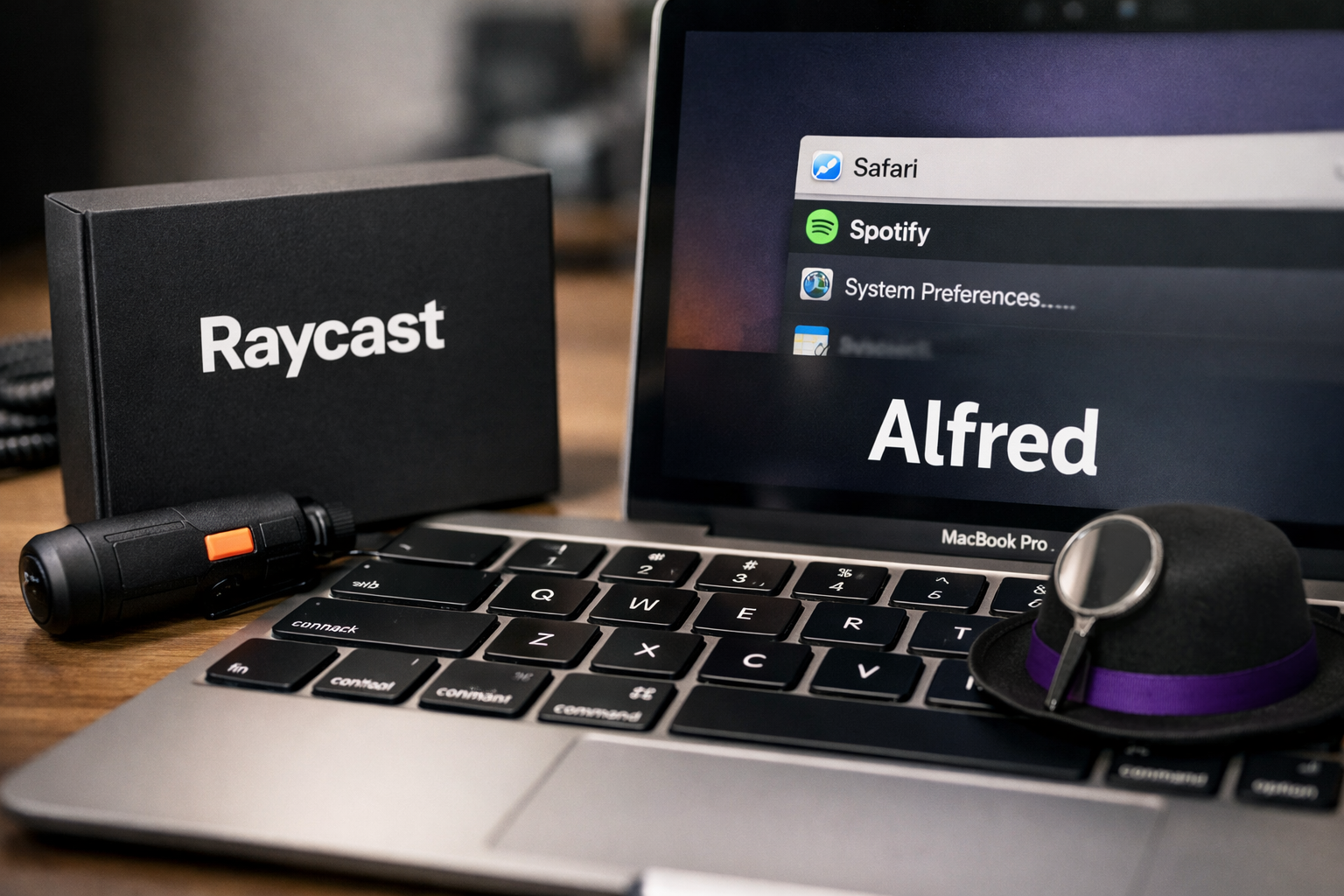
Choosing between raycast vs alfred is less about finding a basic app launcher and more about deciding how you want to work on your Mac. Both are commonly considered by users who want faster app access, keyboard-driven actions, snippets, searches, and repeatable productivity workflows.
This comparison is for Mac users who want a practical answer before changing their daily setup. We will compare value, extensibility, AI, team features, and the workflow factors that matter most when choosing the best Mac launcher for your needs.
Official website · Latest pricing & offers
Raycast vs Alfred: quick verdict for Mac power users
For most people comparing raycast vs alfred, Raycast is the stronger default recommendation. Its $0/month plan includes a broad collection of productivity features, while its paid upgrade creates a clear path to AI, cloud sync, unlimited clipboard history, dictation, and other advanced tools.
Alfred may still be worth evaluating if you already prefer its workflow style or want to compare launcher philosophies before committing. However, Raycast is generally the more compelling starting point for users who want modern capabilities without paying upfront.
Who should choose Raycast
Choose Raycast if you want a launcher that goes beyond opening applications and searching for files. Raycast Free includes Clipboard History, Quicklinks, Calculator, Snippets, Emoji Picker, Window Management, Raycast Notes, Raycast for iOS, thousands of extensions, custom extensions, and developer tooling.
It is especially attractive for users who want to begin with a capable free launcher, then add AI and cloud-based features only if their workflow grows. That makes Raycast for Mac a sensible choice for students, developers, writers, operators, and anyone who works primarily from the keyboard.
Who should still consider Alfred
Alfred remains the main direct Alfred alternative to consider when you are comparing Mac launchers. Some long-time Mac users may prefer its interface, keyboard habits, or established workflow approach.
Because this article does not rely on verified official Alfred feature or pricing documentation, the best approach is to test whether its interaction model feels faster and more natural for your own routine. A launcher only saves time when you genuinely use it every day.
Bottom-line recommendation
In the raycast vs alfred decision, Raycast wins for most new users because it combines a substantial free tier with a defined AI-enabled upgrade path. If you want a modern, feature-rich launcher without immediately paying for premium functionality, you can explore Raycast here.
This article contains affiliate links. If you purchase or subscribe through a link, we may earn a commission at no extra cost to you.
What each app is built to do
At a high level, this mac launcher comparison is about replacing repetitive mouse-driven actions with quick keyboard commands. The right tool should reduce friction when launching apps, accessing information, inserting saved text, managing windows, and triggering frequent actions.
Raycast overview
Raycast is positioned as a productivity tool for Mac users who want a central command interface for everyday work. Its free offering includes essentials such as Clipboard History, Quicklinks, Calculator, Snippets, Emoji Picker, and Window Management, alongside Raycast Notes and Raycast for iOS.
For many people evaluating raycast vs alfred, the important point is the range of built-in and extensible tools. Raycast also offers thousands of extensions, support for custom extensions, and developer tooling, making it suitable for users who want to shape a launcher around their own work.
Raycast Pro extends that foundation with Raycast AI, cloud sync, dictation, translator tools, custom themes, unlimited clipboard history, and custom window management. The result is a platform that can begin as a simple launcher and expand into a broader productivity workspace.
Alfred overview
Alfred is a competing Mac launcher that is frequently mentioned alongside Raycast. It is most relevant for users who want to compare different approaches to keyboard-first navigation and reusable productivity actions.
When researching alfred vs raycast, avoid treating feature lists alone as the final answer. The practical question is whether the launcher’s search behavior, commands, workflow approach, and customization model match the way you think and work on macOS.
Shared use cases
Both tools belong in the same buying conversation because launcher users often want to work faster with fewer context switches. Common needs include finding apps, accessing files or web searches, using text snippets, and carrying out repeatable actions from the keyboard.
The difference in a raycast vs alfred evaluation often comes down to how much you value a broad free feature set, an extension ecosystem, AI assistance, cloud sync, and team-ready options. Your existing habits matter, but so does the future direction of your workflow.
Raycast pricing and plans
The raycast vs alfred cost question is easier to answer on the Raycast side because its official pricing is clearly structured. You can start free, upgrade individually for AI and advanced features, or select a plan designed for teams and enterprise controls.
| Raycast plan | Official price | Best fit | Key included capabilities |
|---|---|---|---|
| Raycast Free | $0/month | Individuals who want core productivity tools | Core launcher tools, extensions, Notes, iOS access, 3 months of Clipboard History |
| Raycast Pro | $8/month, or $96 billed annually | Individuals who want AI and advanced productivity features | 500 AI credits monthly, Raycast AI, unlimited Clipboard History, Cloud Sync, Dictation |
| Teams Pro | $12/user/month, or $144 billed annually | Teams that need shared launcher resources | Pro features plus shared commands, snippets, quicklinks, and private store |
| Enterprise | Custom pricing, billed annually only | Organizations needing advanced governance | SAML, SCIM, allow-lists, enforcement controls, and more |
Raycast Free plan
The Raycast Free plan costs $0/month and is not merely a limited trial. It includes essential productivity tools without AI: Clipboard History, Quicklinks, Calculator, Snippets, Emoji Picker, Window Management, plus many more features.
The raycast free plan also includes Raycast Notes, Raycast for iOS, thousands of extensions, custom extensions, and developer tooling. Clipboard History is retained for up to three months on the Free plan, which is enough for many personal workflows.
This is a major value advantage in the raycast vs alfred conversation because you can establish whether a launcher improves your routine before paying. Users who only need shortcuts, snippets, basic window controls, and extensions may never need to upgrade.
Raycast Pro plan
Raycast Pro costs $8 per month when billed annually, totaling $96 billed annually. The official pricing page shows a monthly equivalent of $120 crossed out alongside the $96 annual price.
Raycast Pro includes everything in Free, plus 500 credits of AI usage each month. It also includes Raycast AI with AI anywhere, files, image generation, tools integration, Screen Awareness, Memory, Profile, and model comparison and management.
For a user comparing raycast vs alfred with AI in mind, Pro is the meaningful dividing line. It additionally provides fast AI models from leading providers, Bring Your Own Key, Cloud Sync, Dictation, Translator, Unlimited Clipboard History, Custom Window Management, and Custom Themes.
Teams Pro and Enterprise
Teams Pro costs $12 per user per month when billed annually, or $144 per user billed annually. It includes everything in Raycast Pro, including 500 credits per user each month, while adding shared commands, snippets, quicklinks, and a private store.
Enterprise uses custom pricing and is billed annually only. Its controls include SAML and SCIM, Domain Capture, MDM sign-in enforcement, Full Cloud Sync Control, Full Dictation Control, 2FA Enforcement, Extensions Allow-List, and IP Allow-List.
These business tiers make the raycast vs alfred choice more relevant for teams than a typical consumer launcher comparison. Organizations can assess whether shared resources and administrative controls justify making Raycast part of a broader productivity standard.
Features comparison: where Raycast stands out
The most useful way to assess raycast vs alfred is to focus on the actions you repeat every day. Raycast’s official feature set is particularly strong for users who want a launcher to act as a flexible productivity hub rather than a narrow search box.
Clipboard History and window management
Clipboard History is one of the features that quickly proves its value during real work. Raycast Free includes three months of Clipboard History, while Pro and Teams Pro include Unlimited Clipboard History.
Window Management is included with Raycast Free, and Pro adds Custom Window Management. For people who constantly switch between browser windows, messaging apps, documents, and terminals, these tools can reduce routine window rearranging.
Store, extensions, and custom extensions
Raycast Free includes thousands of extensions, custom extensions, and developer tooling. That matters because users can add relevant tools to their launcher rather than forcing every task through the same default set of commands.
In a raycast vs alfred comparison, extensibility should be evaluated in practical terms: can you find or build actions for the services you use? Raycast’s official support for both a large extension selection and custom development gives technically minded users room to tailor their setup.
AI tools and workflow automation
Raycast AI is available with Raycast Pro and includes AI anywhere, files, image generation, tools integration, Screen Awareness, Memory, Profile, and model comparison and management. Pro also includes 500 AI usage credits per month and access to fast AI models from leading providers.
This is one of the clearest reasons to choose Raycast if your work includes writing, summarizing, research, ideation, or frequent text transformation. The raycast vs alfred decision changes substantially if built-in AI support is a priority rather than an optional extra.
Raycast Pro also supports Bring Your Own Key, which may appeal to users who want flexibility around their AI setup. The value is not simply having AI available; it is having AI integrated into the same command environment used for the rest of your Mac workflow.
Cloud sync, dictation, and translator
Raycast Pro includes Cloud Sync, Dictation, and Translator, plus Custom Themes. These features are useful for people who want a more personalized environment and who work across devices or regularly convert spoken thoughts into text.
Free users still receive Raycast for iOS and Raycast Notes, while Pro adds a more advanced productivity layer. This staged model makes the raycast vs alfred decision less risky because you can start with free core functionality and upgrade when the added features become genuinely useful.
Official website · Latest pricing & offers
What to look for in Alfred before switching
A fair comparison should not assume that one launcher works best for everyone. Alfred may be a better fit if its style feels more intuitive to you, especially if you have established habits around another launcher environment.
Speed and keyboard-first workflow
Speed is personal in a launcher. Consider how quickly you can remember commands, find the action you need, and return to your main task without interrupting your flow.
When reading an alfred vs raycast Reddit discussion, treat individual opinions as user experiences rather than verified product facts. These discussions can be helpful for identifying workflow preferences, but your own test is more valuable than any broad claim about which launcher is “faster.”
Workflows and automation
Before switching, list the repetitive actions you want to reduce: app launching, text insertion, searches, file-related tasks, window positioning, and service-specific commands. Then assess whether your preferred launcher can make those actions simple enough to become habits.
The raycast vs alfred comparison is not won by the longest feature list. It is won by the tool that removes the most friction from your daily work without requiring excessive setup or memorization.
Pricing/value considerations
Some users strongly prefer a non-subscription pricing model, while others prefer a free entry point with optional paid upgrades. Because no verified official Alfred pricing information is included here, you should check Alfred’s current official terms directly before treating price as a deciding factor.
Raycast’s value proposition is straightforward: Free is $0/month, and Pro is $8/month when billed annually at $96 per year. If subscriptions are a concern, decide whether the AI, cloud sync, and advanced features are worth recurring cost for your own workload.
Raycast vs Alfred: feature-by-feature decision table
This raycast vs alfred table is designed as a decision aid, not an unsupported claim that one tool objectively wins every category. The Raycast column reflects verified product information; the Alfred column describes factors to check during your own evaluation.
| Decision criterion | Raycast | Alfred consideration | Likely better fit |
|---|---|---|---|
| Starting free | $0/month Free plan with core productivity tools, extensions, Notes, and iOS access | Check current official availability and limits directly | Raycast for users wanting verified free value |
| AI-assisted work | Pro includes Raycast AI, 500 monthly credits, AI anywhere, files, and image generation | Evaluate whether AI is important to your workflow and what Alfred currently offers | Raycast for built-in AI needs |
| Clipboard needs | Free includes 3 months; Pro and Teams Pro include unlimited history | Confirm the current clipboard approach that suits you | Raycast for clear official tiers |
| Customization | Thousands of extensions, custom extensions, developer tooling, and custom themes on Pro | Compare how its workflow philosophy feels in practice | Depends on preference |
| Teams | Teams Pro offers shared commands, snippets, quicklinks, and private store | Check whether it matches your team’s collaboration requirements | Raycast for verified team features |
| Governance | Enterprise includes SAML, SCIM, enforcement, and allow-list controls | Verify relevant organization controls directly | Raycast for enterprise requirements |
Best for free users
Raycast is the easier recommendation for free users because the official raycast free plan is clearly defined and broad. You receive core productivity features, extension access, custom extension support, Raycast Notes, and Raycast for iOS at $0/month.
Best for AI-assisted workflows
For AI-assisted work, Raycast is the direct choice based on the verified Pro feature set. Raycast AI, monthly credits, model management, tools integration, and other AI capabilities are built into the Pro offering.
Best for customization
Customization depends on what you mean by it. Raycast provides thousands of extensions, custom extensions, developer tooling, and Pro custom themes, while Alfred users should assess whether its own approach fits their preferred level of configuration.
Best for teams
Raycast has the clearer official team proposition. Teams Pro provides shared commands, snippets, quicklinks, and a private store, while Enterprise adds management and security controls for larger organizations.
Who should pick Raycast
Raycast is ideal for people who want a productive default setup immediately, with room to expand later. It is particularly compelling when you want a tool that combines launching, text utilities, window controls, extension access, and AI in one environment.
You want AI built in
If AI is part of your current workday, Raycast Pro is the better fit in this comparison. Raycast AI includes features for AI anywhere, files, image generation, tools integration, Screen Awareness, Memory, Profile, and model comparison and management.
The raycast vs alfred choice becomes simple when you want those capabilities within your launcher rather than as a separate destination. Pro’s 500 monthly AI credits and Bring Your Own Key option provide a defined starting point for AI-enabled workflows.
You want a strong free plan
Raycast Free is excellent for users who do not need AI yet. You can use Clipboard History, Quicklinks, Calculator, Snippets, Emoji Picker, Window Management, Raycast Notes, iOS access, extensions, and developer tools without a monthly charge.
This makes Raycast one of the more approachable raycast alternatives for users replacing a basic launcher. Start free, learn the command-based workflow, and decide later whether Pro solves a real need.
You want cloud sync and cross-device workflows
Choose Raycast Pro if Cloud Sync matters to you, especially alongside Raycast for iOS. It also adds Dictation, Translator, Unlimited Clipboard History, Custom Window Management, and Custom Themes.
For users who want an all-in-one launcher with a generous free tier and a modern upgrade path, Raycast is worth trying. It is a practical recommendation, not a promise that every feature will matter to every person.
Who should pick Alfred
Alfred may suit users who prefer a different launcher philosophy or who have existing routines that already work well. The goal is not to switch for novelty; it is to choose the environment that makes routine work feel more direct.
You prefer a different launcher philosophy
A launcher is deeply habitual software. If Alfred’s search behavior, visual presentation, or keyboard flow clicks with you more naturally, that preference can be more important than a broad feature checklist.
The best Mac launcher is the one you can use almost unconsciously. Test both tools with the same five or ten real tasks before deciding.
You want to evaluate alternatives carefully
It is reasonable to compare several raycast alternatives before committing. Look beyond screenshots and ask whether you can quickly retrieve copied text, use snippets, access frequent actions, and reduce app-switching in a way that fits your work.
A thoughtful raycast vs alfred test should include the tasks you do repeatedly, not only a few app launches. Try real writing, research, coding, administration, or project-management actions.
You may prefer non-subscription pricing
If avoiding subscriptions is a major priority, Alfred may deserve additional research. Do not assume its current pricing model or capabilities without checking its official website, since those details can change.
Raycast provides a useful compromise for subscription-sensitive buyers: its Free plan costs nothing, and Pro is optional. That lets you receive meaningful utility without paying unless the advanced feature set earns its place in your workflow.
How to decide in 5 minutes
You do not need a week of research to make an initial choice. Use the checklist below to identify the tool that best matches your immediate requirements, then test it with your everyday tasks.
Use-case checklist
Choose Raycast if you want a free launcher with Clipboard History, Quicklinks, Calculator, Snippets, Emoji Picker, Window Management, Notes, iOS access, and extensions. It is also the logical option if custom extensions or developer tooling are important.
Compare Alfred if you want to explore a different keyboard-first launcher experience. Focus on how each tool handles your most common actions rather than trying to learn every possible command on day one.
Budget checklist
For the raycast vs alfred cost decision, start with what you can get for $0/month. Raycast Free delivers substantial core functionality, while Raycast Pro costs $8/month when billed annually, totaling $96 per year.
If you are not sure whether premium features will pay off, begin with Raycast Free. Upgrade only if you need AI, unlimited clipboard history, cloud sync, dictation, translator tools, custom themes, or custom window management.
AI checklist
Choose Raycast Pro when integrated AI matters to your workflow. The plan includes 500 credits each month and Raycast AI features covering AI anywhere, files, image generation, tools integration, Screen Awareness, Memory, Profile, and model management.
If AI is irrelevant to you, do not let it dictate your choice. The core raycast vs alfred decision should still be based on daily comfort, speed, and the actions you need to complete repeatedly.
Official website · Latest pricing & offers
FAQ
Is Raycast better than Alfred for most Mac users?
For most users, Raycast is the better default choice because it has a generous free plan, thousands of extensions, custom extension support, and a modern upgrade path with Raycast AI. Alfred may still suit users who prefer a different launcher style, so personal workflow fit remains important.
Does Raycast have a free plan?
Yes. Raycast Free costs $0/month and includes Clipboard History, Quicklinks, Calculator, Snippets, Emoji Picker, Window Management, Raycast Notes, Raycast for iOS, thousands of extensions, custom extensions, and developer tooling. It includes three months of Clipboard History and does not include AI.
How much does Raycast Pro cost?
Raycast Pro costs $8 per month when billed annually, or $96 billed annually. It includes 500 AI credits per month, Raycast AI, Unlimited Clipboard History, Cloud Sync, Dictation, Translator, Custom Themes, and more advanced features.
Is Raycast worth paying for?
Raycast Pro is worth paying for if you will regularly use Raycast AI, unlimited clipboard history, cloud sync, dictation, translator features, or custom window management. For users who mainly need core launcher and productivity tools, Raycast Free is strong enough to remain a practical long-term option.
Can I use Raycast for teams?
Yes. Teams Pro costs $12 per user per month when billed annually, or $144 per user annually. It includes everything in Pro, 500 AI credits per user each month, shared commands, snippets, quicklinks, and a private store.
What is the best alternative to Raycast?
Alfred is the main direct alternative discussed in this comparison. The right choice depends on whether you value Raycast’s free plan, AI features, extensions, cloud sync, and team capabilities, or prefer a different launcher workflow philosophy.
Final verdict
The outcome of the raycast vs alfred comparison is clear for most Mac power users: Raycast is the best overall starting point. Its Free plan is genuinely useful, its Pro plan adds a practical AI and productivity upgrade path, and Teams Pro provides a credible option for shared workflows.
Best overall
Raycast is the best overall choice for users who want an extensible Mac launcher with strong free functionality and modern premium features. It covers common productivity needs without requiring an immediate subscription.
Best value
Raycast Free offers the best value for users who want useful launcher tools, Clipboard History, snippets, window management, Notes, iOS access, and extensions at $0/month. It is easy to recommend because users can evaluate its impact before spending anything.
Best for advanced workflows
Raycast Pro is the stronger option for advanced workflows that need AI, cloud sync, unlimited clipboard history, dictation, translator tools, and customization. While Alfred may remain a valid preference-driven option, Raycast is the better choice for most readers because of its free plan and AI-enabled path forward—provided those capabilities match how you actually work.
Related Reading
- Is Rezi Free in 2026? What You Get
- Local Falcon Pricing 2026: Plans Explained
- Trustindex Price 2026: Plans, Costs, and Best Value
References
- Raycast official homepage
- Raycast pricing page
- Raycast: Why are people choosing Raycast over Alfred?
- Josh Collinsworth: Alfred vs. Raycast: my constant debate