
5 Best Tally Alternatives in 2026

Tally remains one of the most compelling form builders for users who value a clean, Notion-style editor and an unusually capable free plan. Still, the best tally alternatives can be a better fit when your forms need more visual control, deeper workflow automation, stronger brand presentation, or a more specialized experience for clients and teams.
This guide ranks five practical options for creators, marketers, freelancers, and growing businesses. Rather than claiming one tool wins everywhere, we focus on where each platform makes more sense than Tally—and where Tally is still difficult to beat.
Official website · Latest pricing & offers
Quick verdict: the 5 best Tally alternatives in 2026
Here is the short version for readers comparing form builder alternatives quickly.
| Rank | Alternative | Best for | Main reason to consider it |
|---|---|---|---|
| 1 | Fillout | Most users needing polished forms and workflows | A modern balance of flexibility, presentation, and workflow fit |
| 2 | Jotform | Automation-heavy and operational forms | Broad feature depth for detailed business processes |
| 3 | Typeform | Branded lead generation and surveys | Conversational, presentation-focused respondent experience |
| 4 | Fomr | Design-conscious creators | More layout and style emphasis than a document-style editor |
| 5 | Google Forms | Simple no-cost data collection | Familiar, straightforward, and easy for basic internal use |
Best overall alternative
Fillout is our top pick among the best tally alternatives for users who want a modern form experience without moving into an overly complicated system. It is particularly worth evaluating if Tally’s editor feels a little too document-like for your customer-facing forms.
Tally is still a strong free choice for unlimited forms and submissions. Fillout earns its place because it can appeal to users who want their forms to feel more like a designed part of a workflow, rather than a standalone questionnaire.
Best for automation-heavy workflows
Jotform is the stronger candidate for businesses that treat forms as the starting point of an operational process. Think intake workflows, registrations, approvals, applications, and information collection that needs to move through a team.
For a reader seeking the best form builder for automation, Jotform is often worth shortlisting alongside Tally. Its trade-off is that greater feature depth can require more setup and more deliberate template selection.
Best for design control and branding
Typeform is the leading choice here for marketers and creators who care deeply about how a form feels to complete. Its conversational approach can make lead-generation forms, feedback surveys, and quizzes feel more intentional than a traditional form layout.
Among the best tally alternatives, Typeform is not necessarily the practical winner for every internal workflow. But it is a credible Typeform alternative comparison point when polished brand perception is a priority.
Best for complex forms and advanced features
Jotform also deserves attention for complex business use cases, but Fomr is the more focused recommendation for users who want to explore design-led form creation. It is a useful option when your main reason for leaving Tally is a desire for greater control over page composition and form styling.
This distinction matters: not every form needs advanced operational complexity. Some simply need to look more on-brand and feel less like a document.
Best free/simple option
Google Forms remains a sensible choice for basic surveys, lightweight registrations, and internal requests. It may suit a team that already works heavily in Google’s ecosystem and needs something everyone recognizes immediately.
However, it is not the best free form builder for every situation. Creators and client-facing businesses will often find Tally’s free offering more compelling because Tally includes unlimited forms and submissions, along with features such as conditional logic, calculations, payment collection, and integrations.
Why people look for Tally alternatives
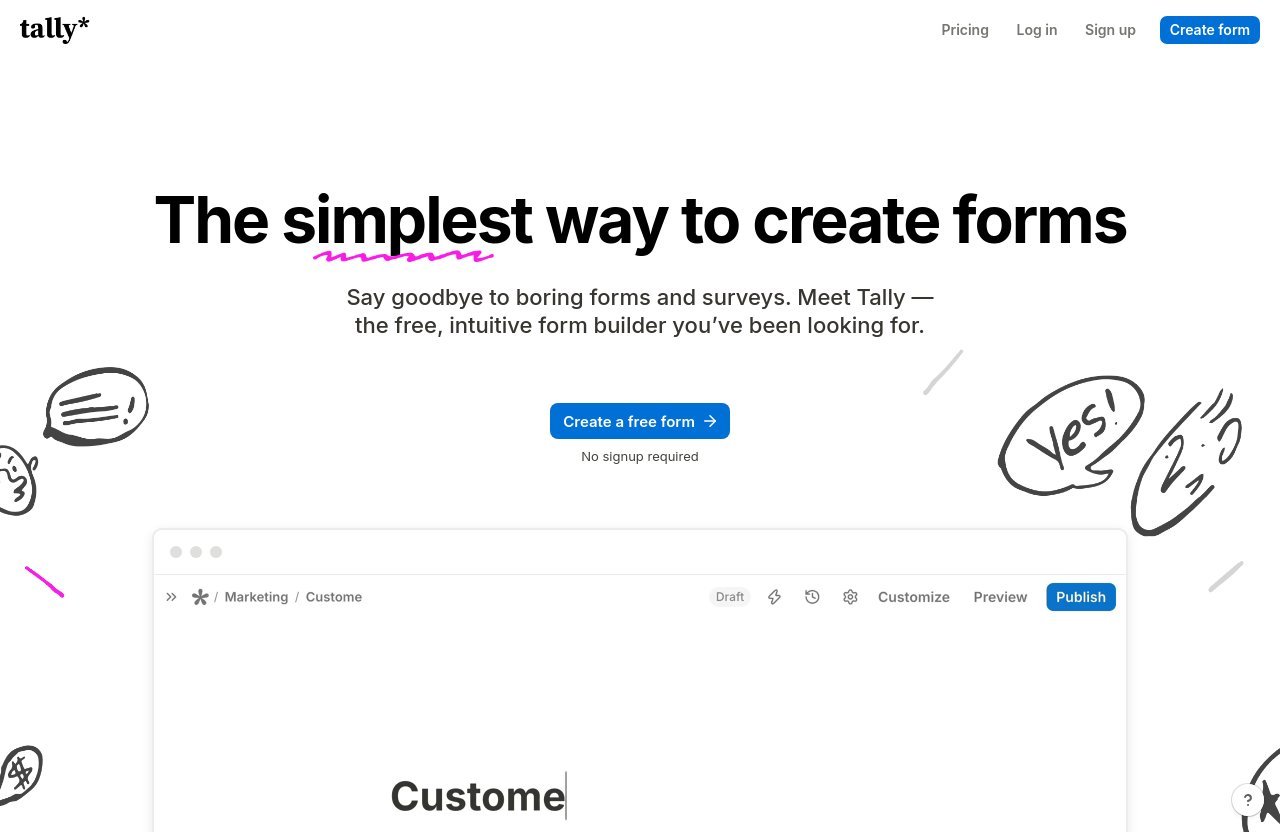
Tally is not a weak product that users must replace. Its official positioning is clear: a simple, no-code, Notion-style form builder with unlimited forms and submissions on the free plan, GDPR compliance, Europe-hosted data, no cookie tracking, and encryption in transit and at rest.
Most people researching the best tally alternatives are not abandoning those benefits. They are deciding whether another interface, workflow style, or brand experience is better for their next stage of growth.
Need more visual design control
Tally’s document-inspired editing experience is fast and approachable. For many people, that is the point.
Yet a marketing team may want more control over how a form is structured visually, especially when it sits on a campaign landing page or represents a premium service. This is where a design-oriented option such as Fomr or a conversational platform such as Typeform can be more attractive.
Need deeper automation and integrations
A simple lead-capture form can work perfectly in Tally. But once a submission starts a multi-step process—routing requests, collecting approvals, generating documents, or moving details between systems—some users prefer a platform built around more extensive business-form workflows.
Jotform is the clearest option in this group. The right choice depends on the workflow you are trying to build, so compare the integrations and actions you actually need instead of assuming every form tool has exact feature parity.
Need stronger branding and custom domains
Professional branding is not only about removing a platform logo. It includes layout, typography, visual rhythm, tone, and whether the form feels consistent with the rest of your site.
Tally Pro includes branding-related capabilities such as removing Tally branding, custom domains, advanced customization, custom CSS, custom email domains, and link-preview customization. Still, some users reviewing best tally alternatives prefer tools whose core experience is more presentation-first from the start.
Need team collaboration or analytics
As forms become a shared asset, teams need orderly ownership and visibility. They may want colleagues to collaborate, understand where respondents leave a form, or preserve versions while campaigns and processes evolve.
Tally Pro includes unlimited team members in shared workspaces, workspaces and folders, visit analytics, drop-off analytics, and version history up to 30 days. Business expands version history up to 90 days and adds data-retention controls and email verification. The question is not whether Tally has team functionality; it is whether its approach matches your team’s working style.
Need a different free-plan experience
Searches for “tally alternatives free,” “best tally alternatives free,” and “tally alternatives reddit” often reveal a common concern: users want useful free functionality without an immediate commitment.
Tally is exceptionally competitive here because its free plan includes unlimited forms and submissions. Google Forms is a practical no-cost option for simplicity, while other form builders may appeal for their interface or workflow positioning. Always check a provider’s current plan page before choosing based on free-plan access, since competitor plans can change.
How we chose these Tally alternatives
This ranking is an editorial comparison, not a claim that these are the only viable tools. We selected recognizable form builder alternatives that serve meaningfully different needs.
Evaluation Criteria for Best Tally Alternatives
We assessed each option based on practical buying factors:
- Ease of building and publishing forms
- Visual flexibility and respondent experience
- Suitability for conditional questions and multi-step workflows
- Business and team use cases
- Integration and automation potential
- Free-plan value and pricing transparency
- Fit for lead capture, surveys, registrations, payments, and internal processes
We also considered whether the product solves a clear reason someone might switch from Tally rather than simply duplicating its strengths.
What we prioritized
We prioritized user fit over generic feature checklists. A freelancer collecting client briefs has different needs from a marketer running high-visibility campaigns or an operations team managing applications.
Where competitor comparisons are based on general market positioning rather than exact specification parity, we state that clearly. We have only used the verified Tally details supplied for specific pricing and plan claims in this article.
What we did not prioritize
We did not rank tools based on vague claims such as “most powerful” or “best value” without a defined use case. We also did not include a tally prime alternative in this list because Tally and TallyPrime address different categories: this article is about online form-building software, not accounting software.
If you are comparing other software categories, our guides to Raycast vs Alfred: Which Is Better for Mac Power Users? and Is Rezi Free in 2026? use the same decision-first approach.
1. Fillout
Why It Stands Out Among Best Tally Alternatives
Fillout is the best overall alternative for many users because it sits in a useful middle ground. It can appeal to people who want a polished form-building environment and a stronger workflow-oriented feel, without necessarily needing the broadest possible business-form toolkit.
Its comparison with Tally is most relevant when appearance, data collection, and downstream actions all matter. Fillout’s public comparison positioning emphasizes a modern alternative path for users evaluating Tally, but you should verify current capabilities directly against your own workflow before migrating.
Best use cases
Fillout is a practical fit for:
- Lead-capture forms that need a refined presentation
- Client intake forms for freelancers and agencies
- Application and registration flows
- Surveys requiring a more designed experience
- Teams connecting forms to broader processes
It is especially suitable for users who like Tally’s accessibility but want to test a form builder with a different balance of customization and workflow design.
Pros and trade-offs
Strengths: polished positioning, broad appeal across marketing and operations use cases, and a natural upgrade path for users who need more than a basic form.
Trade-offs: if you already rely on Tally’s free unlimited forms and submissions, switching should solve a specific problem. Do not migrate merely because another builder looks different; test a real form and assess completion experience, integrations, and administration first.
2. Jotform
Why It Stands Out Among Best Tally Alternatives
Jotform is one of the most established names to consider when forms are central to business operations. It is a strong Jotform alternative comparison point for users who need templates, detailed form scenarios, and a mature ecosystem rather than Tally’s intentionally streamlined editor.
In this ranking, Jotform is the choice for feature-minded buyers. It is not necessarily the simplest platform, but that is often the appeal for teams building forms that must support more involved processes.
Best use cases
Jotform is a sensible shortlist candidate for:
- Detailed client or patient intake processes
- Registrations and application workflows
- Internal request forms and approvals
- Organizations managing several types of forms
- Businesses that prefer starting from templates
For these use cases, the best tally alternatives are not about replacing simplicity with complexity for its own sake. They are about choosing a tool that has the right depth for the job.
Pros and trade-offs
Strengths: mature form-builder positioning, broad template appeal, and a better fit for users who expect forms to support a variety of business processes.
Trade-offs: the platform may feel more expansive than necessary for a solo creator with one simple contact form. Tally can be the more pleasant option when speed, a clean editor, and generous free access are the priorities.
Official website · Latest pricing & offers
3. Typeform
Why It Stands Out Among Best Tally Alternatives
Typeform remains notable for its conversational approach to questions. Instead of presenting respondents with a standard form-first experience, it is commonly chosen by brands that want surveys, quizzes, and lead forms to feel more guided and interactive.
That makes Typeform one of the best tally alternatives for marketing-facing work. If the form itself is part of the customer experience, a presentation-led tool can be worth considering.
Best use cases
Typeform is best suited to:
- Brand surveys and customer feedback
- Qualifying leads before a sales conversation
- Interactive quizzes
- Creator audience research
- Campaign forms where completion experience matters
It can also make sense for agencies delivering polished assets to clients. The visual experience is often the reason to choose it, not the need to run an internal request form.
Pros and trade-offs
Strengths: strong conversational positioning and a distinctive respondent experience that can suit premium brand campaigns.
Trade-offs: the best visual experience is not automatically the best operational experience. Before choosing a Typeform alternative or Typeform itself, consider whether your form needs a flowing one-question-at-a-time interaction or a more direct, information-dense layout.
4. Fomr
Why It Stands Out Among Best Tally Alternatives
Fomr deserves a place for users who view forms as designed web experiences rather than digital paperwork. It is particularly relevant if Tally’s simple document-style editor is efficient for you but does not give you the creative direction you want for public-facing work.
The distinction is useful. Tally emphasizes writing and building quickly, while Fomr is worth exploring when visual layout and style are key decision factors.
Best use cases
Fomr may fit:
- Portfolios and creator websites
- Brand-consistent contact and inquiry forms
- Campaign landing-page forms
- Freelancers who want client forms to feel more customized
- Small businesses that care about visual differentiation
For users searching “tally alternatives india,” the same selection logic applies: focus on your audience, payment and data needs, and local business workflow rather than assuming a popular international tool is automatically the best fit.
Pros and trade-offs
Strengths: design-led appeal and a relevant alternative for users whose main pain point is visual control.
Trade-offs: it may not be the first choice for teams prioritizing broad operational form complexity. If automation-heavy processes are your core concern, compare Fomr alongside Jotform or Fillout rather than selecting based on visual presentation alone.
5. Google Forms
Why It Stands Out Among Best Tally Alternatives
Google Forms is the no-friction option. It is widely recognized, straightforward to share, and appropriate when the goal is collecting responses quickly without turning the form into a branded digital experience.
It belongs among the best tally alternatives because many readers do not need a feature-rich replacement. They simply need a dependable, familiar tool for basic data collection.
Best use cases
Google Forms is a sensible option for:
- Internal employee questionnaires
- Simple event sign-ups
- Classroom or community surveys
- Basic feedback collection
- Informal team requests
It is especially practical when every respondent already works with Google tools and presentation is not a major concern.
Pros and trade-offs
Strengths: familiarity, simplicity, and a low learning curve.
Trade-offs: it is less compelling for polished lead generation, brand differentiation, and sophisticated business-facing experiences. In many cases, Tally’s free plan is a more capable free alternative because it includes unlimited forms and submissions plus payments, signatures, file uploads, logic, calculations, and integrations.
Tally vs the best alternatives: which one should you choose?
The correct choice depends on the kind of form you are building, who completes it, and what happens after submission.
Choose Tally if you want simplicity and generosity
Choose Tally if you want a fast, clean, no-code form builder and do not want to compromise on core capabilities just because you are using a free plan. Its verified free offering includes unlimited forms and submissions, payments, signatures, uploads, conditional logic, calculations, Google Sheets, Notion, Airtable, Zapier, Make, and webhooks.
For many freelancers and small businesses, that is enough to avoid paying for another platform. It is also an excellent fit if you prefer a Notion-like content-writing experience over a design canvas.
Choose an alternative if you need branding control
Choose Typeform when respondent experience and a guided, conversational feel are central to your campaign. Choose Fomr when your form’s layout and visual style need more attention than a document-style approach provides.
Fillout is a strong middle-ground choice for users who want a modern, polished experience without centering the decision entirely on conversational forms. These best tally alternatives are most useful when the form is visible to prospects, customers, or a client’s audience.
Choose an alternative if you need advanced workflows
Choose Jotform when forms are a major operational system rather than a lightweight entry point. Its broader business-form positioning may be a better match for diverse applications, intake processes, and structured workflows.
Before switching, map your actual submission journey: who receives the data, where it goes next, what must happen automatically, and which team member owns it. This simple exercise often makes the best form builder for automation obvious.
For WordPress-specific forms, a dedicated plugin comparison such as WPForms Lite vs Pro may also be more useful than choosing a standalone hosted form builder.
Pricing and free plan comparison
Pricing can change, so this section limits specific plan and price claims to verified Tally details. For alternatives, review their official pricing pages before committing.
What Tally’s free plan includes
Tally’s free plan includes unlimited forms and unlimited submissions. It also supports collecting payments, signatures, and file uploads; custom Thank You pages; self-email notifications; redirects on completion; conditional logic and calculations; duplicate-submission prevention; password protection; form closing by limit or date; answer piping; 45+ languages and RTL support.
The free plan also includes Google Sheets, Notion, Airtable, Zapier, Make, and webhook integrations. This is why Tally remains a serious contender in searches for “best tally alternatives free”—it sets a high bar for free-plan utility.
What Pro adds
Tally Pro costs $24 per month and includes everything in Free. It adds the ability to remove Tally branding, use custom domains, collaborate with unlimited team members in shared workspaces, save partial submissions, access advanced customization and custom CSS, use email notifications and custom email domains, customize link previews, organize workspaces and folders, allow unlimited uploads, and view form visit and drop-off analytics.
Pro also includes version history up to 30 days and premium integrations for Google Analytics and Meta Pixel. Tally Business costs $74 per month and adds data-retention controls, email verification, and version history up to 90 days, alongside future additions.
How alternatives typically differ
Alternative platforms often distinguish themselves through a more specialized interface, workflow style, template selection, or design philosophy. That does not automatically make them better value.
When comparing the best tally alternatives, start with the form you need today, then assess the cost of branding, collaboration, analytics, and automation as you grow. For related plan-by-plan buying research, see our guides to Trustindex Price 2026: Plans, Costs, and Best Value and Alohi Pricing 2026: Plans, Costs & Value.
Official website · Latest pricing & offers
FAQ
Is there any better software than Tally?
There can be, depending on what “better” means for your project. Fillout may be better for users seeking a polished alternative, Jotform may suit complex business workflows, Typeform can be stronger for conversational branding, and Fomr can appeal to design-focused creators.
However, Tally remains excellent for simple and capable forms, especially because its free plan includes unlimited forms and submissions. The best choice is the one that fits your workflow rather than the one with the longest feature list.
Is there another app like Tally?
Yes. Fillout, Jotform, Typeform, Fomr, and Google Forms are all comparable form builders, although each has a different emphasis. The closest fit depends on whether you care most about workflow depth, branded presentation, visual control, or no-cost simplicity.
These tools are better described as alternatives than exact clones. Their editors and respondent experiences can feel very different from Tally’s Notion-style approach.
What are some good alternatives to Tally forms?
The strongest options are Fillout for an all-around modern form experience, Jotform for detailed business use cases, Typeform for presentation-led surveys and lead forms, Fomr for design control, and Google Forms for basic internal collection.
For most people assessing best tally alternatives, Fillout is the most balanced first comparison. For users who need unlimited forms and submissions with a clean editor, Tally itself may still be the better answer.
Is Tally outdated now?
No. Tally is still a modern, competitive form builder with a strong free plan, GDPR compliance, Europe-hosted data, no cookie tracking, and encrypted data in transit and at rest.
Some teams simply outgrow its editor or require a different approach to visual design, analytics, collaboration, or advanced workflows. That is a fit issue, not evidence that Tally is outdated.
Final recommendation
Best for most users
Fillout is the best starting point for users who want to compare Tally with a polished, modern alternative that may better suit customer-facing forms and broader workflow needs. It is the most balanced choice in this ranking.
Best for teams
Jotform is the more logical choice when forms are embedded in operational processes and teams need a deeper business-form environment. Typeform and Fomr are better considered when presentation and design are the primary drivers.
Best for creators
Tally is still the recommendation for creators, freelancers, and lean businesses that want fast form creation with generous free functionality. If its Notion-style workflow feels right and you do not need a more specialized interface, you may not need to switch at all.
For that audience, it is worth reviewing Tally’s current options before paying for another form builder. The best tally alternatives solve real niche needs, but Tally remains one of the strongest overall values when simplicity, unlimited forms, and flexible core features matter most.
Related Reading
References
- Best Tally alternatives: 6 form builders worth considering
- Tripetto – A free Tally alternative
- Fillout: the free Tally alternative
- Best Tally Alternatives & Competitors in 2026