Rss.com vs Podbean: Which Podcast Host Is Better for Creators?

Choosing a podcast host is not just a technical decision. It affects how you publish episodes, track growth, build revenue, and scale from a solo show into a larger media project. In this rss.com vs podbean comparison, RSS.com is the stronger recommendation for most new podcasters because its verified free plan is genuinely free with no expiration, while its paid tiers clearly show what you get as your needs grow.
Podbean is an established podcast host and a common alternative worth considering, especially for people who already use it. However, because verified competitor pricing and feature documentation were not provided for this comparison, the fairest approach is to evaluate RSS.com on confirmed facts rather than make unsupported feature-for-feature claims about Podbean.
Official website · Latest pricing & offers
RSS.com vs Podbean: Quick Verdict for Podcasters
For most beginners, solo creators, and small teams, RSS.com is the better starting point. It offers a $0/month plan with no trial or expiration, unlimited episodes, unlimited audio, unlimited downloads, a free podcast website, listener donations, and publishing to Apple Podcasts, Spotify, and more.
The biggest advantage in this rss.com vs podbean decision is clarity. RSS.com has transparent plan pricing, a usable free tier, and defined upgrade paths for ads, subscriptions, multiple podcasts, team access, video publishing, and API access.
| Buying factor | RSS.com | Podbean |
|---|---|---|
| Free starting option | Verified $0/month plan with no expiration | Official plan details were not provided for verification |
| Hosting limits on free plan | Unlimited episodes, audio, and downloads | Not compared without verified specifications |
| Distribution | Publish to Apple Podcasts, Spotify, and more | Established host, but exact distribution details are not verified here |
| Monetization | Donations, automatic ads on Plus, Apple Podcasts paid subscriptions, and video ad revenue on Max | Do not assume options without current official plan verification |
| Team and multi-show scaling | Pro supports up to 10 podcasts and unlimited team members | Not compared without verified specifications |
| Paid-plan protection | Cancel anytime and 30-day money-back guarantee | Not compared without verified terms |
> Short verdict: RSS.com is the cleaner choice for buyers who want a no-risk start and a transparent route to growth. Podbean may still make sense for existing users who prefer staying with their current workflow.
Best for beginners who want simplicity
In a practical rss.com vs podbean evaluation, beginners should prioritize low risk and enough room to publish consistently before paying for advanced tools. RSS.com Free is compelling because it does not expire, is not a limited trial, and includes unlimited episodes, audio, and downloads.
That means a new creator can focus on recording and releasing episodes rather than worrying about hitting a basic hosting ceiling. The free website, listener donation option, and download tracking also create a more complete starting foundation than a bare upload account.
Best for creators who want monetization early
Creators who want to turn audience attention into income have a clear RSS.com upgrade path. RSS.com Plus includes automatic ads with as few as 10 downloads, paid subscriptions on Apple Podcasts, and AI-generated transcripts.
For a rss.com vs podbean buyer focused on podcast monetization, those verified options are easier to assess than vague promises. You can start free, validate the show, then move to Plus when ads, subscriptions, transcripts, advanced analytics, and unlimited voicemails become useful.
When Podbean may still be worth a look
Podbean remains a reasonable podcast host to consider because it is an established name in the category. If you already have a show hosted there, have routines built around it, or simply prefer its interface after testing it, switching may not be necessary.
Still, new buyers comparing rss.com vs podbean should not assume that staying with a familiar brand is automatically the best value. Review current plan pages, migration requirements, and the exact tools you need before committing.
What RSS.com Actually Offers: Verified Pricing and Features
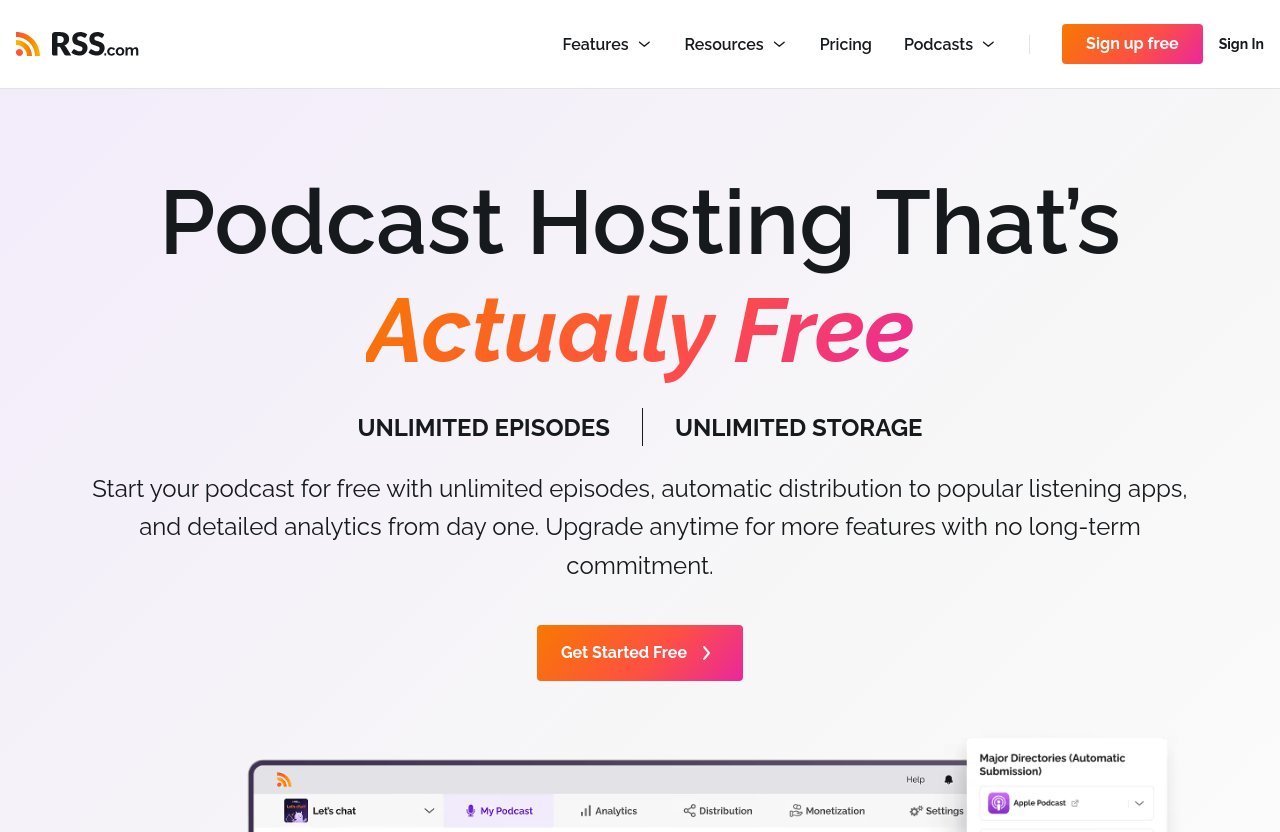
A trustworthy rss.com review should separate verified product details from assumptions. The following RSS.com pricing and feature information is based on the provided official product facts.
All paid RSS.com plans can be canceled anytime and include a 30-day money-back guarantee. Annual billing saves 25% compared with the listed monthly plan price.
Free plan
RSS.com Free costs $0/month. It is not a trial, has no expiration date, and gives creators unlimited episodes, unlimited audio, and unlimited downloads.
The RSS.com free plan also includes publishing to Apple Podcasts, Spotify, and more, plus a free website for your podcast. You can accept listener donations and track downloads and podcast growth.
For many people researching rss.com vs podbean, this is the most important differentiator: RSS.com allows you to launch and continue publishing without an initial monthly hosting bill.
Plus plan
RSS.com Plus costs $19.99 per month on monthly billing. It costs $15 per month when billed annually, or $180 billed annually, which represents a 25% savings.
Plus includes everything in Free, then adds:
- Automatic ads with as few as 10 downloads
- Paid subscriptions on Apple Podcasts
- YouTube videos created from audio episodes
- AI-generated transcripts
- Advanced analytics
- Unlimited voicemails
For a solo creator comparing rss.com vs podbean for revenue potential, Plus is the first paid tier to examine. It is designed for shows that want to go beyond publishing and begin using ad access, subscriber options, and richer audience insight.
Pro plan
RSS.com Pro costs $34.99 per month on monthly billing. With annual billing, it costs $26 per month, or $312 billed annually, saving 25%.
Pro includes everything in Plus and adds the ability to host up to 10 podcasts. It also includes unlimited team members, all-time analytics for every show, automatic transcripts for every episode, and the ability to keep 70% of ad revenue with PAID.
This plan is particularly relevant in a podcast hosting comparison for producers, small networks, and teams that need more than one show under one account structure.
Max plan
RSS.com Max costs $49.99 per month when billed monthly. It costs $37 per month with annual billing, or $444 billed annually, also reflecting a 25% annual-billing savings.
Max includes everything in Pro, along with unlimited audio and video podcasts. One upload publishes to Apple Podcasts and YouTube, and the plan includes 70% of video ad revenue plus full API access.
For creators considering rss.com vs podbean with a video-first roadmap, Max offers a verified publishing workflow that joins audio and video podcast needs in a single plan.
Who each plan is for
| RSS.com plan | Verified price | Best fit |
|---|---|---|
| Free | $0/month | Beginners and hobby podcasters who want unlimited hosting without an expiration date |
| Plus | $19.99/month or $15/month annually | Solo creators exploring ads, subscriptions, transcripts, and advanced analytics |
| Pro | $34.99/month or $26/month annually | Teams, producers, and creators managing up to 10 podcasts |
| Max | $49.99/month or $37/month annually | Video podcasters, larger operators, and users who need API access |
Verdict: RSS.com pricing is easy to understand because the free tier is clearly defined and every paid tier adds identifiable capabilities. That transparency is valuable when choosing the best podcast hosting platform for a growing show.
How RSS.com Compares to Podbean on the Factors That Matter Most
The most responsible way to handle rss.com vs podbean is to compare verified RSS.com strengths against the questions every buyer should ask. Podbean is a recognized podbean alternative to consider, but its exact current specifications should be confirmed directly before you make a final choice.
Pricing transparency
RSS.com publishes a straightforward free option and three paid tiers with monthly and annual pricing. The annual plans save 25%, and the annual totals are clearly stated: $180 for Plus, $312 for Pro, and $444 for Max.
In the podbean vs rss.com choice, compare the total annual cost rather than only the lowest monthly figure. Also check whether a competitor’s advertised price requires a long commitment or excludes tools you expect to use.
Free plan value
RSS.com Free has no trial period and no expiration. It includes unlimited episodes, unlimited audio, unlimited downloads, distribution to Apple Podcasts, Spotify, and more, a free site, listener donations, and download tracking.
That makes RSS.com a strong option for someone seeking the best podcast host for beginners. You can test your consistency and audience interest without being pushed into a paid plan just to keep old episodes available.
Storage and episode limits
RSS.com explicitly provides unlimited episodes, unlimited audio, and unlimited downloads on its Free plan. This is a meaningful point in any rss.com vs podbean comparison because episode limits and download limits can affect the real cost of hosting over time.
Before choosing any host, read the fine print around storage, bandwidth, archived content, and video. Do not assume “unlimited” means the same thing across providers; confirm what each company currently defines in its plan terms.
Distribution and setup
RSS.com Free supports publishing to Apple Podcasts, Spotify, and more. RSS.com Max goes further by allowing one upload to publish to Apple Podcasts and YouTube.
For podcast distribution, the practical question is whether the platform supports the destinations that matter to your audience. RSS.com’s confirmed distribution options make it a sensible choice for creators who want to reach major listening platforms without starting with a paid account.
Monetization options
RSS.com supports listener donations on the Free plan. Plus adds automatic ads with as few as 10 downloads and paid subscriptions on Apple Podcasts, while Pro includes keeping 70% of ad revenue with PAID.
Max adds 70% of video ad revenue. This gives the rss.com vs podbean buyer several verified monetization paths, from voluntary audience support to ads, subscriptions, and video revenue.
Analytics and growth tools
RSS.com Free includes download and podcast-growth tracking. Plus adds advanced analytics, while Pro provides all-time analytics for every show and automatic transcripts for every episode.
This progression is useful because not every creator needs advanced reporting on day one. As a show matures, access to deeper analytics and transcripts can become more relevant to planning, promotion, and team collaboration.
Verdict: RSS.com wins on verifiable value, especially for free hosting, transparent upgrade pricing, and clearly stated growth tools. Podbean may be worth testing as an established alternative, but buyers should verify its live plan details independently.
Official website · Latest pricing & offers
Best Use Cases: Which Podcasters Should Choose RSS.com?
RSS.com is not only for one type of creator. Its tiered structure makes it a practical fit for beginners, independent hosts, small podcast networks, and video-focused publishers.
First-time podcasters
A first-time host should usually begin with RSS.com Free. The plan costs $0/month, never expires, and supports unlimited episodes, audio, and downloads.
That lowers the pressure to monetize before you have learned how often you can publish. In the rss.com vs podbean decision, a no-expiration free option gives beginners more room to experiment responsibly.
Solo creators monetizing early
Solo creators who have started building a listener base can look at RSS.com Plus. Its automatic ads with as few as 10 downloads, paid subscriptions on Apple Podcasts, advanced analytics, and AI-generated transcripts create a clear next step.
Plus also includes unlimited voicemails and the ability to create YouTube videos from audio episodes. These tools can help an independent host add audience interaction and repurpose episodes without moving to a multi-show plan.
Podcast networks and teams
RSS.com Pro is the strongest fit for teams and small networks. It supports up to 10 podcasts and unlimited team members, making it appropriate when production involves more than one host, editor, producer, or show.
All-time analytics for every show can be especially useful for operators reviewing a full catalog. For a small network weighing rss.com vs podbean, Pro is a clearly defined option for consolidating multiple podcasts.
Video podcasters
RSS.com Max is the plan for creators who want unlimited audio and video podcasts. Its one-upload publishing to Apple Podcasts and YouTube is a major practical benefit for shows that publish in both formats.
Max also includes 70% of video ad revenue and full API access. It is best suited to creators who already have, or expect to build, a repeatable video podcast workflow.
Agency-style operators
Agency-style operators should consider RSS.com Pro or Max depending on whether video and API access are necessary. Pro covers up to 10 podcasts and unlimited team members, while Max adds unlimited audio and video podcasts plus full API access.
| Creator situation | Recommended RSS.com plan | Why |
|---|---|---|
| Launching a first podcast | Free | No expiration, unlimited episodes, unlimited audio, and unlimited downloads |
| Earning from a solo show | Plus | Ads, Apple Podcasts subscriptions, advanced analytics, and transcripts |
| Running a small network | Pro | Up to 10 podcasts, unlimited team members, and all-time analytics |
| Publishing audio and video | Max | Unlimited audio and video podcasts, Apple Podcasts and YouTube publishing, API access |
Verdict: RSS.com is especially strong for buyers who want to begin free and upgrade only when their show requires monetization, multiple podcasts, team access, or video distribution.
Where Podbean May Appeal More
A balanced rss.com vs podbean review should acknowledge that changing podcast hosts is not always the right move. Podbean may appeal to users whose current setup already works for them.
If you already use Podbean
If your show is already hosted on Podbean and you are comfortable with the workflow, staying where you are can be reasonable. A migration takes planning, and there is little value in changing platforms solely because another host has a different pricing structure.
Review what you currently pay, what features you actively use, and whether your existing arrangement meets your publishing goals. If it does, continuity can be valuable.
If your workflow is built around an existing host
Podcasting workflows often include established routines for editing, publishing, team handoffs, and audience communication. If those routines are built around your current host, consider the time cost of moving before switching.
That said, creators who are not yet deeply invested may find RSS.com easier to evaluate because its plan inclusions and pricing are clearly laid out. This is why RSS.com remains the better default recommendation for new buyers.
If you want to compare interface preferences
Interface preference is personal. Some creators may prefer Podbean’s interface, while others may prefer RSS.com’s workflow after trying it.
The best approach is to test what you can, compare the current official pages, and avoid selecting a platform based only on brand familiarity. In the rss.com vs podbean choice, the most suitable platform is the one that matches your actual publishing needs and budget.
Hidden Cost Checklist Before You Choose a Podcast Host
A podcast host can look inexpensive until you need more uploads, more shows, team permissions, monetization tools, or video support. Use this checklist before committing.
Free plan catch-check
Ask whether a free plan is a trial, whether it expires, and whether it limits episodes, audio, downloads, or distribution. RSS.com Free is confirmed to cost $0/month with no trial and no expiration, while including unlimited episodes, unlimited audio, and unlimited downloads.
Also check whether a free account includes a podcast website, analytics, or a way to receive audience support. RSS.com includes a free website, download tracking, podcast growth tracking, and listener donations.
Monthly vs annual billing
Always compare total annual cost. RSS.com Plus, Pro, and Max each save 25% when billed annually, but annual billing also means a larger upfront payment: $180, $312, and $444 respectively.
Monthly billing can be useful when you are still validating a show or testing a workflow. Annual billing can make more sense when you are confident that the selected plan will remain appropriate for the year.
Monetization lockups
Do not assume all podcast monetization tools are available at every level. With RSS.com, listener donations are available on Free, while automatic ads with as few as 10 downloads and Apple Podcasts paid subscriptions are part of Plus.
For every host you consider, check the exact plan required for ads, subscriptions, revenue sharing, and video monetization. This prevents an unpleasant upgrade surprise after your audience begins to grow.
Migration risk
Changing hosts can require time, testing, and careful communication. Before moving, confirm how episodes, analytics history, website URLs, and distribution feeds will be handled.
This matters whether you move from Podbean to RSS.com or in the other direction. If you are launching from scratch, choosing a transparent platform now can reduce the chance of a disruptive move later.
Support and ease of use
Evaluate support resources and the day-to-day publishing experience before you commit. The best platform is not necessarily the one with the longest feature list; it is the one your team can use consistently.
RSS.com offers a low-risk way to assess fit because the free plan does not expire. Paid plans can also be canceled anytime and include a 30-day money-back guarantee, which provides meaningful protection when upgrading.
Official website · Latest pricing & offers
FAQ
Is RSS.com better than Podbean for beginners?
For most beginners, RSS.com is the stronger choice because it has a $0/month plan with no trial and no expiration. The RSS.com free plan includes unlimited episodes, unlimited audio, unlimited downloads, a free podcast website, distribution to Apple Podcasts, Spotify, and more, plus donation and download-tracking tools.
Does RSS.com have a free plan?
Yes. RSS.com Free costs $0/month and has no expiration date. It includes unlimited episodes, unlimited audio, unlimited downloads, a free podcast website, listener donations, publishing to Apple Podcasts, Spotify, and more, and podcast growth tracking.
What is the cheapest RSS.com paid plan?
RSS.com Plus is the entry-level paid plan. It costs $19.99 per month on monthly billing or $15 per month when billed annually, totaling $180 annually and saving 25%.
Can I monetize a podcast with RSS.com?
Yes. RSS.com supports listener donations on the Free plan. Plus adds automatic ads with as few as 10 downloads and paid subscriptions on Apple Podcasts, while Max includes 70% of video ad revenue.
Which RSS.com plan is best for teams or multiple podcasts?
RSS.com Pro is the most relevant choice for teams and multiple shows. It supports up to 10 podcasts, includes unlimited team members, and provides all-time analytics for every show.
Final Recommendation: Is RSS.com or Podbean Better for Podcasters?
For most people researching rss.com vs podbean, RSS.com is the better overall choice. Its no-expiration free plan, unlimited episodes and downloads, distribution to major podcast platforms, monetization options, and clearly structured paid tiers make it a strong fit for new and growing creators.
Best overall
RSS.com is the best overall recommendation for beginners, solo creators, and small teams. It offers transparent RSS.com pricing and a logical progression from free hosting to more advanced monetization, analytics, team, and video capabilities.
Best budget pick
RSS.com Free is the best budget pick because it costs $0/month and does not expire. It provides enough verified functionality to launch a real show without immediately taking on a recurring hosting expense.
Best for growth
RSS.com Plus and Pro are the best choices for creators who need more growth tools. Plus adds ads, subscriptions, transcripts, advanced analytics, and audio-to-video creation, while Pro adds up to 10 podcasts and unlimited team members.
Best for video
RSS.com Max is the strongest RSS.com option for video podcasters. It includes unlimited audio and video podcasts, one-upload publishing to Apple Podcasts and YouTube, 70% of video ad revenue, and full API access.
If you are a new buyer, start with the RSS.com free plan and see whether the workflow fits your show. It is a no-risk way to assess the platform, and the paid plans add a 30-day money-back guarantee if you decide to upgrade.
Ultimately, the rss.com vs podbean decision comes down to your current situation. Existing Podbean users may reasonably stay where they are if their workflow is working well, but RSS.com is the clearer recommendation for most new podcasters who want flexible hosting, transparent pricing, and room to grow.
Related Reading
- Crocoblock vs Elementor Pro comparison
- Best WPForms alternatives in 2026
- How much does Scrimba cost in 2026?
References
- RSS.com: Free Podcast Hosting – Unlimited Episodes & Audio
- Podcast Hosting Pricing | RSS.com
- Podcast Hosting Platforms Compared: Pricing, Features & Reviews 2026
- Compare Podbean vs. RSS.com in 2026