Best Foreplay Alternatives in 2026
Official website · Latest pricing & offers
Introduction: What buyers really mean by “Foreplay alternatives”
When marketers search for foreplay alternatives, they usually are not asking for one identical replacement. They are trying to solve a specific bottleneck in the paid social creative process: saving ads, finding inspiration, monitoring competitors, briefing creators, or reporting on what works.
That distinction matters. A freelancer who only needs an ad inspiration tool has a very different buying decision than an agency that needs agency ad workflow software across strategists, media buyers, designers, and clients.
This guide compares the best Foreplay alternatives in 2026 by use case first, then by product fit. I’ll keep Foreplay claims tied to the official product and pricing information provided, and I’ll keep competitor comparisons broad where exact pricing or specifications are not verified here.
Why users search this query in 2026
Most buyers looking for foreplay alternatives are already aware that Foreplay.co is more than a basic swipe file. They are comparing whether they need the full workflow or a narrower tool that does one job well.
In practice, the search often comes from one of these scenarios:
| Buyer situation | What they are really looking for |
|---|---|
| Solo creator or freelancer | A simple way to save and organize ads |
| Media buyer | Faster competitor ad research |
| Creative strategist | Better briefs, patterns, and creative insights |
| Agency owner | Collaboration, client visibility, and repeatable workflows |
| Scaling brand | More structured creative analytics and reporting |
That is why the strongest foreplay.co alternatives are not always direct clones. Some are lightweight ad swipe file tools, some are competitor ad research tools, and some are broader ad workflow tools.
The 3 biggest reasons teams switch from Foreplay
The first reason is budget. Some teams only need to capture creative inspiration, so they may not want to pay for a broader workflow platform.
The second reason is specialization. A team might already have internal briefing, reporting, or analytics systems and only need a dedicated competitor ad research tool.
The third reason is team workflow. Agencies and performance teams often compare foreplay alternatives because they want the tool that best matches how their strategists, media buyers, editors, and clients already work together.
How this guide evaluates substitutes
This guide evaluates Foreplay competitors around real buying questions, not just feature checklists. The goal is to help you decide whether you need a full creative operating system or a focused replacement for one part of the process.
The comparison criteria are:
- Ad saving and organization
- Creative discovery and research depth
- Competitor monitoring
- Analytics and performance insight
- Briefing and collaboration
- Budget fit and team scalability
Where Foreplay pricing or features are mentioned, I use only the verified official facts provided. For competitors, I avoid unsupported exact claims and focus on visible market positioning and likely workflow fit.
Foreplay at a glance: what the official product actually offers
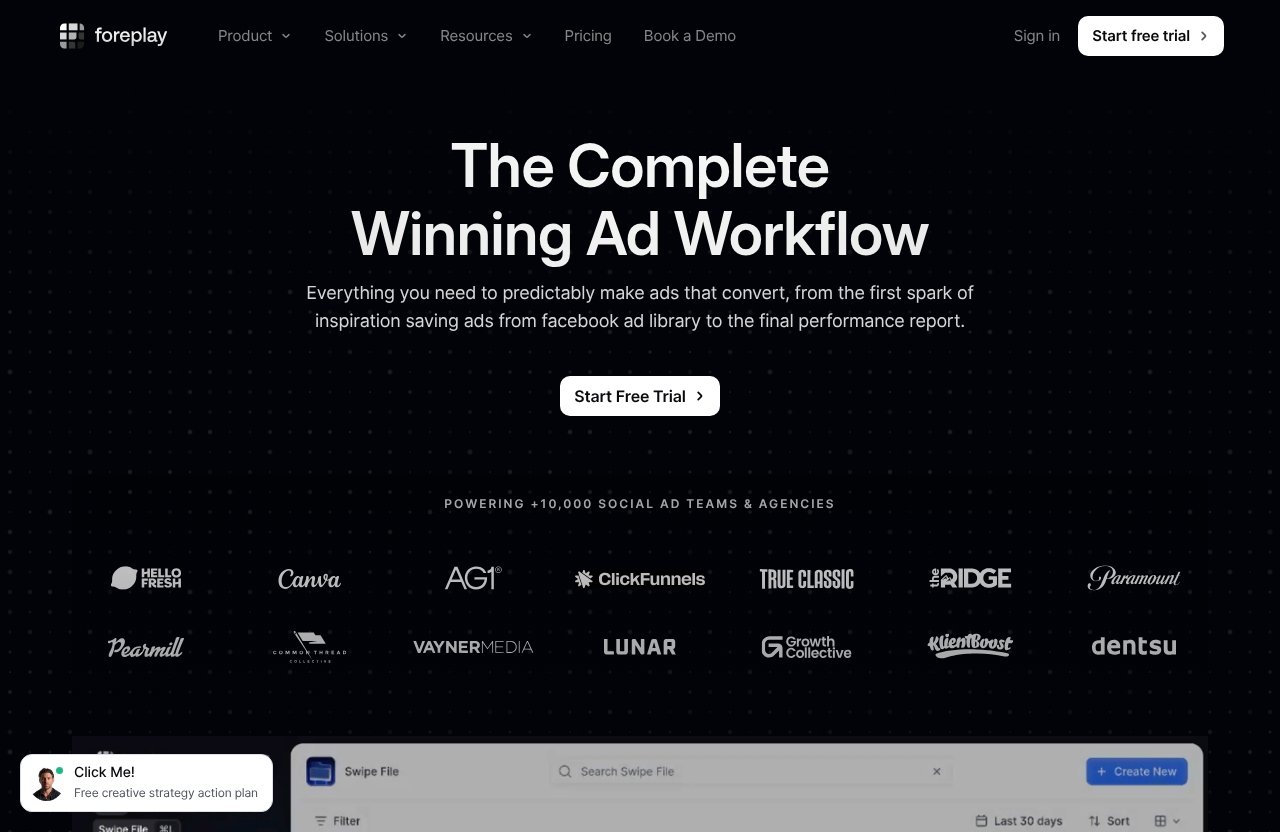
Foreplay positions itself as “The Complete Winning Ad Workflow.” The official homepage says it helps teams save ads from ad libraries and make ads that convert, from inspiration through final performance report.
That positioning is important when comparing foreplay alternatives. Foreplay is not presented only as an ad swipe file tool; it is presented as an end-to-end creative workflow platform for social ad teams and agencies.
According to the official site, Foreplay powers 10,000+ social ad teams and agencies. If your buying process is about replacing multiple disconnected tools, that breadth is the main reason Foreplay remains a serious benchmark.
Core product areas: Swipe File, Discovery, Spyder, Lens, Briefs
Foreplay’s official product areas are Swipe File, Discovery, Spyder, Lens, and Briefs.
| Foreplay module | Official positioning |
|---|---|
| Swipe File | Save and share creative inspiration |
| Discovery | Ad search engine with over 100M ads |
| Spyder | Track and analyze competitor advertising 24/7 |
| Lens | Advertising analytics for creative teams |
| Briefs | Turn inspiration into actionable briefs |
This is the core reason many foreplay alternatives feel narrower by comparison. A simple swipe file may cover saving inspiration, but it may not cover discovery, competitor tracking, analytics, and briefing in one connected workflow.
Who Foreplay is built for
The official site presents Foreplay as suitable for several buyer types: E-Commerce & Retail, Agencies, Mobile Apps & Gaming, B2B & SaaS, Info/Education/Community, and Freelancers/Creators.
That range explains why the market for foreplay alternatives is fragmented. A SaaS team may care most about competitor messaging, while an e-commerce agency may care more about creative volume, briefs, and performance learnings.
For pricing, the official page shows Monthly and Annual billing options. Annual billing mentions “Save 15% + Unlimited Spyder.”
The Basic plan is listed at $59/month, with 1 user included, $20 per additional user, a 7-day free trial, and no credit card required. The verified inclusions are Swipe File, Discovery, Briefs, Spyder, Lens, API Access with 10,000 credits, and MCP.
The Workflow plan is listed at $175/month, with up to 5 users included, $20 per additional user, a 7-day free trial, and no credit card required. The verified inclusions are Swipe File, Discovery, Briefs, Spyder with 15 brands, Lens with 1 brand with Unlimited Ad Spend, and API.
Why teams use it across the full creative workflow
Foreplay’s advantage is workflow continuity. A team can save inspiration, research ads, monitor competitors, analyze creative, and turn findings into briefs without treating each step as a separate process.
That matters for agencies and performance teams because creative work often breaks down at the handoff points. Media buyers find insights, strategists create briefs, designers produce assets, and account managers need to explain the logic to clients.
If your team wants that full loop, it is worth reviewing Foreplay directly. You can evaluate the official workflow and trial availability through Foreplay via TopTrustReview if the research-to-brief model fits your buying criteria.
How to choose the right Foreplay alternative
The best way to choose among foreplay alternatives is to start with the bottleneck. Do not begin with the brand name; begin with the part of your process that is slow, messy, or expensive.
If your problem is “we cannot find enough ideas,” you need research depth. If your problem is “we lose good examples,” you need saving and organization. If your problem is “briefs are inconsistent,” you need collaboration and workflow.
Best for swipe-file and inspiration capture
If your team mainly needs to save ads, organize references, and share inspiration, you may not need a full creative analytics platform. Lightweight ad swipe file tools can be enough for freelancers, small brands, and early-stage teams.
Look for:
- Fast saving from ad libraries
- Clean folders, tags, or boards
- Easy sharing with teammates or clients
- Simple search inside your own saved examples
- A low-friction interface your team will actually use
For this use case, foreplay alternatives such as SwipeKit, MagicBrief, AdsLibrary.ai, or even manual workflows around Meta Ads Library may be worth investigating. The right choice depends on how much structure you need beyond saving examples.
Best for competitive ad research
If your main bottleneck is competitor visibility, prioritize search, filtering, and monitoring. A competitor ad research tool should help you understand what rival brands are running, how messaging changes over time, and which creative patterns are common in your category.
This is where tools such as AdSpy, AdsLibrary.ai, Semrush, Atria, or AdManage may enter the shortlist. Based on broad market positioning, these tools are more likely to appeal to buyers who care about research and competitive intelligence.
The key question is whether you need a research database only or a workflow that carries findings into briefs and reporting. Many foreplay alternatives are strongest at one side of that equation.
Best for creative analytics and reporting
For performance marketers, saving ads is only half the work. The harder question is which creative angles, formats, hooks, and messages are actually contributing to results.
If analytics is the bottleneck, prioritize tools that connect creative review with performance understanding. You want to know whether a platform helps teams interpret patterns, not just collect examples.
Foreplay’s official Lens module is positioned as advertising analytics for creative teams. If a competitor claims to be a creative analytics platform, compare how deeply it supports your reporting workflow, attribution expectations, and creative decision-making process.
Best for agency collaboration and briefs
Agencies need more than inspiration storage. They need repeatable systems for turning research into briefs, getting client alignment, and handing work from strategy to production.
For this use case, evaluate:
- Brief creation workflows
- Shareable boards or workspaces
- Team roles and collaboration patterns
- Client-friendly presentation of insights
- Handoff quality between strategists, media buyers, and creators
Foreplay’s official Briefs module is positioned around turning inspiration into actionable briefs. When reviewing foreplay alternatives, ask whether the tool actually supports briefing or simply lets you collect examples.
Best for the lowest budget
If budget is the constraint, start with the narrowest viable workflow. A small team may begin with Meta Ads Library plus a simple saving system, then upgrade when manual research becomes too time-consuming.
Budget-conscious buyers should avoid comparing only monthly cost. The real comparison is tool cost plus labor cost.
A cheaper tool can be the right choice if it saves enough time for your current stage. But if your team spends hours rebuilding briefs, screenshots, reports, or competitor tracking manually, the lowest subscription price may not be the lowest total cost.
The best Foreplay alternatives in 2026, ranked by use case
The best foreplay alternatives in 2026 depend on which part of the ad workflow matters most to you. Below is a use-case-first ranking of commonly surfaced Foreplay competitors and adjacent tools.
Because competitor pricing and exact specifications are not verified in this prompt, I am intentionally avoiding unsupported numbers. Always confirm current plans, limits, and integrations on each vendor’s official site before buying.
Atria
Atria is a relevant option for teams researching foreplay alternatives because it appears in the same conversation around ad creative research and workflow. It may fit buyers who want a modern creative strategy tool rather than a basic inspiration folder.
The likely fit is for strategists and performance teams who want to study ads, organize references, and support creative ideation. If your workflow centers on research and turning patterns into action, Atria belongs on the shortlist.
Where Atria may fit better than Foreplay is for teams that prefer its specific interface or workflow style. Where Foreplay may remain stronger is if you want the verified combination of Swipe File, Discovery, Spyder, Lens, and Briefs in one platform.
MagicBrief
MagicBrief is often discussed in the context of ad creative inspiration and briefing. It is a logical consideration for buyers comparing ad swipe file tools with more structured creative workflows.
The likely fit is for creators, marketers, and smaller teams that want to save examples and support brief development. If you are searching for a magicbrief alternative, Foreplay may come up because both tools are associated with creative inspiration and ad briefing.
MagicBrief may be attractive if your team wants a focused, creator-friendly workflow. However, compare it carefully against Foreplay’s officially listed modules if you need competitor tracking, discovery, analytics, and briefs under one roof.
AdManage
AdManage appears relevant for buyers who think beyond inspiration and want more operational control around advertising workflows. It may be a fit for teams looking at campaign management, creative organization, or broader paid media processes.
For performance marketers, the question is whether AdManage solves the exact bottleneck you have. If the pain is creative workflow, compare its research and briefing experience. If the pain is ad operations, it may fit a different part of the stack.
Among foreplay alternatives, AdManage is most worth reviewing when your team wants workflow structure around ads rather than only a library of creative examples.
AdsLibrary.ai
AdsLibrary.ai is clearly positioned by name around ad libraries and ad research. Buyers considering adslibrary.ai are usually trying to improve how they discover and study ads across the market.
The likely fit is for teams that want a searchable ad inspiration and research experience. It may be useful for competitor research, angle discovery, and creative ideation.
AdsLibrary.ai may fit better than Foreplay if your main need is simply searching and browsing ad examples. But if you need a connected path from discovery to analytics to briefs, compare it against the broader Foreplay workflow before switching.
SwipeKit
SwipeKit is one of the more obvious names for buyers who mainly want swipe-file functionality. It appears suited to users who want to capture, organize, and revisit ad inspiration without necessarily buying a full workflow system.
For freelancers, creators, and lean teams, this kind of tool can be practical. If your process is “find good ads, save them, and reference them later,” a focused swipe-file product may be enough.
The tradeoff is scope. SwipeKit may be a practical foreplay replacement for simple saving, but not necessarily for teams that need discovery, competitor tracking, analytics, and briefs together.
AdCreative.ai
AdCreative.ai is an adjacent option rather than a direct Foreplay clone. It is more likely to appeal to teams thinking about creative generation and production support, not only research and swipe files.
If your bottleneck is producing ad variants, an AI-oriented creative tool may deserve attention. It can sit beside research tools rather than fully replacing them.
As one of the broader foreplay alternatives, AdCreative.ai may fit teams that want help moving from idea to asset. But if you specifically need competitor monitoring and creative workflow intelligence, compare the full process carefully.
Semrush
Semrush is a broad marketing intelligence platform, not a dedicated Foreplay-style creative workflow tool. It is relevant because some teams prefer larger marketing suites for competitive research, search intelligence, and broader digital visibility.
The likely fit is for marketing teams that want competitor intelligence beyond paid social creative. If your team already uses Semrush, you may prefer consolidating research inside a familiar platform.
However, Semrush should not be evaluated as a simple ad swipe file tool. Among foreplay alternatives, it is more of a broader research suite than a direct creative briefing workflow.
Smartly
Smartly is generally associated with larger-scale advertising workflows and paid social operations. It is most relevant for bigger brands or agencies that need enterprise-grade workflow around creative and media execution.
The likely fit is scaling teams with more complex campaign operations. If your pain is not just inspiration but running creative at volume, Smartly may be worth reviewing.
That said, Smartly may be more platform than a small team needs. If you are comparing foreplay competitors as a freelancer or boutique team, confirm whether its scope and buying process match your stage.
AdSpy
AdSpy is commonly associated with competitor ad research. It is relevant for buyers who want to inspect what other advertisers are running and use that intelligence for creative strategy.
The likely fit is performance marketers and researchers who care primarily about competitor visibility. If you are looking for an adspy alternative, Foreplay may be relevant because its official Spyder module is positioned around tracking and analyzing competitor advertising 24/7.
AdSpy may be a better fit when the main goal is ad spying or research. Foreplay may be a better fit when that research needs to flow into inspiration saving, analytics, and briefs.
Meta Ads Library
Meta Ads Library is the practical baseline for many teams. It is not a full paid workflow platform, but it is a direct source many marketers use to review ads running across Meta properties.
The likely fit is budget-conscious teams, early-stage founders, and anyone doing basic competitor research manually. It can be useful, but it may become slow when you need organization, collaboration, history, or repeatable briefing.
For teams comparing foreplay alternatives, Meta Ads Library is best viewed as the free starting point, not necessarily a complete workflow replacement.
Official website · Latest pricing & offers
Closest substitutes by budget
Budget matters, but it should not be the only filter. The right foreplay alternatives depend on whether you are buying a simple tool, a team workflow, or a more advanced platform for creative intelligence.
Because competitor pricing was not verified in the provided facts, treat the categories below as positioning guidance rather than exact cost ranking. Always check current vendor pricing pages before making a final decision.
Budget-friendly tools for simple swipe files
Budget-friendly buyers should start with the narrowest requirement: saving and organizing inspiration. If that is all you need, consider simple ad swipe file tools, lightweight research products, or a manual workflow using Meta Ads Library.
Good fits may include:
- Meta Ads Library for manual research
- SwipeKit for focused swipe-file workflows
- AdsLibrary.ai if your priority is browsing and discovery
- MagicBrief if you want inspiration plus briefing support
This category works best for solo operators, creators, and small teams. It is less ideal when multiple people need to collaborate on research, performance analysis, and client-ready briefs.
Mid-tier tools for smaller teams
Mid-tier buyers usually need more than saving examples but less than enterprise-scale campaign infrastructure. They may want discovery, competitive research, shared workspaces, and cleaner handoffs into creative production.
This is where many foreplay alternatives become serious contenders. Atria, MagicBrief, AdManage, AdsLibrary.ai, and Foreplay itself may all be worth comparing depending on your preferred workflow.
For context, Foreplay’s verified Basic plan is $59/month with 1 user included, and the Workflow plan is $175/month with up to 5 users included. Both verified plans show a 7-day free trial with no credit card required.
Premium workflow platforms for agencies and scaling brands
Premium buyers usually care about process reliability, not just tool access. They need repeatable creative research, competitor monitoring, analytics, approvals, and team collaboration.
Smartly may be relevant for larger paid social operations. Semrush may be relevant for broader marketing intelligence. Foreplay may be relevant for teams that want an ad workflow built around Swipe File, Discovery, Spyder, Lens, and Briefs.
For agencies, the best tool is often the one that reduces handoff friction. If creative strategists, media buyers, and account managers all use the same system, the subscription cost can be easier to justify.
Feature comparison: what to look for before you switch
Before switching tools, map each option against the workflow you actually run every week. The best foreplay alternatives are not the ones with the longest feature pages; they are the ones that remove your most expensive bottleneck.
Use the checklist below as a practical buying framework.
| Capability | Why it matters | Tools to compare closely |
|---|---|---|
| Saving and organization | Prevents good ads from getting lost | Foreplay, SwipeKit, MagicBrief |
| Search and discovery | Helps find new angles faster | Foreplay, AdsLibrary.ai, AdSpy, Meta Ads Library |
| Competitor tracking | Supports market awareness | Foreplay, AdSpy, Semrush, Atria |
| Analytics | Connects creative to performance learning | Foreplay, Smartly, AdCreative.ai |
| Briefs and collaboration | Improves handoff quality | Foreplay, MagicBrief, Atria, AdManage |
Ad saving and organization
At minimum, your tool should make it easy to save ads and organize them in a way your team understands. A messy swipe file becomes useless once it grows beyond a few dozen examples.
Look for tagging, folders, boards, notes, and sharing options. If people cannot retrieve examples quickly, the tool will not improve creative velocity.
Foreplay’s official Swipe File module is built for saving and sharing creative inspiration. When comparing foreplay alternatives, ask whether the substitute is equally strong at both saving and team sharing.
Search and discovery depth
Discovery is where tools start to separate. Basic tools may help you store ads you already found, while stronger research tools help you find new ads and patterns.
Foreplay’s official Discovery module is described as an ad search engine with over 100M ads. That is a verified claim from the provided product facts.
When evaluating competitors, check what sources they cover, how search works, whether filters match your workflow, and how easy it is to move from discovery into action.
Competitor tracking
Competitor tracking is useful when you need ongoing visibility rather than one-off research. It helps you notice when rivals test new hooks, offers, formats, and landing angles.
Foreplay’s official Spyder module is positioned to track and analyze competitor advertising 24/7. Annual billing also mentions “Save 15% + Unlimited Spyder,” based on the verified pricing information.
Among foreplay alternatives, AdSpy, AdsLibrary.ai, Semrush, and Atria may be relevant research options. The key is whether they support the frequency, categories, and workflow your team needs.
Analytics and performance insights
Creative analytics helps teams understand not just what ads look like, but what patterns are worth repeating. This is especially important for performance marketers who need to turn creative testing into learning.
Foreplay’s official Lens module is described as advertising analytics for creative teams. The verified Workflow plan includes Lens with 1 brand and Unlimited Ad Spend.
If analytics is central to your decision, evaluate whether each tool helps with creative review, reporting, and insight generation. Do not assume every ad inspiration tool is also a creative analytics platform.
Briefing and collaboration
Briefing is where many creative workflows fall apart. Research may be strong, but if the brief is vague, production slows down and performance learnings get lost.
Foreplay’s official Briefs module is positioned around turning inspiration into actionable briefs. That makes it more relevant for teams that need structured handoffs.
When comparing foreplay alternatives, look for how easily a strategist can move from saved ads to a brief, how teammates collaborate, and whether the output is useful for designers, editors, and media buyers.
When Foreplay is still the better choice
Foreplay is still the better choice when your team wants one connected workflow rather than a stack of single-purpose tools. Many foreplay alternatives can replace one module, but fewer are positioned around the entire creative process.
If your current workflow involves screenshots, spreadsheets, scattered links, and inconsistent briefs, a broader system may save more time than a cheaper point solution.
Best for teams wanting one platform for research, analysis, and briefs
Foreplay’s official product areas cover Swipe File, Discovery, Spyder, Lens, and Briefs. That combination makes it a strong fit for teams that want to move from inspiration to research, analysis, and briefing in one environment.
A focused competitor may still win if your needs are narrow. But if you need the full chain, Foreplay is less like a simple ad inspiration tool and more like an operating system for creative workflow.
This is the main reason buyers should not judge foreplay alternatives only by price. Scope matters.
Best for agencies that need collaboration across creative and media teams
Agencies often need a shared space where creative strategists, media buyers, and account teams can align. The value is not just saving ads; it is building a repeatable way to turn market observations into client-ready creative direction.
Foreplay’s official site says it powers 10,000+ social ad teams and agencies. It is also presented as suitable for agencies, e-commerce and retail, mobile apps and gaming, B2B and SaaS, info/education/community, and freelancers/creators.
If your agency needs collaboration across the full ad workflow, Foreplay deserves a close look. If you want to assess that workflow directly, the official trial can be reviewed through Foreplay on TopTrustReview.
Best for buyers who value unlimited usage and ad spend across products
This point needs careful wording because only certain verified details are available. The official pricing page shows annual billing with “Save 15% + Unlimited Spyder.” It also shows the Workflow plan including Spyder with 15 brands and Lens with 1 brand with Unlimited Ad Spend.
Those verified details may matter for teams that want more predictable usage around competitor tracking and creative analytics. However, you should still confirm the latest plan terms on Foreplay’s official pricing page before buying.
Compared with narrower foreplay alternatives, Foreplay’s appeal is breadth: saving, discovery, tracking, analytics, and briefs are all part of the official product areas.
Final recommendation: which Foreplay alternative fits your team?
The best foreplay alternatives are not universal. The right answer depends on whether you need a simple swipe file, deeper research, creative analytics, agency collaboration, or an all-in-one workflow.
Here is the practical shortlist by buyer type.
| Buyer type | Best-fit direction |
|---|---|
| Freelancer or creator | Simple swipe-file tool or Meta Ads Library workflow |
| Small performance team | MagicBrief, SwipeKit, AdsLibrary.ai, Atria, or Foreplay Basic |
| Creative strategy team | Atria, MagicBrief, Foreplay, or AdManage |
| Competitor research-heavy team | AdSpy, AdsLibrary.ai, Semrush, or Foreplay Spyder |
| Agency or scaling brand | Foreplay, Smartly, AdManage, or broader workflow platforms |
If you want the simplest substitute
If you only need to save ads and organize inspiration, start with a focused swipe-file product. SwipeKit, MagicBrief, AdsLibrary.ai, or a manual Meta Ads Library workflow may be enough.
This is the most practical path for solo marketers and very small teams. You can always upgrade later if research, analytics, or briefs become bottlenecks.
If you want the closest all-in-one replacement
If you want the closest all-in-one Foreplay replacement, compare tools that cover multiple steps: research, saving, competitor tracking, analysis, and briefs.
Atria, MagicBrief, AdManage, and Foreplay itself are the most relevant places to start depending on how you define “all-in-one.” Foreplay remains the benchmark here because its official modules span Swipe File, Discovery, Spyder, Lens, and Briefs.
If you want the cheapest practical option
The cheapest practical option is usually Meta Ads Library plus a lightweight organization system. That can work if your team has more time than budget.
However, this approach becomes painful as soon as you need repeatable competitor tracking, searchable archives, structured briefs, or performance reporting. At that point, paid foreplay alternatives may save enough labor to justify their cost.
If you want the strongest agency workflow
For agencies, prioritize collaboration, briefs, analytics, and repeatability. A cheap swipe file may help with inspiration, but it will not necessarily improve client communication or creative production speed.
Foreplay is still one of the most credible options when you need the full research-to-brief workflow. For larger operations, also compare Smartly, AdManage, Atria, and broader agency ad workflow software based on your internal process.
In conclusion, the best foreplay alternatives in 2026 are best chosen by bottleneck: SwipeKit or Meta Ads Library for simple saving, AdsLibrary.ai or AdSpy for research, Semrush for broader intelligence, Smartly for larger paid social operations, and Foreplay when you want the complete creative workflow from inspiration to briefs and analytics.
Official website · Latest pricing & offers
FAQ
What are the best Foreplay alternatives in 2026?
The best foreplay alternatives in 2026 include Atria, MagicBrief, AdManage, AdsLibrary.ai, SwipeKit, AdCreative.ai, Semrush, Smartly, AdSpy, and Meta Ads Library. The right choice depends on whether you need swipe-file storage, competitor research, analytics, briefs, or a broader ad workflow.
Is Foreplay better than a simple ad swipe-file tool?
Foreplay is broader than a simple swipe-file app. Its official product areas include Swipe File, Discovery, Spyder, Lens, and Briefs, so it is better suited to teams that need research, competitor tracking, analytics, and briefing in one workflow.
A simpler tool may be enough if your only need is saving and organizing creative inspiration.
What should agencies look for in a Foreplay alternative?
Agencies should look for collaboration, briefing workflows, competitor tracking, creative analytics, and team scaling. Inspiration capture is useful, but agency teams usually need a repeatable process from research to client-ready creative direction.
The best foreplay.co alternatives for agencies are the ones that reduce handoff friction between strategists, media buyers, creators, and account teams.
Can I use a cheaper tool instead of Foreplay?
Yes, if you only need basic saving and organization, a cheaper ad swipe file tool or Meta Ads Library workflow may be enough. This is especially true for freelancers, creators, and early-stage teams.
However, cheaper tools may not replace Foreplay’s full workflow across Discovery, Spyder, Lens, and Briefs. Compare the subscription cost against the manual time your team spends on research, reporting, and briefs.
Does Foreplay offer a free trial?
Yes. The official Foreplay pricing page shows a 7-day free trial with no credit card required for the verified Basic and Workflow plans.
Related Reading
- Best Adcreative.ai Alternatives in 2026
- Foreplay vs MotionApp: Which Ad Workflow Tool Is Better in 2026?
- Contentstudio vs Hootsuite: Which Social Media Management Tool Is Better in 2026?
References
- Foreplay alternatives: 6 other ad workflow tools that satisfy – Atria
- Best Foreplay.co Alternatives in 2026
- Top 10 Foreplay Alternatives & Competitors in 2026
- Best Foreplay Alternative for Detailed Ads Analytics & Multi-Platform …