
Skool vs Discord: Which Platform Is Better for Paid Communities in 2026?
If you are comparing skool vs discord, the most important question is not “Which platform has more activity?” It is “Which platform helps people pay, stay, learn, and find what they need later?”
For most paid communities, coaching programs, course memberships, and creator-led groups, Skool is the stronger choice. Discord is excellent for fast, real-time conversation, especially in gaming, fandom, and chat-first communities. But when members are paying for access, structure matters. Lessons, discussions, support threads, events, and accountability need to feel organized—not buried in a stream of messages.
This skool vs discord comparison breaks down organization, monetization, engagement, workflow, and value so you can choose the right platform for your business.
Official website · Latest pricing & offers
Skool vs Discord: quick verdict for paid communities
The short version: Skool is usually better for paid, structured communities. Discord is usually better for live, casual, chat-heavy communities.
That does not mean Discord is “bad” for creators. It simply means Discord and Skool solve different problems. If your members are paying for transformation, education, accountability, or expert access, Skool gives you a cleaner foundation.
If your members mainly want constant live conversation, voice hangouts, or a familiar chat environment, Discord can still make sense.
Who each platform is built for
Skool is built around community, courses, member access, and monetization. Based on the official Skool homepage and pricing page, Skool supports unlimited members, unlimited courses, unlimited videos, unlimited live calls, a custom URL, and affiliates on both available plans.
That makes Skool especially relevant for:
- Coaches
- Course creators
- Membership businesses
- Accountability groups
- Paid mastermind communities
- Creator-led education groups
Discord is built around real-time communication. It works well when the main value is immediate conversation, social presence, and live interaction.
Discord often fits:
- Gaming communities
- Fan groups
- Casual creator communities
- Live chat communities
- Free communities with high message volume
- Groups where speed matters more than long-term organization
In a skool vs discord decision, the first filter is simple: are people paying for structured outcomes or real-time conversation?
Best choice by use case
| Use Case | Better Fit | Why |
|---|---|---|
| Paid coaching program | Skool | Structured discussions, course hosting, monetization, and member access are central |
| Online course community | Skool | Lessons and conversations can live closer together |
| Accountability group | Skool | Members can revisit prompts, wins, and support threads more easily |
| Gaming server | Discord | Real-time chat and live interaction are the core experience |
| Fan community | Discord | Casual, high-frequency discussion is often enough |
| Premium membership | Skool | Built-in monetization and organization reduce operational complexity |
| Free hangout community | Discord | Chat-first environments are familiar and fast |
For most creators selling access, Skool is the better business platform. For social groups built around constant conversation, Discord remains a strong option.
Bottom-line recommendation
Choose Skool if your community needs structure, searchable content, paid access, courses, events, and a professional member experience. Choose Discord if your community is mostly about live chat, voice interaction, and casual engagement.
If you are building a paid membership and want fewer moving parts, you can review Skool through our affiliate link here: check Skool on the official site. Pricing and features can change, so always verify the latest details before buying.
What Skool and Discord are trying to do differently
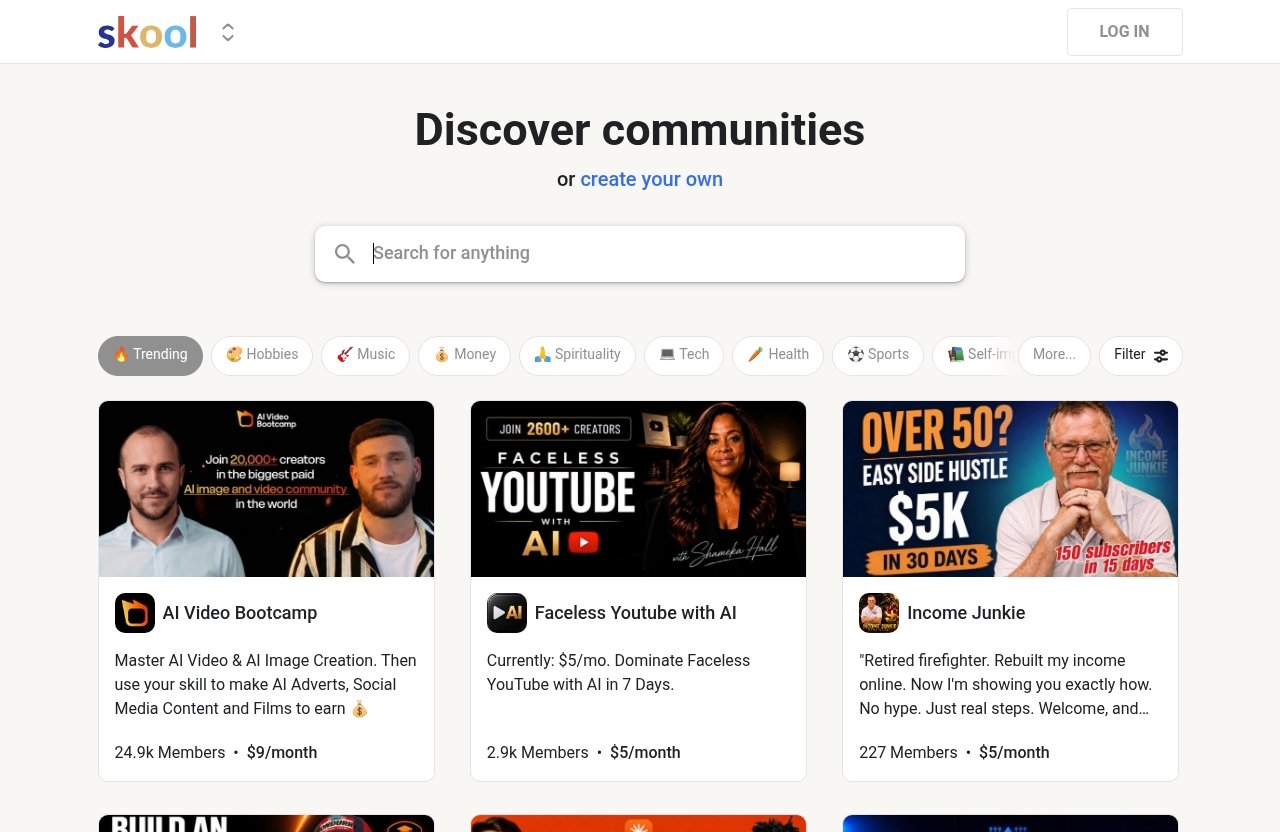
A fair skool vs discord review has to start with product intent. These platforms are not trying to be the same thing.
Skool is closer to a community and learning platform. Discord is closer to a real-time communication platform. That difference shapes almost every decision you will make as a creator.
Skool as a community + course platform
Skool is designed for creators who want to bring community and course-style content together. Instead of treating lessons, member discussion, and monetization as separate systems, Skool puts them into a more unified environment.
According to the official Skool pricing page provided for this review, both the Hobby and Pro plans include:
- Unlimited members
- Unlimited courses
- Unlimited videos
- Unlimited live calls
- Custom URL
- Affiliates
That matters because paid communities are rarely just “chat.” Members usually need onboarding, lessons, replays, announcements, support, and ongoing reasons to return.
Skool gives creators a more business-oriented setup from the start.
Discord as a real-time chat platform
Discord is strongest when the community experience is live, fast, and conversational. Members can jump into discussions, respond quickly, and participate in an active stream of conversation.
That style is great for groups where immediacy is the value. Gaming communities, live fan groups, and casual creator audiences often benefit from this type of environment.
But for paid education or membership delivery, a chat-first format can create friction. Valuable answers, resources, and discussions may become harder to find as the community grows.
Why this difference matters for creators
The skool vs discord choice affects more than layout. It affects your business model.
If your community is part of a paid offer, every new member needs a clear path:
- Join
- Understand where to start
- Find lessons or resources
- Ask questions
- See progress
- Stay engaged
- Renew or keep paying
Skool is better aligned with that journey. Discord can support community energy, but creators often need extra structure around it to make it work for paid programs.
That is why many people researching discord alternatives for communities end up considering Skool.
Organization and content discovery: searchable structure vs chat overload
Organization is one of the biggest reasons the skool vs discord conversation matters for paid communities. A free social group can tolerate messiness. A paid membership usually cannot.
When people pay, they expect to find the onboarding post, replay, lesson, template, or answer without digging through endless messages.
Forum-style threads and course structure in Skool
Skool’s appeal is that community and learning content can be easier to separate, revisit, and organize. In a paid group, that makes the member experience feel more intentional.
For example, a coaching program might need:
- A welcome area
- Weekly implementation lessons
- Q&A discussion threads
- Replay access
- Accountability check-ins
- Announcements
- Support conversations
In Skool, this type of community feels more naturally aligned with the platform’s purpose. Members are not just chatting; they are moving through a structured experience.
That is especially useful for skool course hosting, where lessons and community discussion are both part of the value.
Fast-moving channels in Discord
Discord’s chat-first format can be a strength or a weakness. In active groups, messages move quickly. That can create energy, but it can also make important content harder to recover later.
For a gaming community, fast-moving chat is usually the point. For a coaching client trying to find last month’s answer about sales calls, it can become frustrating.
This is where skool vs discord for paid communities becomes clearer. Paid members often value clarity over constant motion.
Which platform works better when content needs to be found later
If content needs to be referenced later, Skool generally has the advantage. Structured posts, courses, and discussions are more suitable for evergreen value.
Discord is better when the value is in the moment. If a message matters for ten minutes, chat works. If a lesson, answer, or framework should remain useful for months, Skool is usually the safer choice.
Here is the practical test:
| Question | If Yes, Prefer |
|---|---|
| Will members revisit lessons repeatedly? | Skool |
| Will support answers need to stay searchable? | Skool |
| Is most value created through live chat? | Discord |
| Does the group need a course or curriculum? | Skool |
| Are conversations mostly casual and temporary? | Discord |
For structured paid offers, the skool vs discord decision usually tilts toward Skool because the content has a longer shelf life.
Monetization: how each platform handles paid access
Monetization is where Skool becomes especially compelling for creators. A community platform is not just a place to host members; it is part of your revenue system.
When evaluating skool vs discord pricing, you need to look beyond the monthly subscription. Consider how easily you can sell access, manage members, host content, and support retention.
Skool pricing and built-in monetization
Skool’s official pricing page lists two plans:
| Skool Plan | Monthly Price | Transaction Fee | Included |
|---|---|---|---|
| Hobby | $9/month | 10% | Unlimited members, unlimited courses, unlimited videos, unlimited live calls, custom URL, affiliates |
| Pro | $99/month | 2.9% | Unlimited members, unlimited courses, unlimited videos, unlimited live calls, custom URL, affiliates |
The official pricing page also shows “2 months free!” and a Monthly/Yearly toggle, but no additional yearly prices were visible in the provided page content.
This is important: pricing can change. The Skool pricing and feature details in this article come from the official Skool homepage and official pricing page available for this review. Always verify current pricing on the official site before buying.
For creators, the key benefit is not just the plan price. It is that Skool is built around paid communities and memberships. You are not forced to stitch together a separate course tool, payment access process, and community home just to get started.
Discord monetization workarounds and third-party tools
Discord can be used around memberships, but it is not primarily positioned as a structured course and paid community platform in the same way Skool is. Many creators who use Discord for memberships rely on external tools, integrations, or separate systems to manage access and paid content.
That can work. It may even be fine for creators who already have a tech stack they like.
But it can also create more setup and maintenance. If your business depends on clean onboarding, content delivery, and member retention, extra moving parts can become expensive in time—even if the base community tool feels low-cost.
Which platform reduces setup friction for paid communities
For paid creators, Skool reduces friction because the platform is aligned with the business model. You can build around community, courses, calls, members, and affiliates in one place.
That does not mean every creator should abandon Discord. If your paid offer is mostly live access and informal conversation, Discord may be enough.
But if you want the best platform for paid community operations with less complexity, Skool is generally the stronger choice. In a practical skool vs discord comparison, monetization is one of Skool’s clearest advantages.
Member engagement: community behavior, retention, and daily activity
Engagement is not just “How many messages did people send?” In paid communities, better engagement means members understand what to do, get value consistently, and keep returning.
That is why skool vs discord is really a question about behavior design.
Gamification and return visits in Skool
Skool is often discussed for its gamification appeal, including leaderboard-style engagement signals. For many communities, this can encourage participation, recognition, and return visits.
This is not just cosmetic. In an accountability group, members may be more likely to post progress if participation feels visible. In a coaching community, thoughtful answers and useful posts can become part of the culture.
Skool’s structure also supports a slower, more intentional engagement style. Members do not need to be online all day to get value.
That can be helpful for premium memberships where people are busy professionals, founders, students, or creators themselves.
Real-time chat, voice, and spontaneity in Discord
Discord shines when immediacy matters. A fast chat environment can make a community feel alive.
For gaming groups, live fan discussions, and casual hangouts, this is ideal. Members can jump in, react, and feel present with others.
In discord for memberships, this can work well when the main promise is access to a live community rather than structured learning. For example, a creator might use Discord for daily live conversation, group hangs, or active peer chat.
The trade-off is that high-speed engagement can become noisy. Some members love that. Others feel overwhelmed.
Which engagement style fits premium memberships
Premium memberships usually need intentional engagement. Members want to feel guided, not lost.
Skool fits especially well when engagement is tied to:
- Completing lessons
- Asking thoughtful questions
- Posting wins
- Joining live calls
- Following accountability prompts
- Revisiting community knowledge
- Moving through a program
Discord fits better when engagement is tied to:
- Real-time chat
- Voice conversations
- Live reactions
- Casual social presence
- Community entertainment
- Fast-moving topics
So, in skool vs discord, the question becomes: do you want members to consume and implement, or mainly hang out and react?
For paid learning communities, Skool’s engagement model is usually more sustainable.
Official website · Latest pricing & offers
Creator workflow: setup, moderation, and admin experience
A platform can be great for members but exhausting for creators. That is why workflow matters.
When comparing skool vs discord, think about what your week looks like after launch. Are you organizing content, approving members, answering questions, hosting calls, posting lessons, managing access, and keeping people engaged? If so, the admin experience matters a lot.
Ease of setup and cleanup
Skool is appealing because it reduces the need to assemble multiple tools. Since both Skool plans include unlimited courses, unlimited videos, unlimited live calls, unlimited members, custom URL, and affiliates, creators can build a more complete paid community system inside one platform.
That can make setup cleaner for:
- Solo creators
- Coaches
- Course sellers
- Consultants
- Small teams
- Niche experts
Discord can be fast to start for conversation, but a polished paid community may require more planning around channels, member access, onboarding, and external systems.
The more structured your offer, the more Skool’s workflow advantage matters.
Moderation and permissions
Moderation needs differ by community type. Discord communities often require careful channel management as activity grows, especially when many conversations happen at once.
Skool’s more structured environment can make the community feel easier to keep tidy, particularly when discussions are connected to a paid program or learning outcome.
This does not mean moderation disappears. Every community still needs rules, expectations, and consistent leadership. But for paid communities, structure can reduce confusion before it becomes a moderation problem.
Managing courses, discussions, and events
Paid community owners usually juggle several content types:
- Course lessons
- Community posts
- Live calls
- Replays
- Announcements
- Member questions
- Accountability threads
Skool is designed to make these pieces feel more connected. That is a major reason creators considering a skool review often focus on simplicity and business readiness.
Discord can support discussion, but when course delivery and paid access become central, creators may need to connect more tools around it.
In the skool vs discord workflow decision, Skool wins when you want fewer systems to manage.
Best use cases: when Skool wins and when Discord wins
The best platform depends on your offer. A serious community platform comparison should not pretend one tool is perfect for everyone.
Skool wins when structure and monetization matter. Discord wins when live interaction and casual conversation matter most.
Coaching programs and memberships
Skool is the stronger fit for coaching programs and paid memberships because it supports a clear member journey.
A coach might use Skool to host:
- Program lessons
- Weekly call information
- Q&A discussions
- Client wins
- Accountability check-ins
- Member resources
This creates a more premium experience than a scattered chat feed. Members know where to go and what to do next.
In skool vs discord for paid communities, coaching is one of the clearest Skool use cases.
Courses, lessons, and accountability groups
Skool also works well for courses and accountability-based communities. If the promise is “Join, learn, implement, and get support,” the platform needs to support that flow.
Examples include:
- Fitness accountability groups
- Creator growth programs
- Business courses
- Sales coaching groups
- Language learning communities
- Productivity memberships
- Student cohorts
In these cases, searchable discussions and structured course content matter more than constant chat speed.
Discord can still play a role if your members want live banter. But if the core offer is transformation, Skool is usually the better home base.
Gaming, fan communities, and casual live chat
Discord is the better choice when your group is built around live presence.
Examples include:
- Gaming squads
- Fan communities
- Creator livestream communities
- Casual peer groups
- Hobby chats
- Event-based discussion rooms
These groups often do not need formal courses, organized resources, or built-in monetization as much as they need energy and immediacy.
So the skool vs discord answer is not “Skool always.” It is “Skool for structured paid value; Discord for real-time social activity.”
Cost comparison and value for money
Cost is one of the most misunderstood parts of skool vs discord pricing. The cheapest tool is not always the best value.
For a creator business, value comes from revenue, retention, time saved, and member experience. If a platform helps members stay longer and reduces admin complexity, it may be worth more than a lower-cost setup that requires extra tools.
Skool official pricing plans
Based on the official Skool pricing page provided for this article, Skool has two monthly plans:
| Plan | Price | Transaction Fee | Best For |
|---|---|---|---|
| Hobby | $9/month | 10% | New creators testing a paid community or smaller offer |
| Pro | $99/month | 2.9% | Creators who want a lower transaction fee and a more serious membership setup |
Both plans include unlimited members, unlimited courses, unlimited videos, unlimited live calls, custom URL, and affiliates.
The “unlimited” allowances are meaningful for creators who want room to grow without constantly rethinking their community structure. You can add courses, videos, calls, and members without immediately moving into a more complicated platform setup.
Again, verify the latest pricing directly on Skool before making a purchase decision.
What ‘free’ can mean on Discord
Discord is often seen as a lower-cost or free-to-use option for communities. That can be attractive, especially when you are starting a casual audience group.
However, “free” can become less straightforward when the community is part of a business. You may still need other tools for course hosting, payments, access control, landing pages, affiliate tracking, or member onboarding.
This is where creators should be careful. A platform with a low entry cost may still create hidden operational costs if it requires multiple systems to run a paid membership professionally.
How to evaluate total cost, not just subscription price
When comparing skool vs discord, ask these questions:
- How will members pay?
- Where will courses live?
- Where will videos live?
- How will members find old answers?
- How will you host or organize calls?
- How will affiliates be handled?
- How much time will setup take?
- How much admin cleanup will be required each week?
- Will the member experience support retention?
Skool’s value is strongest when you want an organized, monetization-ready community with fewer disconnected tools.
If your community is free, casual, or mainly chat-based, Discord may offer better value. But for paid memberships, Skool often provides a better business foundation.
Pros and cons summary
A good skool vs discord comparison should make trade-offs easy to see. Both platforms can work, but they optimize for different outcomes.
Here is the practical buyer-focused summary.
Skool pros and cons
| Skool Pros | Skool Cons |
|---|---|
| Built for paid communities and memberships | Not as chat-first as Discord |
| Supports unlimited members on both official plans | Transaction fees apply on both plans |
| Supports unlimited courses and videos on both official plans | May be more platform than needed for a casual free group |
| Includes unlimited live calls on both official plans | Real-time social energy may feel different from Discord |
| Custom URL and affiliates included on both official plans | Pricing should be verified before purchase |
| Strong fit for structured learning and accountability | Creators still need a clear community strategy |
Skool’s biggest advantage is clarity. It helps creators package community, education, and monetization into one more coherent experience.
Its biggest limitation is that it may not be the best fit if your community is primarily spontaneous chat.
Discord pros and cons
| Discord Pros | Discord Cons |
|---|---|
| Excellent for fast real-time conversation | Important content can be harder to find later |
| Strong fit for gaming and casual communities | Less naturally structured for course-driven memberships |
| Familiar to many online communities | Paid community setup may require additional systems |
| Good for live social interaction | Fast-moving chats can overwhelm some members |
| Useful for fan groups and live discussions | Not always ideal as the central home for premium learning offers |
Discord’s biggest advantage is immediacy. It makes people feel like something is happening right now.
Its biggest limitation for paid creators is organization. If your offer depends on members finding lessons, answers, and resources later, Discord can feel less efficient.
Which trade-offs matter most for paid communities
For paid communities, the most important trade-offs are not cosmetic. They affect revenue and retention.
Prioritize Skool if you care most about:
- Organized member experience
- Paid access
- Course delivery
- Searchable discussions
- Accountability
- Lower tech complexity
- Long-term knowledge value
Prioritize Discord if you care most about:
- Live chat
- Voice-based interaction
- Gaming-style engagement
- Casual audience building
- High-frequency conversation
- Free or informal communities
In the skool vs discord debate, the winner depends on whether your community is a product or a hangout. Paid communities usually need to behave like a product.
Final recommendation: which platform should you choose?
The final skool vs discord recommendation is straightforward: choose Skool for most paid community businesses, and choose Discord for chat-first communities where structure is less important.
Skool is the stronger option for creators who want to sell access, host course content, keep discussions organized, run calls, and reduce the number of tools needed to manage a membership.
Discord is the better fit when the community’s core value is live conversation, casual interaction, or gaming-style presence.
Choose Skool if…
Choose Skool if your community is tied to a paid offer.
It is especially strong if you are building:
- A coaching program
- A paid membership
- An online course community
- A cohort-based program
- An accountability group
- A creator education business
- A mastermind
- A professional learning community
Skool is also a smart choice if you are tired of patching together multiple tools for payments, lessons, calls, community, and affiliate promotion.
If that sounds like your situation, you can check Skool here through our affiliate link. It is a soft recommendation based on its fit for structured paid communities, not a claim that every creator needs it.
Choose Discord if…
Choose Discord if your community is mostly about live interaction.
It may be the better fit for:
- Gaming servers
- Fan communities
- Casual creator audiences
- Livestream companion chats
- Free community groups
- Voice-first social spaces
- Fast-moving discussion groups
Discord is also useful when your members already expect that style of interaction and do not need much structured content.
If your audience wants to hang out, Discord can be excellent. If your audience wants a guided premium experience, Skool is usually better.
Recommended stack for ambitious creators
For ambitious creators, the cleanest recommendation is to make Skool your main paid community hub. Use it for the member experience, course content, discussions, live calls, and monetization.
You can still use other tools around your business for marketing, email, or content creation. But your paid community should have one clear home.
That is the central lesson of skool vs discord in 2026: structure compounds. The easier it is for members to find value, the more likely they are to stay, participate, and recommend the community.
For paid memberships, courses, and coaching programs, Skool is the more business-ready choice.
Official website · Latest pricing & offers
FAQ
Which is better, Skool or Discord?
For paid communities, Skool is usually better because it is built around organized content, memberships, course-style delivery, and member retention. Discord is better when your community is chat-first, highly real-time, and less dependent on searchable lessons or structured resources.
Who is Discord's biggest rival?
For community-led creators and paid memberships, Skool is one of Discord’s strongest rivals because it combines community, courses, monetization, calls, and affiliate support in one platform. Other tools may compete in specific categories, but in the creator membership space, Skool is a serious Discord alternative.
Is anything better than Discord?
Yes, depending on the use case. If your priority is structured discussions, searchable content, courses, paid access, and a cleaner membership experience, Skool can be better than Discord. If you need constant live conversation, gaming-style engagement, and voice-first community activity, Discord may still be the better fit.
Why don't schools use Discord instead of Zoom?
Schools usually need more control, privacy, structure, and class management than a fast-moving chat environment typically provides. Zoom is commonly associated with scheduled live classes, while Discord is more of a real-time community chat environment. For education, the right tool depends on supervision, compliance needs, and how lessons are delivered.
Related Reading
References
- Skool vs Discord · Content Academy
- Skool vs Discord vs Circle 2026: Which Platform Is Right for Your Community?
- Skool: Pricing