Podsqueeze for Agencies: Podcast Client Workflow Guide for 2026
If you run podcast production, content marketing, or media services, podsqueeze for agencies is worth investigating because it addresses one of the biggest delivery bottlenecks: turning every episode into usable client assets quickly and consistently. Instead of manually drafting transcripts, show notes, newsletters, social posts, clips, audiograms, and landing pages from scratch, agencies can use Podsqueeze as a podcast content automation layer.
This Podsqueeze for agencies review is written for buyers comparing tools, workflows, and pricing. Disclosure: toptrustreview.com may earn a commission if you purchase through our Podsqueeze affiliate link, at no extra cost to you.
Official website · Latest pricing & offers
What Podsqueeze Is and Why Agencies Care
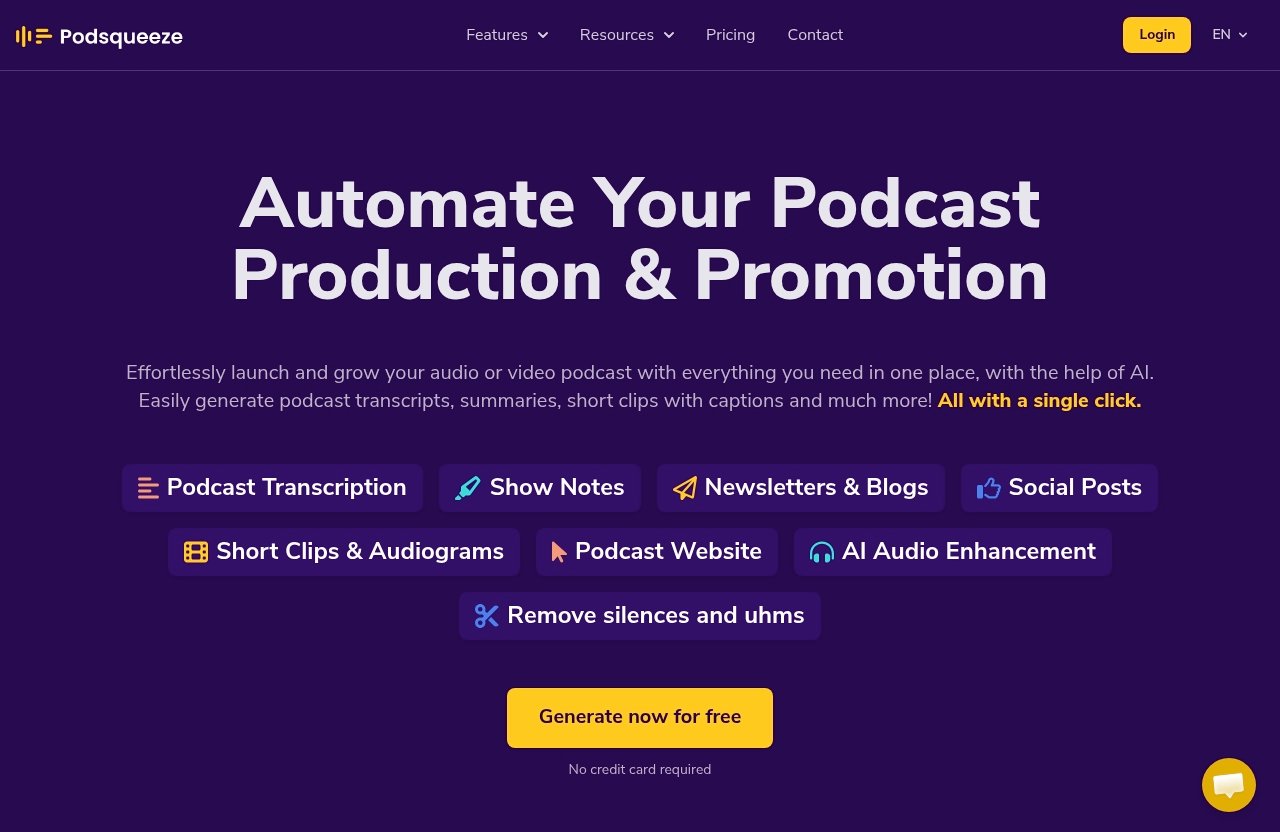
Podsqueeze is an AI podcast marketing tool built to help podcasters, podcast managers, agencies, producers, and studios repurpose podcast episodes into multiple content formats. Official product capabilities include transcripts, show notes, blog posts, newsletters, social posts, short clips or audiograms, quote images, podcast landing pages, podcast websites, audio enhancement, a podcast audio editor, chat with transcript, personalized results, saved video templates, folders, content page sharing, AI voice tuning for each show, and a podcast topics finder.
For agencies, the value is not simply “AI writes content.” The more useful angle is workflow standardization. A repeatable podcast marketing workflow lets your team move from raw episode intake to client-ready drafts faster, while still leaving strategy, editing, quality assurance, and approval in human hands.
If you want a broader creator-focused overview, see our related guide on Podsqueeze use cases for podcasters. This article focuses specifically on podsqueeze for agencies and whether it fits scalable client delivery.
Agency-specific use cases
Agencies typically need more than one transcript or one show note draft. They need repeatable deliverables across multiple clients, formats, publishing cadences, and review preferences.
Common agency use cases include:
| Agency Need | How Podsqueeze Can Help |
|---|---|
| Episode transcription | Generate transcripts and use chat with transcript for faster research |
| Podcast repurposing | Create show notes, blog posts, newsletters, and social posts |
| Social content production | Produce podcast clips and audiograms, quote images, and bite-sized insights |
| Client review | Share content pages with clients and team members |
| Brand consistency | Create personalized results and tune the AI voice for each show |
| Multi-show organization | Use folders for different podcasts or client accounts |
| Future planning | Use the podcast topics finder to support episode ideation |
From an editorial perspective, podsqueeze for agencies is strongest when you already have a defined service package. For example, if every client receives a transcript, show notes, five social captions, one newsletter draft, and a few short promotional assets, Podsqueeze can help create a more predictable production process.
How it differs from solo creator workflows
A solo podcaster usually cares about speed and convenience. An agency cares about speed, but also about repeatability, client separation, review handoffs, and keeping deliverables consistent across accounts.
That distinction matters. In a solo workflow, a creator might generate one episode page and publish it quickly. In a podcast client workflow, the agency may need to organize assets by client, review tone, make edits, send drafts to stakeholders, and revise based on feedback.
Podsqueeze for agencies is not just about producing more content. It is about reducing the repetitive first-draft work that slows down account managers, editors, and content strategists.
Core promise: faster podcast repurposing at scale
The core promise of Podsqueeze is faster podcast repurposing from existing audio or video. Officially supported outputs include transcripts, show notes, blog posts, newsletters, social posts, podcast clips and audiograms, quote images, landing pages, and podcast websites.
For an agency, that means one episode can become a structured content package. The practical benefit is not that every output will be publish-ready with no review. The benefit is that your team starts from a full set of drafts instead of a blank page.
That is the right way to think about podsqueeze for agencies: a scalable production assistant, not a replacement for client strategy.
Podsqueeze for Agencies: The Client Workflow Explained
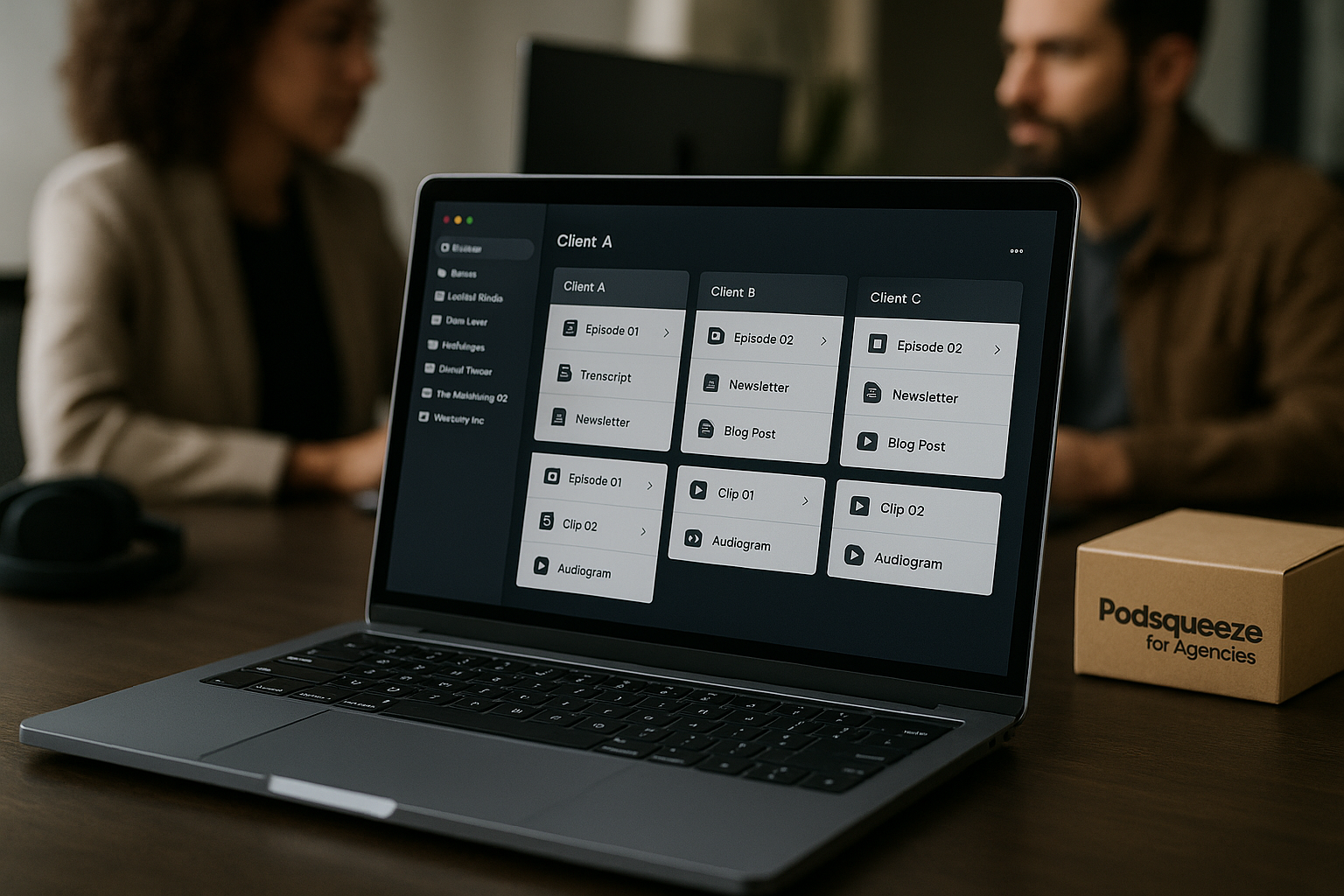
A strong podcast client workflow should be easy to repeat, easy to audit, and easy for clients to understand. Podsqueeze supports that by giving agencies a place to organize podcasts, generate content, personalize outputs, and share content pages with clients and team members.
Below is a practical workflow based on official Podsqueeze capabilities and general agency best practices.
Step 1: Organize podcasts in folders
For multi podcast management, the first operational step is organization. Podsqueeze officially supports podcast folders, which agencies can use to separate shows, clients, or production queues.
A simple folder structure might look like this:
| Folder Type | Example Use |
|---|---|
| Client folders | One folder per client account |
| Show folders | One folder per podcast if a client has multiple shows |
| Production folders | Intake, in review, approved, archived |
| Campaign folders | Launch campaigns, seasonal series, sponsor campaigns |
Editorially, this is where podsqueeze for agencies starts to become more useful than a one-off creator tool. Client work gets messy when raw files, transcripts, clips, and copy drafts live in disconnected locations. Folders reduce that friction.
Step 2: Upload audio, video, or connect a feed
Once the folder structure is in place, the next step is intake. Agencies can upload podcast files, work from audio or video assets, or use a podcast feed workflow where appropriate.
The official pricing page also confirms file upload limits by plan: Starter supports file upload up to 4Gb, while Pro and Agency Lite support file upload up to 10Gb. That matters if your agency handles longer interviews, video podcasts, or larger source files.
At this stage, a good podcast marketing workflow should include naming conventions, due dates, and assigned reviewers. Podsqueeze can help generate the content assets, but your internal project management process should still define ownership.
Step 3: Generate transcripts, summaries, and social assets
After intake, Podsqueeze can generate the core assets agencies often package for clients: transcripts, show notes, blog posts, newsletters, social posts, clips, audiograms, quote images, and other episode-based content.
This is where podcast repurposing AI can reduce repetitive production work. Instead of assigning a writer to listen through an entire episode before drafting from zero, the team can start with a transcript and AI-generated outputs.
For podsqueeze for agencies, the important point is consistency. If your team builds a standard checklist for each episode, Podsqueeze can help create the same types of deliverables every time.
Step 4: Share content pages with clients for review
Client review is often where podcast agencies lose momentum. Drafts get copied into documents, links get scattered across emails, and feedback arrives in multiple places.
Podsqueeze officially supports sharing content pages with clients and team members. That makes it useful for agencies that want a cleaner review handoff.
A practical review flow could be:
- Generate episode content in Podsqueeze.
- Edit the transcript, show notes, and promotional copy internally.
- Share a content page with the client or account lead.
- Collect requested changes.
- Finalize approved assets for publishing.
This does not remove the need for client approval. It helps make the approval process more organized.
Step 5: Edit, approve, and publish across channels
The final stage is human review and channel preparation. Podsqueeze includes a podcast audio editor and audio enhancement, but agencies still need quality control before anything goes live.
Editors should check names, claims, quotes, context, formatting, and client-specific preferences. Strategists should make sure the content supports the client’s goals, whether that means lead generation, thought leadership, audience growth, or sponsor visibility.
Podsqueeze for agencies works best when the tool handles first-draft production and your team handles final judgment.
Podsqueeze for agencies workflow note
Official Podsqueeze pages mention the ability to tune the AI voice for each show, create personalized results, and use a podcast topics finder. These features are especially relevant for agencies because different clients rarely want the same tone, structure, or content angle.
In practice, you can use AI voice tuning and personalized results to support brand voice consistency, then use the topics finder to help plan future episodes. That combination makes Podsqueeze more than a post-production tool; it can also support the planning side of a podcast content program.
Key Features Agencies Can Use to Scale Delivery
The best way to evaluate podsqueeze for agencies is to look at each feature through an agency delivery lens. The question is not “Can this generate content?” The better question is “Can this help us deliver consistent client assets faster without lowering quality?”
Transcripts and SRT subtitles
Transcripts are the foundation of most podcast marketing work. They help writers understand the episode, pull quotes, identify themes, and create accurate summaries.
Podsqueeze officially supports transcripts and SRT subtitles. For agencies, this can reduce the time spent creating episode documentation and subtitle assets manually.
Transcripts also support internal review. Account managers can scan the transcript to identify sensitive claims, client-specific language, or high-value moments for repurposing.
Show notes, blog posts, and newsletters
Show notes, blog posts, and newsletters are core long-form and owned-channel deliverables. Podsqueeze can generate these from podcast episodes, giving agencies structured drafts to edit and refine.
This is useful if your agency sells podcast content automation as part of a monthly retainer. A client may not only want the episode published; they may expect supporting content for email, SEO, and community channels.
For related content workflow ideas, you may also find our Contentstudio for agencies review useful, especially if your agency is building a broader social content operation around podcast assets.
Social posts and bite-sized insights
Social content is often the most repetitive part of podcast repurposing. Every episode can contain multiple talking points, quotes, lessons, objections, and promotional hooks.
Podsqueeze can generate social posts and bite-sized insights from podcast content. Agencies can then adapt those drafts for LinkedIn, X, Facebook, Instagram captions, or other channels based on the client’s distribution strategy.
The editorial caution is simple: do not publish AI-generated social copy without review. Podsqueeze for agencies should accelerate ideation and drafting, while humans check positioning, tone, compliance, and relevance.
Short clips, audiograms, and quote images
Short-form assets are a major part of modern podcast marketing. Podsqueeze supports short clips, audiograms, and quote images, which are useful for promoting episodes across social and owned channels.
The official pricing page lists plan-based limits for video clips or audiograms. Starter includes 8 video clips or audiograms, Pro includes 20, and Agency Lite includes 40. Enterprise Custom includes custom clips.
If your agency specializes in short-form video, you may also want to compare your broader workflow with tools covered in our Syllaby for YouTube Shorts and Klap free trial 2026 guides. Those resources can help you think through where podcast clips and audiograms fit inside a larger content system.
Audio enhancement and podcast audio editor
Podsqueeze officially includes audio enhancement and a podcast audio editor. For agencies, these features can help streamline parts of the episode preparation process.
That said, audio quality expectations vary by client. A light editing workflow for a founder-led interview show is different from a polished branded podcast with strict production standards.
Podsqueeze for agencies is most useful here as part of the workflow, not necessarily the entire production department. Your team should still define audio standards and perform final listening checks before delivery.
Podcast landing pages and podcast websites
Podsqueeze supports podcast landing pages and podcast websites, depending on the plan. The official pricing page lists Podcast Website on Starter, and Podcast landing pages on Pro and Agency Lite.
For agencies, landing pages can be valuable because podcast content often needs a destination. A client may want a shareable episode page, a campaign-specific landing page, or a simple web presence for a show.
This is especially useful when the agency is responsible for both production and promotion. Podsqueeze for agencies can help package podcast assets in a more client-ready way.
Podsqueeze for agencies feature summary
| Feature Category | Official Podsqueeze Capability | Agency Benefit |
|---|---|---|
| Written assets | Transcripts, show notes, blog posts, newsletters | Faster first drafts and standardized deliverables |
| Social assets | Social posts, bite-sized insights, quote images | More consistent promotional content |
| Video/audio assets | Short clips, audiograms, audio enhancement, podcast audio editor | Supports repurposing and production workflows |
| Client delivery | Folders, shared content pages | Easier organization and review handoff |
| Brand support | Personalized results, AI voice tuning per show | Better alignment with client tone |
| Planning | Podcast topics finder | Helps plan future episode ideas |
Official website · Latest pricing & offers
Podsqueeze Pricing for Agencies
Podsqueeze agency pricing is straightforward at the plan level, but agencies should evaluate it based on monthly podcast minutes, clips or audiograms, file upload limits, and whether the team needs custom support.
The pricing below uses only the verified official pricing details provided for this article.
Product Facts: Official Podsqueeze Pricing
| Plan | Price | Official Included Limits and Features |
|---|---|---|
| Starter | $8.99/mo | 120 mins of podcast time per month, Minutes Rollover, 8 video clips or audiograms, Quote images, file upload up to 4Gb, Unlimited Uploads, Unlimited YouTube conversions, Podcast Website, Audio Enhancement, Podcast Audio Editor, Chat with transcript, Create personalized results, Save Video Templates. |
| Pro | $49/mo | 320 Minutes per month, Minutes Rollover, 20 video clips or audiograms, Quote Images, file upload up to 10Gb, Unlimited Uploads, Unlimited YouTube conversions, Podcast landing pages, Audio Enhancement, Podcast Audio Editor, Chat with transcript, Create personalized results, Save Video Templates. |
| Agency Lite | $89/mo | 600 Minutes per month, Minutes Rollover, 40 video clips or audiograms, Quote images, file upload up to 10Gb, Unlimited Uploads, Unlimited YouTube conversions, Podcast landing pages, Audio Enhancement, Podcast Audio Editor, Chat with transcript, Create personalized results, Save Video Templates. |
| Enterprise Custom | Custom pricing | Everything in Pro, Custom minutes, Custom clips, Priority support, Feature Requests, Team onboarding and training. |
Starter plan overview
Starter costs $8.99/mo and includes 120 mins of podcast time per month. It also includes Minutes Rollover, 8 video clips or audiograms, Quote images, file upload up to 4Gb, Unlimited Uploads, Unlimited YouTube conversions, Podcast Website, Audio Enhancement, Podcast Audio Editor, Chat with transcript, Create personalized results, and Save Video Templates.
For agencies, Starter is best viewed as an entry-level testing plan or a fit for a freelancer handling a very small number of episodes. It may also be useful if you want to evaluate podsqueeze for agencies before moving into higher-volume work.
Pro plan overview
Pro costs $49/mo and includes 320 Minutes per month. It also includes Minutes Rollover, 20 video clips or audiograms, Quote Images, file upload up to 10Gb, Unlimited Uploads, Unlimited YouTube conversions, Podcast landing pages, Audio Enhancement, Podcast Audio Editor, Chat with transcript, Create personalized results, and Save Video Templates.
Pro is a stronger fit for podcast managers or small agencies with a limited client roster. The higher file upload limit and additional minutes make it more practical for recurring production than Starter.
Agency Lite plan overview
Agency Lite costs $89/mo and includes 600 Minutes per month. It also includes Minutes Rollover, 40 video clips or audiograms, Quote images, file upload up to 10Gb, Unlimited Uploads, Unlimited YouTube conversions, Podcast landing pages, Audio Enhancement, Podcast Audio Editor, Chat with transcript, Create personalized results, and Save Video Templates.
For many buyers researching podsqueeze for agencies, Agency Lite is the clearest agency-specific plan. It gives more monthly podcast time and more clips or audiograms than Pro, which matters when serving multiple shows.
Enterprise Custom overview
Enterprise Custom uses custom pricing. It includes Everything in Pro, Custom minutes, Custom clips, Priority support, Feature Requests, Team onboarding and training.
Enterprise makes sense when a team’s needs go beyond fixed plan limits. Larger agencies, studios, and media teams may need custom minutes, more clips, priority support, or structured onboarding for staff.
How to choose the right plan for an agency
Start with your monthly production volume. Count the total podcast minutes your agency processes each month, then estimate how many podcast clips and audiograms you deliver per client.
A practical plan-fit summary:
| Buyer Type | Likely Fit | Why |
|---|---|---|
| Freelancer testing podcast repurposing AI | Starter | Low monthly cost and enough capacity for light use |
| Podcast manager with a few recurring clients | Pro | More minutes, more clips, and larger file upload limit |
| Small agency with multiple shows | Agency Lite | Agency-specific plan with 600 Minutes per month and 40 clips or audiograms |
| Larger studio or media team | Enterprise Custom | Custom minutes, custom clips, priority support, and onboarding |
If you are ready to compare the plans directly, you can review Podsqueeze through our partner link. The key is to match the plan to your actual client workload, not just the lowest monthly price.
Where Podsqueeze Fits in an Agency Content Stack
Podsqueeze for agencies works best as a content automation layer between raw podcast intake and final publishing. It helps produce first drafts and repurposed assets, while your team remains responsible for positioning, approvals, edits, and publishing decisions.
Replacing repetitive first-draft production
The repetitive part of podcast marketing is rarely strategy. It is the mechanical work: transcribing, summarizing, pulling quotes, drafting captions, creating basic promotional assets, and preparing episode pages.
Podsqueeze can reduce that first-draft burden. Instead of assigning a team member to produce every asset manually, agencies can generate the baseline materials and focus human time on refinement.
This is the clearest commercial argument for podsqueeze for agencies. It does not eliminate service work; it shifts your team’s time toward higher-value review and strategy.
Supporting editors and strategists
Editors can use transcripts, show notes, and chat with transcript to understand an episode faster. Strategists can review AI-generated angles, identify stronger positioning, and adapt outputs to campaign goals.
For example, a B2B client might need a thought-leadership newsletter, while a creator client might need more short social posts and quote images. The source episode is the same, but the strategy is different.
Podsqueeze agency software should therefore be evaluated by how well it supports your team’s service model. The tool generates assets; your agency turns them into client outcomes.
Using AI for client deliverables without losing brand voice
Brand voice is a legitimate concern with AI-generated content. Podsqueeze addresses this through official capabilities such as creating personalized results, generating content in your own voice, and tuning the AI voice for every show.
For agencies, that can support consistency across episodes and clients. However, it does not remove the need for an editorial review process.
A good workflow should include client voice notes, approved phrases, banned claims, formatting rules, and final human approval. Podsqueeze for agencies can support brand voice, but your team still owns brand governance.
Best-fit agency types
Podsqueeze is most relevant for agencies that already work with podcast episodes as source material. That includes podcast production agencies, content marketing agencies, founder-brand agencies, executive thought-leadership teams, and studios offering repurposing packages.
It may also fit social media agencies that want to add podcast repurposing AI to their service menu. If your clients regularly publish interviews, webinars, YouTube conversations, or audio-first shows, Podsqueeze can help turn those assets into a more complete content engine.
For agencies focused only on non-podcast content, the fit may be narrower.
Podsqueeze vs Manual Podcast Marketing Work
Manual podcast marketing can produce excellent results, but it is difficult to scale profitably when every transcript, summary, clip brief, caption, and newsletter starts from scratch. Podsqueeze for agencies is best evaluated against that manual baseline.
Time savings
Official Podsqueeze capabilities cover many of the assets agencies usually create manually: transcripts, show notes, blog posts, newsletters, social posts, short clips, audiograms, quote images, landing pages, and podcast websites.
The practical time saving comes from generating drafts quickly, then editing rather than starting from a blank page. This can be especially helpful when a client publishes weekly or when an agency manages several shows at once.
The caveat is important: AI-generated drafts still need review. Time savings should come from workflow acceleration, not skipping quality control.
Consistency at scale
Manual work becomes inconsistent when different team members interpret the same task differently. One writer may create detailed show notes, while another may produce a shorter summary. One editor may pull strong quotes, while another misses them.
Podsqueeze can help standardize the asset creation stage. If every episode goes through the same podcast marketing workflow, agencies can deliver more predictable outputs.
That consistency is one reason podsqueeze for agencies is a commercial investigation worth taking seriously.
Cost comparison considerations
When comparing Podsqueeze with manual work, do not look only at the subscription cost. Consider the internal labor required to transcribe, summarize, draft, edit, clip, format, and package content.
Also consider capacity. If one account manager or editor can handle more episodes because the first-draft work is automated, the subscription may support better margins.
That said, the real cost depends on your workflow complexity, client expectations, revision cycles, and how polished each final deliverable needs to be.
Where human review still matters
Human review still matters in four areas: accuracy, strategy, tone, and approval. AI can generate assets from podcast content, but it should not be the final authority on factual claims or brand-sensitive messaging.
Agencies should review:
- Guest names and titles
- Product claims and statistics
- Legal or compliance-sensitive language
- Client-specific tone and positioning
- Quote accuracy and context
- Final formatting for each channel
Podsqueeze for agencies is best treated as a production accelerator. Human expertise remains the quality layer.
Pros, Cons, and Best Use Cases
A balanced podsqueeze for agencies review should acknowledge both the upside and the limits. The tool is useful for scaling repeatable podcast content delivery, but the best fit depends on your volume, team structure, and client promises.
Best reasons agencies choose Podsqueeze
The strongest reasons to consider Podsqueeze are speed, asset variety, and workflow organization. Agencies can generate multiple deliverables from one episode and use folders to manage different podcasts or clients.
Key advantages include:
- Transcripts and SRT subtitles for easier editing and accessibility workflows
- Show notes, blog posts, newsletters, and social posts for content repurposing
- Short clips, audiograms, and quote images for social promotion
- Audio enhancement and podcast audio editor for production support
- Podcast landing pages and podcast websites for client-facing destinations
- Personalized results and AI voice tuning for each show
- Shared content pages for clients and team members
- Podcast topics finder for planning future episodes
For multi podcast management, these features are particularly useful because they support both production and review.
Potential limitations to consider
The main limitation is that Podsqueeze does not replace an agency’s strategic layer. Your team still needs to define positioning, approve outputs, and adapt content to each client’s goals.
Plan limits also matter. Agencies should review monthly minutes, clips or audiograms, and upload limits before choosing a plan. Larger teams may need Enterprise Custom if fixed limits do not match their production volume.
Finally, client workflows vary. If your agency has complex approval chains, strict compliance needs, or highly customized creative deliverables, you should treat Podsqueeze as one part of the system rather than the whole system.
Ideal agency profiles
Podsqueeze is a strong fit for agencies that sell recurring podcast content packages. It also fits teams that need to repurpose long-form conversations into newsletters, blog drafts, social posts, and promotional clips.
Ideal profiles include:
| Agency Profile | Fit |
|---|---|
| Podcast production agency | Very strong fit for episode repurposing and client review |
| Content marketing agency | Strong fit if podcasts feed blogs, newsletters, and social content |
| Social media agency | Useful if clients provide podcast or video episodes |
| Executive brand agency | Useful for turning interviews into thought-leadership assets |
| Media studio | Strong fit if multiple shows require repeatable content packages |
Podsqueeze for agencies is less compelling if you rarely work with audio or video episodes. Its value increases as podcast volume and repeatable deliverables increase.
Official website · Latest pricing & offers
FAQ
How much does Podsqueeze cost to use?
Podsqueeze pricing starts with Starter at $8.99/mo, which includes 120 mins of podcast time per month, Minutes Rollover, 8 video clips or audiograms, Quote images, file upload up to 4Gb, Unlimited Uploads, Unlimited YouTube conversions, Podcast Website, Audio Enhancement, Podcast Audio Editor, Chat with transcript, Create personalized results, and Save Video Templates.
Pro is $49/mo and includes 320 Minutes per month, Minutes Rollover, 20 video clips or audiograms, Quote Images, file upload up to 10Gb, Unlimited Uploads, Unlimited YouTube conversions, Podcast landing pages, Audio Enhancement, Podcast Audio Editor, Chat with transcript, Create personalized results, and Save Video Templates.
Agency Lite is $89/mo and includes 600 Minutes per month, Minutes Rollover, 40 video clips or audiograms, Quote images, file upload up to 10Gb, Unlimited Uploads, Unlimited YouTube conversions, Podcast landing pages, Audio Enhancement, Podcast Audio Editor, Chat with transcript, Create personalized results, and Save Video Templates.
Enterprise Custom uses custom pricing and includes Everything in Pro, Custom minutes, Custom clips, Priority support, Feature Requests, Team onboarding and training.
Can Podsqueeze help podcast agencies manage multiple clients?
Yes. Podsqueeze for agencies can support multiple-client workflows through official agency-oriented capabilities such as podcast folders, sharing content pages with clients and team members, and managing multiple podcasts.
From an agency operations perspective, folders are useful for keeping client accounts separate, while shared content pages can simplify review and approval. The team should still maintain its own project management process for deadlines, ownership, and final publishing.
What content can Podsqueeze generate for agency clients?
Podsqueeze can generate transcripts, show notes, blog posts, newsletters, social posts, short clips, audiograms, quote images, podcast landing pages, and podcast websites. It also includes audio enhancement and a podcast audio editor.
For agencies, these outputs can form a complete podcast repurposing package. The strongest workflow is to generate the assets, edit them for brand voice and accuracy, then deliver approved versions to the client.
Does Podsqueeze support brand voice consistency?
Yes. Official Podsqueeze capabilities include creating personalized results, generating content in your own voice, and tuning the AI voice for every show.
This is important for agencies because each client may have a different tone, audience, and content standard. Human review is still necessary, but these features can help make AI-generated drafts more aligned with each show.
Which Podsqueeze plan is best for agencies?
Agency Lite is the clearest agency-specific paid plan on the official pricing page. It costs $89/mo and includes 600 Minutes per month, Minutes Rollover, 40 video clips or audiograms, Quote images, file upload up to 10Gb, Unlimited Uploads, Unlimited YouTube conversions, Podcast landing pages, Audio Enhancement, Podcast Audio Editor, Chat with transcript, Create personalized results, and Save Video Templates.
Enterprise Custom is better for larger teams that need custom minutes, custom clips, priority support, feature requests, team onboarding, and training. Smaller teams or freelancers may start with Starter or Pro depending on monthly podcast volume.
Final Verdict: Is Podsqueeze Worth It for Agencies?
Podsqueeze for agencies is worth considering if your business turns podcast episodes into repeatable client deliverables. It is especially useful for agencies that want faster first drafts, more consistent asset packages, cleaner client review, and a scalable podcast content automation workflow.
The best buyers are not looking for AI to replace their team. They are looking for a way to reduce repetitive manual production while preserving human strategy, editing, and approval.
Who should buy Starter, Pro, or Agency Lite
Starter is best for freelancers, very small client workloads, or agencies testing Podsqueeze before scaling usage. At $8.99/mo with 120 mins of podcast time per month, it is the lowest-cost entry point.
Pro is a better fit for podcast managers or small agencies handling a few recurring shows. At $49/mo with 320 Minutes per month and 20 video clips or audiograms, it gives more practical room for client work.
Agency Lite is the most direct fit for agencies. At $89/mo with 600 Minutes per month and 40 video clips or audiograms, it aligns better with multi-client podcast delivery.
When Enterprise makes sense
Enterprise Custom makes sense when your agency or studio needs more than fixed plan limits. Custom minutes, custom clips, priority support, feature requests, and team onboarding and training are the main reasons to consider it.
This is likely the right path for larger media teams, studios with high-volume production, or agencies standardizing Podsqueeze across multiple staff members.
Bottom-line recommendation
For most small agencies evaluating podsqueeze for agencies in 2026, Agency Lite is the most logical starting point because it is the dedicated agency-level plan with higher monthly minutes and more clips or audiograms. Pro can work for smaller teams, while Enterprise Custom is the better route for larger operations that need custom capacity and support.
Bottom line: Podsqueeze is a practical podcast agency software option if your workflow depends on turning episodes into transcripts, written assets, social content, clips, audiograms, and client-ready pages. Use it to accelerate production, but keep humans responsible for strategy, quality, and final approval.
Related Reading
- Podsqueeze use cases for podcasters
- Repurpose.io tutorial for beginners
- Contentstudio for agencies review