Podsqueeze for Marketing Teams Review 2026: A Practical B2B Content Repurposing Tool
For B2B teams trying to turn long-form conversations into pipeline-supporting content, podsqueeze for marketing teams is worth a serious look. Podcasts, webinars, customer interviews, founder videos, and expert roundtables often contain strong ideas, but most teams do not have enough time to convert them into blog posts, newsletters, clips, and social assets.
Podsqueeze is built around that exact repurposing problem. It helps users generate transcripts, summaries, show notes, newsletters, blogs, social posts, short clips, audiograms, captions, and audio improvements from audio or video podcast content.
This review is written for marketing managers, content strategists, demand generation teams, and agencies. It includes a transparent affiliate recommendation: if you decide to try the platform, you can review Podsqueeze through our affiliate link. We may earn a commission, but the analysis below is intentionally balanced and does not claim guaranteed ROI.
Official website · Latest pricing & offers
What Podsqueeze Is and Why B2B Marketing Teams Care
Podsqueeze is an AI-assisted content repurposing platform for audio and video podcast workflows. The official homepage says it helps users launch and grow audio or video podcasts with AI and generate podcast transcripts, summaries, short clips with captions, and more.
For B2B marketers, the more interesting angle is not “podcasting” alone. It is how podsqueeze for marketing teams can turn one substantial conversation into multiple content assets for organic search, email nurture, social distribution, executive thought leadership, and campaign follow-up.
What Podsqueeze for marketing teams does in one workflow
In a practical content operation, Podsqueeze starts with long-form source material and helps convert it into reusable formats. The core outputs listed on the homepage include Newsletters & Blogs, Social Posts, Short Clips & Audiograms, AI Audio Enhancement, and tools to remove silences and “uhms.”
A B2B team could record a 45-minute founder interview, process it through Podsqueeze, and leave with a transcript, show notes, blog-style draft, newsletter recap, social snippets, and short-form video options. That does not replace editorial judgment, but it reduces the blank-page work that slows many marketing teams down.
This is where podsqueeze for marketing teams becomes useful: it helps content teams move from “we recorded something” to “we have assets ready for review.”
Why repurposing matters for lead generation with Podsqueeze for marketing teams
Podcast repurposing for lead generation is rarely about one single asset creating instant pipeline. It is about increasing the number of useful touchpoints created from high-value conversations.
A webinar can become an SEO article, a newsletter recap, short clips for LinkedIn, quote images, and follow-up content for prospects. A customer interview can become social proof content, an ungated blog post, and sales enablement material. An executive podcast can support personal brand building and top-of-funnel awareness.
Podsqueeze for marketing teams supports this by making repurposing faster. More consistent content output can help drive traffic, build trust, and keep nurture programs active, although results still depend on strategy, distribution, offer quality, and audience fit.
Who it is best for: demand gen, content, and field marketing teams
Podsqueeze is best suited for teams that already produce or plan to produce long-form audio or video content. That includes B2B podcasts, webinar series, customer interviews, partner conversations, analyst-style discussions, and founder-led thought leadership.
Demand generation teams can use it to create campaign assets from events and webinars. Content teams can use it to accelerate blog, newsletter, and social production. Field marketing teams can reuse event recordings for regional campaigns, post-event follow-up, and sales support.
Agencies may also find podsqueeze for marketing teams relevant when managing recurring content operations across multiple clients or brands, especially because the homepage says users can manage content creation for multiple podcasts, create podcast folders, and share content pages with clients and teams.
Core Features That Help Marketing Teams Repurpose Content Faster
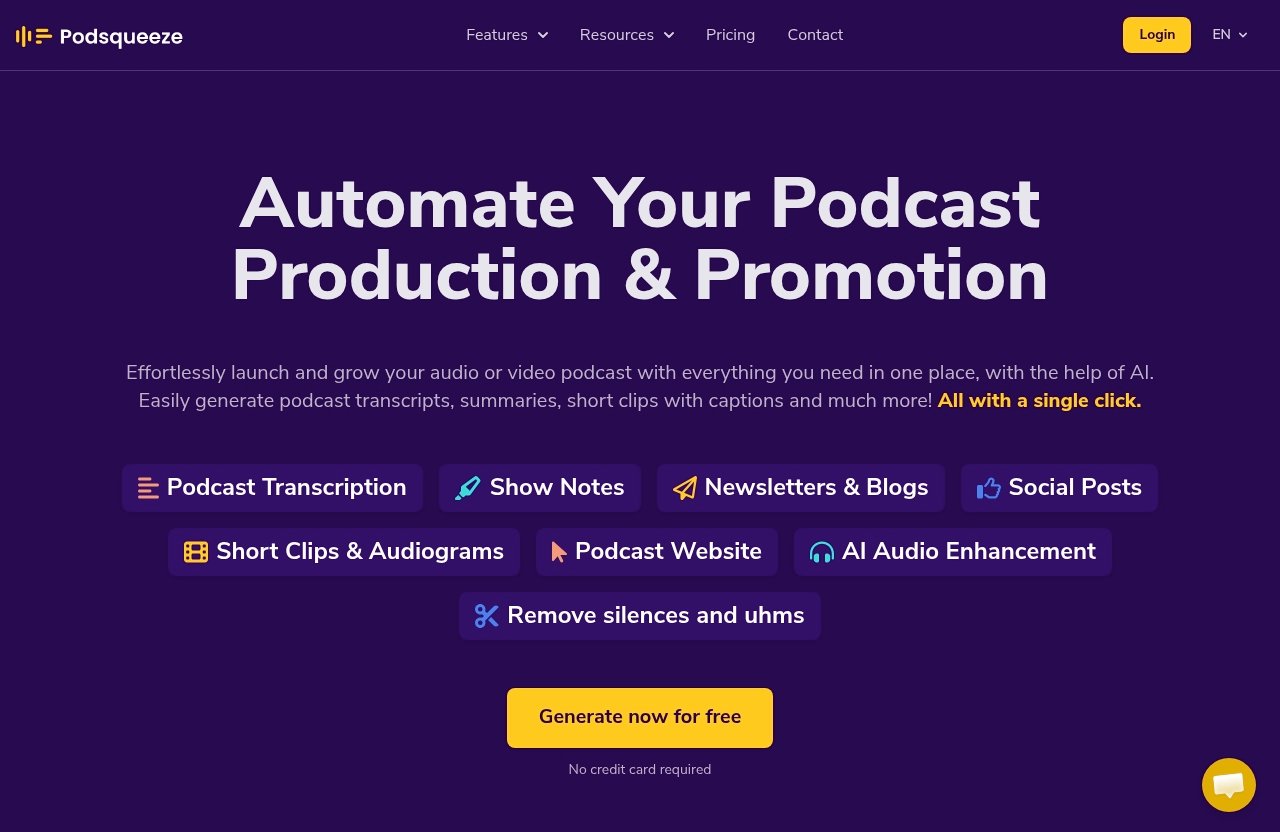
The strongest case for Podsqueeze is that it brings several repurposing steps into one workflow. Instead of manually transcribing, summarizing, clipping, captioning, and drafting content across separate processes, teams can generate a first version faster and then refine it.
For B2B teams, the value is not simply automation. It is having a repeatable production system that supports every episode, webinar, or interview.
Transcripts and speaker-labeled summaries
Podsqueeze provides full transcripts of podcast episodes and YouTube video transcripts. It also provides SRT files for subtitles, which matters for accessibility, video republishing, and social clip workflows.
For marketing teams, transcripts are the foundation for repurposing. They make it easier to identify key claims, customer quotes, executive viewpoints, objections, product themes, and content angles.
A practical workflow might look like this:
| Source Content | Transcript Use | Marketing Output |
|---|---|---|
| Founder interview | Pull strategic POVs | LinkedIn posts and blog draft |
| Customer conversation | Identify proof points | Case-study-style social content |
| Webinar recording | Extract key sections | Follow-up email and recap article |
| Partner podcast | Capture mentions and topics | Co-marketing newsletter |
This is one reason podsqueeze for marketing teams is stronger when teams have recurring long-form content. The more source material you have, the more value a transcript-first workflow can create.
Show notes, blog posts, newsletters, and social posts
The homepage says Podsqueeze show notes include summaries in the user’s own voice with timestamps, bullet points, and mentions. It also says Blog and Newsletter outputs include actionable blog posts and ready-to-send newsletters with main takeaways.
For B2B marketers, this can shorten the path from recording to distribution. A content strategist can review the AI-generated blog draft, add brand-specific context, optimize the structure for search intent, and publish a polished article.
The same source can also become a newsletter recap for subscribers or prospects. Social media outputs are described as short posts and bite-sized insights, which can help teams keep LinkedIn, X, and other channels active without starting from scratch every time.
This is the practical benefit of podsqueeze content repurposing: one interview can support multiple channels without asking the team to rewrite the same ideas repeatedly.
Short clips, audiograms, and one-click shorts
Podsqueeze’s clips feature lets users choose a chapter from an episode and export it as a clip or audiogram for TikTok, Instagram, and YouTube Shorts. Users can choose a template and tune it to their own style.
The text-based editor lets users fine-tune subtitles and trim video by removing specific words. The one-click shorts feature can shorten each chapter to under 60 seconds.
For B2B teams, short clips are useful for top-of-funnel reach and executive amplification. A webinar answer about a common customer pain point can become a 45-second clip. A founder’s point of view can become a captioned LinkedIn video. A partner discussion can become a co-marketing asset.
If your team regularly needs to repurpose webinar into clips, this part of podsqueeze for marketing teams may save substantial editing time compared with a fully manual process.
Audio enhancement and transcript chat
Podsqueeze includes AI Audio Enhancement and the ability to remove ums and silences. The pricing page also lists audio enhancement, a podcast audio editor, and chat with transcript among plan features.
For marketers, audio cleanup matters because poor sound quality can reduce content credibility. Removing long silences and filler words can also make interviews and clips easier to consume.
The transcript chat feature is useful for content review. A strategist can interrogate the transcript for themes, takeaways, or sections worth turning into posts. Human review is still necessary, but chat with transcript can help teams find angles faster.
This makes podsqueeze for marketing teams less like a simple transcription tool and more like a content operations assistant.
Podcast website / landing page capabilities
The homepage says Podsqueeze can build a professional online hub with embedded audio players, auto-generated episode pages, and show notes. It also describes these pages as SEO-optimized and no-code.
The pricing page mentions a podcast website on Starter and podcast landing pages on Pro and Agency Lite. For B2B teams without a fast web publishing process, these pages can provide a lightweight way to organize episode content.
That said, teams with an existing CMS, SEO process, and conversion tracking setup should think carefully about where these pages fit. A podcast landing page can support discovery and content organization, but your broader demand generation strategy may still require dedicated landing pages, forms, attribution, and CRM workflows handled elsewhere.
Best B2B Marketing Use Cases for Podsqueeze
The best use cases for Podsqueeze are recurring, content-rich workflows where teams already have conversations worth repurposing. If your team records one-off videos only occasionally, the value may be limited. If you run regular webinars, podcasts, interviews, or founder-led content, podsqueeze for marketing teams becomes much more compelling.
Repurposing podcasts into SEO blog content
The clearest use case is converting a podcast to blog post AI-assisted workflow. Podsqueeze generates blog-style outputs and transcripts that marketers can turn into SEO content.
A good process is to start with the transcript, identify the search intent, and then reshape the content into a structured article. For example, a podcast episode about “how CFOs evaluate RevOps tools” could become a blog post targeting a specific buying question.
The important point is that the AI draft should not be published untouched. B2B SEO content needs structure, examples, internal links, product positioning, and editorial review. Podsqueeze helps accelerate the first draft and extraction process.
Turning webinars and interviews into social proof content
Webinars and interviews often contain customer objections, use cases, expert explanations, and memorable quotes. These moments are valuable for social proof and nurture campaigns.
A demand generation team could use Podsqueeze to generate a transcript, extract key points, create short clips, and draft social posts. A customer success interview could be converted into quote images, newsletter highlights, and a recap article.
This is where podsqueeze for marketing teams can support pipeline indirectly. It helps teams reuse proof-oriented content across channels, giving prospects more reasons to trust the brand before they speak with sales.
Building founder-led marketing and personal brand assets
Founder-led marketing depends on consistency. The problem is that founders often have ideas but limited time to turn them into publishable assets.
With Podsqueeze, a founder interview or solo commentary episode can become social posts, short clips, newsletter content, and blog drafts. The homepage also says users can tune the AI voice for every show, which can help teams move closer to a consistent style.
Marketing teams should still edit for nuance. Founder content works best when it feels specific, opinionated, and credible. Podsqueeze for marketing teams can provide the raw materials, but the final positioning should come from the team’s strategy.
Creating newsletter recaps and nurture content
Newsletters are a strong channel for repurposed long-form content because they do not always require a full new article. A strong recap with takeaways, quotes, and links can keep subscribers engaged.
Podsqueeze’s ready-to-send newsletter outputs with main takeaways can help teams produce post-webinar and post-episode emails faster. For nurture campaigns, marketers can turn a series of interviews into a multi-email sequence around a pain point or buying stage.
For example, a three-part expert series on account-based marketing could become three newsletter recaps, several social posts, and a longer comparison-style article. This is practical marketing podcast content automation when paired with human editing and campaign planning.
Supporting multi-client or multi-brand content operations
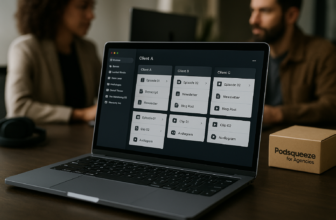
Agencies and in-house portfolio teams often manage multiple shows, brands, or stakeholder groups. The homepage says Podsqueeze supports managing content creation for multiple podcasts, creating podcast folders, and sharing content pages with clients and teams.
This is useful for agencies that need a repeatable delivery model. One client may need blog recaps, another may need clips, and another may need show notes and newsletters.
For these teams, podsqueeze for marketing teams can help standardize intake, output, review, and delivery. The main requirement is a clear naming system, approval process, and quality checklist so generated assets do not become disorganized.
Official website · Latest pricing & offers
Podsqueeze Pricing and Which Plan Fits a Marketing Team
Podsqueeze pricing is listed on the official pricing page as Starter at $8.99/mo, Pro at $49/mo, Agency Lite at $89/mo, and Enterprise with custom pricing. Monthly and annual billing are available, with annual billing showing 30% off, but the official facts provided do not include annual prices.
Here is the buyer-focused breakdown based only on verified plan details.
| Plan | Official Price | Monthly Podcast Time | Clips / Audiograms | File Upload Limit | Best Fit |
|---|---|---|---|---|---|
| Starter | $8.99/mo | 120 mins | 8 | Up to 4Gb | Light use or testing |
| Pro | $49/mo | 320 mins | 20 | Up to 10Gb | Small professional teams |
| Agency Lite | $89/mo | 600 mins | 40 | Up to 10Gb | Agencies or higher-volume teams |
| Enterprise | Custom | Custom minutes | Custom clips | Not specified in facts | Custom scale and onboarding |
All three listed paid plans include minutes rollover, quote images, unlimited uploads, unlimited YouTube conversions, audio enhancement, podcast audio editor, chat with transcript, personalized results, and saved video templates.
Starter plan for light usage
Starter costs $8.99/mo and includes 120 minutes of podcast time per month, minutes rollover, 8 video clips or audiograms, quote images, upload up to 4Gb, unlimited uploads, unlimited YouTube conversions, a podcast website, audio enhancement, podcast audio editor, chat with transcript, personalized results, and saved video templates.
This plan is best for solo marketers, founders, or teams testing podsqueeze for marketing teams with a limited content schedule. It may be enough for a light monthly podcast or occasional interview workflow.
For serious B2B content operations, the minutes and clip count may become limiting quickly.
Pro plan for professional teams
Pro costs $49/mo and includes 320 minutes per month, minutes rollover, 20 video clips or audiograms, quote images, upload up to 10Gb, unlimited uploads, unlimited YouTube conversions, podcast landing pages, audio enhancement, podcast audio editor, chat with transcript, personalized results, and saved video templates.
For many small B2B marketing teams, the podsqueeze pro plan looks like the most practical starting point. It gives more room for recurring episodes, webinars, and interviews without immediately moving into agency-level volume.
If your team publishes weekly or repurposes multiple long-form recordings per month, Pro is likely the first plan to evaluate.
Agency Lite for multiple clients or brands
Agency Lite costs $89/mo and includes 600 minutes per month, minutes rollover, 40 video clips or audiograms, quote images, upload up to 10Gb, unlimited uploads, unlimited YouTube conversions, podcast landing pages, audio enhancement, podcast audio editor, chat with transcript, personalized results, and saved video templates.
The podsqueeze agency lite plan is better aligned with agencies, consultants, or internal teams managing multiple content streams. The higher monthly minutes and clip allowance make more sense when you have several clients, shows, brands, or webinar programs.
For podsqueeze for marketing teams at a multi-brand level, Agency Lite is likely the plan to compare against your current manual editing and writing workload.
Enterprise for custom scale and onboarding
Enterprise uses custom pricing and includes everything in Pro, custom minutes, custom clips, priority support, feature requests, team onboarding, and training.
This is the plan to consider if your organization needs custom scale, internal enablement, or formal onboarding. Larger demand generation teams, media teams, and agencies with high output requirements should evaluate Enterprise directly with Podsqueeze.
Because pricing is custom, buyers should clarify expected monthly volume, clip requirements, review workflows, and support needs before adopting company-wide.
Pros, Limitations, and Buying Considerations
A balanced podsqueeze for marketing teams review should be clear about both strengths and tradeoffs. Podsqueeze can accelerate content repurposing, but it does not remove the need for strategy, editing, compliance review, and distribution planning.
Strengths for teams focused on speed and reuse
Podsqueeze’s biggest strength is multi-format output from long-form content. Transcripts, summaries, blog drafts, newsletters, social posts, short clips, audiograms, captions, and audio cleanup all support faster publishing.
It is especially useful when your bottleneck is the manual work between recording and distribution. If your team has valuable conversations sitting unused, podsqueeze for marketing teams can help unlock that content.
Another strength is workflow repeatability. Once your team defines a process, every new episode or webinar can follow the same repurposing path.
Where Podsqueeze may be less useful
Podsqueeze may be less useful for teams that do not create long-form audio or video content. If your marketing program is mostly written reports, product pages, or paid media landing pages, it may not be central to your workflow.
It also should not be treated as a complete strategy solution. It can generate assets, but it does not decide your ICP, offer, messaging hierarchy, campaign goals, or sales follow-up process.
Teams in regulated industries should add human review before publishing. Accuracy, compliance, and brand voice still matter.
What to check before adopting it company-wide
Before adopting podsqueeze for marketing teams broadly, review your source content volume. How many podcasts, webinars, interviews, and executive recordings do you publish each month?
Also check your review process. Who approves transcripts, blog drafts, clips, subtitles, social posts, and newsletters? Who adapts AI-generated drafts to match brand voice?
Finally, consider your existing stack. If you already use a CMS, email marketing platform, social scheduler, video editor, or agency partner, define where Podsqueeze fits rather than assuming it replaces everything.
How Podsqueeze Compares to Agency-Based Repurposing
Many B2B teams currently repurpose content through freelancers, agencies, or internal specialists. Podsqueeze sits in a different category: it provides automation and AI-assisted outputs that can reduce manual production work.
This comparison should be strategic rather than absolute. Agencies can provide creative direction and deeper editorial judgment, while Podsqueeze can help teams move faster on repeatable production tasks.
Why teams consider automation over agencies
Teams consider automation when content volume increases faster than headcount or budget. A webinar program, podcast series, and founder-led social strategy can quickly create more raw material than a small team can process.
Podsqueeze for marketing teams is attractive because it turns source content into multiple draft assets quickly. Instead of waiting for every transcript, summary, post, and clip to be produced manually, teams can generate a first pass and focus human effort on refinement.
This can be especially helpful for lean teams that need content velocity but cannot support a large production operation.
Cost and turnaround advantages
Podsqueeze’s official pricing starts at $8.99/mo for Starter, with Pro at $49/mo and Agency Lite at $89/mo. Those prices are straightforward to evaluate against manual production time, although the right comparison depends on your team’s volume and quality requirements.
The potential turnaround advantage is that assets can be generated inside an AI-assisted workflow rather than queued through a fully manual process. That can shorten the time between recording and publishing.
However, buyers should not compare subscription cost alone. Include editing time, approvals, brand review, publishing, and distribution in your real cost model.
When an agency may still make sense
An agency may still make sense when you need campaign strategy, creative concepts, positioning, advanced editing, motion design, or hands-on distribution support.
Podsqueeze can help create drafts and clips, but it does not replace senior marketing judgment. If your team lacks messaging strategy or does not have anyone to review content, an agency or experienced content lead may still be necessary.
For many B2B teams, the best model is hybrid: use podsqueeze for marketing teams to accelerate production, then rely on humans for strategy and final quality.
How to Set Up a Content Repurposing Workflow with Podsqueeze
A good Podsqueeze workflow starts before you upload content. Decide which types of assets you want from each recording and how they support your funnel.
For example, one webinar might produce an SEO recap, three LinkedIn clips, a sales follow-up email, a newsletter blurb, and a few quote graphics. That is a much stronger system than generating random assets with no distribution plan.
Upload audio, video, or connect a feed
Start with your source content. Podsqueeze supports podcast episodes and YouTube video transcripts, and the pricing page lists file upload allowances by plan. For podcast operations, organize shows and episodes clearly so each recording can move through the same process.
If your team uses podcast feeds or other source workflows, verify the exact setup during your trial or onboarding. The goal is to make intake simple enough that marketers do not avoid the tool.
For podsqueeze for marketing teams, the source content should ideally be planned with repurposing in mind. Ask sharper questions in interviews, create chapter-friendly webinar segments, and leave room for concise answers that can become clips.
Review outputs and edit for brand voice
After Podsqueeze generates transcripts, summaries, show notes, blogs, newsletters, or social posts, assign a human editor. This step is essential.
Check for accuracy, remove repetition, strengthen the hook, add company-specific language, and align the asset with campaign messaging. If the content includes customer claims, product details, or regulated topics, route it through the right approval process.
The best results come when Podsqueeze handles the heavy first-pass work and your team handles editorial judgment.
Export assets for SEO, email, and social
Next, map each output to a channel. Blog drafts can move into your CMS. Newsletter drafts can be adapted for your email platform. Social posts and clips can be scheduled for LinkedIn or other channels.
Short clips and audiograms are useful for awareness and engagement. Blog posts support organic discovery. Newsletters and recaps support nurture.
This is the operational value of podsqueeze for marketing teams: it helps one recording become a coordinated content package instead of a single published episode.
Create a repeatable workflow for every episode or webinar
Document the workflow so every recording follows the same steps. A simple process might be:
- Record webinar, podcast, or interview.
- Process source content in Podsqueeze.
- Review transcript and summary.
- Select strongest themes and clips.
- Edit blog, newsletter, and social drafts.
- Approve final assets.
- Publish and schedule distribution.
- Track performance by channel.
Over time, this repeatable process helps content teams build a library of SEO posts, clips, newsletters, and thought-leadership assets. It also makes planning easier because every long-form recording has a defined repurposing path.
Official website · Latest pricing & offers
FAQ
Is Podsqueeze good for marketing teams, or only for podcasters?
Podsqueeze is built for podcasting professionals, but it can also be useful for B2B marketing teams that repurpose long-form conversations. That includes podcasts, interviews, founder content, webinars, and YouTube-based video content.
The strongest use case for podsqueeze for marketing teams is turning recordings into blog posts, clips, newsletters, show notes, and social posts. It is not limited to traditional podcast promotion if your team treats audio and video content as raw material for demand generation.
Can Podsqueeze help generate leads from podcast content?
Podsqueeze can support lead generation indirectly. It helps turn podcast content into SEO posts, social clips, newsletters, and website or landing page content that can expand reach and drive traffic.
It does not guarantee leads or revenue. Podcast repurposing for lead generation still depends on topic selection, audience fit, distribution, conversion paths, and follow-up strategy.
How much does Podsqueeze cost?
Official podsqueeze pricing lists Starter at $8.99/mo, Pro at $49/mo, Agency Lite at $89/mo, and Enterprise with custom pricing.
Annual billing is available with 30% off shown on the pricing page, but the verified information provided does not include specific annual prices.
What is the best Podsqueeze plan for a small marketing team?
For many small professional teams, Pro is likely the strongest starting point because it includes 320 minutes per month, 20 video clips or audiograms, upload up to 10Gb, podcast landing pages, and the core included tools.
Starter may work for light testing. Agency Lite is better for higher-volume teams, agencies, or multi-brand operations because it includes 600 minutes per month and 40 video clips or audiograms.
Does Podsqueeze replace a human content team?
No. Podsqueeze automates and accelerates much of the repurposing workflow, but human review is still important.
Marketing teams still need people to define strategy, check accuracy, refine brand voice, handle compliance, improve hooks, choose distribution channels, and approve final content.
Final Verdict: Is Podsqueeze Worth It for B2B Marketing Teams?
Podsqueeze is worth considering if your team regularly creates long-form audio or video and struggles to turn it into enough useful marketing assets. It is especially relevant for podcasts, webinars, interviews, founder-led content, and recurring thought-leadership programs.
If you want to evaluate it directly, you can visit Podsqueeze through this TopTrustReview affiliate link. Treat the trial or first month as a workflow test: process real content, review the outputs, and compare the time saved against your current production process.
Best fit scenarios for Podsqueeze for marketing teams
The best-fit teams are B2B content teams, demand generation teams, founder-led marketing teams, field marketers, and agencies with recurring long-form content.
Podsqueeze is especially useful when your team wants to create SEO blog drafts, newsletter recaps, social posts, short clips, audiograms, subtitles, and show notes from the same source material.
It is also a good fit when content velocity is the bottleneck and your team already has someone available to review and polish outputs.
Who should skip it
Teams should probably skip Podsqueeze if they do not produce podcasts, webinars, interviews, YouTube videos, or other long-form audio/video content.
It may also be a poor fit if your team expects AI-generated assets to be published without review. B2B content still needs accuracy, positioning, subject-matter expertise, and editorial control.
If your biggest problem is strategy rather than production, solve that first.
Bottom-line recommendation on Podsqueeze for marketing teams
The bottom-line recommendation: podsqueeze for marketing teams is a practical workflow accelerator, not a magic lead-generation engine. It can help B2B teams repurpose valuable conversations into more blog content, newsletters, clips, audiograms, and social posts with less manual effort.
Starter is sensible for testing or light use. Pro is likely the best starting point for small professional marketing teams. Agency Lite is better for agencies, multi-client teams, and higher-volume content operations. Enterprise is the path for custom scale, onboarding, and training.
For B2B marketers committed to content repurposing, Podsqueeze deserves a place on the shortlist.
Related Reading
- Podsqueeze for Solo Podcasters Review 2026
- Klap for Podcasters Review
- Contentstudio Pros and Cons in 2026
References
- Podsqueeze Home
- Podsqueeze Pricing
- Podcast Marketing Agency
- Learn more about Podsqueeze and how we're building it!